A 17th-century survivor is imperiled
When the first stone was laid for Sellers Hall in 1682, there was no Upper Darby, Philadelphia was largely an imaginary place, and Samuel Sellers was living in a cave near what is now Garrett Road in Delaware County.
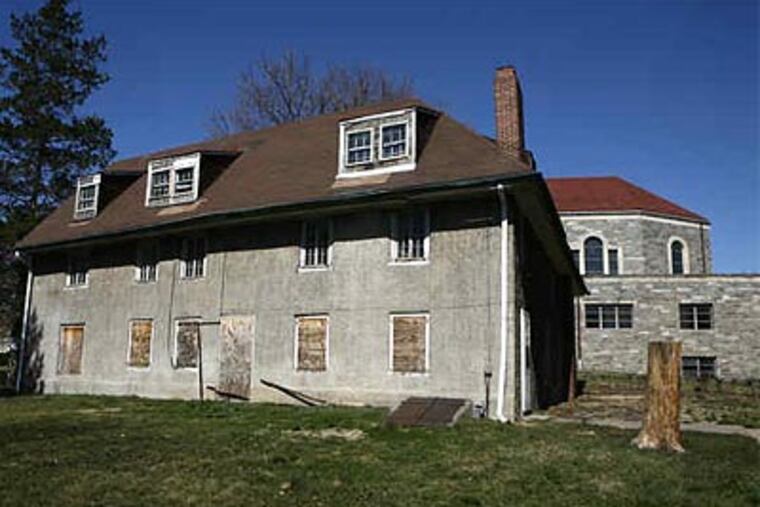
When the first stone was laid for Sellers Hall in 1682, there was no Upper Darby, Philadelphia was largely an imaginary place, and Samuel Sellers was living in a cave near what is now Garrett Road in Delaware County.
The house was completed a year or so later, Sellers moved in with his new bride, and the couple launched what would become a remarkable multigenerational engineering clan that ultimately tooled the machines driving America's industrial revolution.
Sellers family members were founders and leaders of the American Philosophical Society and the Franklin Institute. They were staunch abolitionists, and the little Upper Darby house with the steeply raked roof became a documented Underground Railroad stop.
More than three centuries after it was built, Sellers Hall still stands, boarded up and vacant, on the grounds of its current owner, St. Alice Church.
But how long it will remain standing is in doubt. Citing the building's bedraggled condition, the Roman Catholic parish would like to tear it down, and has solicited bids to do so - to the dismay of many historically minded local residents, Sellers descendants, representatives of the preservation community, and political leaders.
The Rev. Peter N. Quinn, pastor of St. Alice, which has owned Sellers Hall since 1922, said the church lacked money to repair it.
"Financially we are not able to save it," he said. "It could cause problems, or damage, or vandalism. Even if we fix it up, what would we use it for? The [church finance] council recommended demolishing. It is up to the hands of the diocese."
State Rep. Mario J. Civera Jr. of Upper Darby, the Republican chair of the House Appropriations Committee, said he opposed demolition and offered to help find a solution short of that.
"I would be happy to sit down with everyone and see what can be done," he said.
The Archdiocese of Philadelphia, which acquired Sellers Hall for St. Alice for $1, according to documents at the Pennsylvania Historical and Museum Commission, has joined the call for more discussion.
The archdiocese is "hopeful of meeting in the near future," spokeswoman Donna Farrell wrote in an e-mail. "At that time, it would be our goal to discuss various scenarios and come to an understanding of the exact historical significance of this site and work toward a viable solution to a very complicated matter."
John Gallery, head of the Preservation Alliance of Greater Philadelphia, noted that 17th-century buildings such as Sellers Hall "are extremely rare" in this area and said: "Every effort should be made to preserve it. We'd be happy and eager to be part of any conversation to see what can be done."
Though one of only a handful of 17th-century structures remaining in Pennsylvania, the building is not protected by any historical designation, and Upper Darby has no preservation ordinance that could shield it, township officials said.
Township Manager Tom Judge noted that "we don't own it." Ownership affords the only protection at the township's disposal, he said.
Mortimer Sellers, regents professor of law at the University of Maryland and a direct descendant of Samuel Sellers, has proposed establishing a nonprofit group to raise money and perhaps maintain the building. But he has said he is open to any approach that might save it.
About five years ago, when the roof began leaking badly, Sellers helped an informal group, the Friends of Sellers Hall, raise money for emergency repairs. At that time, there was hope that a long-term preservation arrangement could be worked out with the church, he said.
"The starting point is that it is something St. Alice's can take pride in. They own this very, very important building, and it has been part of their history for a very long time. Masses were held there originally. Visiting priests lived there. It was a library for the church."
Sellers added: "My first interest is that it not be destroyed. Then, if it is restored, that it be done in as accurate a way as possible."
Samuel Sellers acquired much land in what is now Upper Darby, establishing several mills and using his skills as a wire weaver to create screens of all kinds. One of his sons added to the family holdings and invented a machine for weaving worsteds.
John Sellers (1728-1804), Samuel's grandson, built sawmills, gristmills, and a tilt mill on area streams. He invented textile machines and constructed wire rolling screens for cleaning wheat and flax seed - possibly the first in the country. He was a surveyor, an astronomer, and a founder of the American Philosophical Society.
His grandson John Sellers III greatly expanded the Sellers milling operation at Milbourne Mills. Coleman Sellers, a 19th-century descendant, was an inventor and engineer, receiving 30 patents. William Sellers, who moved to Delaware, was an engineer and inventor with 90 patents. He created the standardized screw, served as president of the Franklin Institute in the mid-1860s, and built a powerful machine-tooling business.
Despite its occupants' far-flung activities, Sellers Hall remained critical to the family's moral and ethical life. Its basement hid slaves fleeing north before the Civil War.
Coleman Sellers, a photographer who lives in Delaware, said a document written by a member of the abolitionist Garrett family in Upper Darby described a prewar visit to Sellers Hall.
"In the basement he heard a noise, opened the door, and saw people," Sellers recounted. "He described dark faces and bright white eyes, eyes full of fear that they had been caught."
"The family story is really critical," said George Thomas, an architectural historian at the University of Pennsylvania. "They ran maybe the most important machine business in the world."
Preparations for a listing on the National Register of Historic Places began four years ago, members of the Upper Darby Historical Society said.
Most papers were drawn up by the Delaware County Planning Commission and submitted to the state, but more were required, and the county planning official spearheading the effort retired.
The society has sought help gathering information on Sellers Hall for several years, as well as passage of a local ordinance that would slow demolition of historic structures, said Beverly Rorer, the group's corresponding secretary.
"It's really hard to save a building," she said. "We don't have money to buy. You need owners who can restore or others who can buy. Right now, you can get a permit and the next day it's gone."
No permit has been applied for in the case of Sellers Hall, according to the township office of licenses and inspections. But St. Alice has sought bids, said Jeanne M. Gallagher, a member of the church finance council. She characterized the building as "somewhat of an eyesore" that the council decided should make way for usable space. Perhaps, she said, a prefabricated building could be set on a cement slab in the cleared area.
Gallagher said the church and council were not unmindful of Sellers Hall's historical significance. What's needed, she said, is a specific proposal.
"At this point, we're waiting to hear from the archdiocese. It's not that the parish is unwilling to consider this. We're very aware that there's a lot of concern. The parish absolutely does not have the resources to deal with it."
Gallagher said the church wanted to see "a plan and a timeline."
"So far, no one has come to the parish . . . with any kind of concrete plan saying, 'This is what we want to do.' "