Church does more than root-root-root to save organ
For 12 years, since the roof caved in from repeated water damage, the organ at St. Malachy's Church has remained silent, save for the hymn or two church members managed to draw out each year.
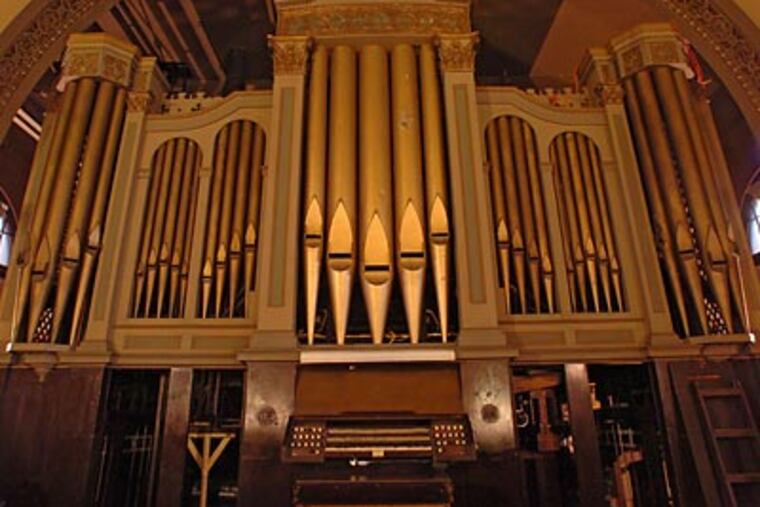
For 12 years, since the roof caved in from repeated water damage, the organ at St. Malachy's Church has remained silent, save for the hymn or two church members managed to draw out each year.
The organ is believed to be the only one of its kind left in Philadelphia. Its 994 pipes were handcrafted 140 years ago; today, only a few still stand. Most of the lead, tin, and wood pipes - from 4 inches to 25 feet long - lie on pews around the organ, many of them dented or broken into pieces.
The roof collapse heavily damaged not only the pipes but also the organ's aging wood and leather parts. The cost to repair the unit? About $300,000, far too much for the small North Philadelphia parish, which brought in a piano instead.
But now the nuns, pastor, and staff at St. Malachy's hope to rally support for restoration around the organ's unusual connection to baseball history: The organ-builder's grandson Jack Norworth wrote the 1908 classic "Take Me Out to the Ball Game."
The church, at 11th and Jefferson Streets, will hold its first fund-raising event April 5 - opening day for the Phillies.
"We're calling it a pep rally," said Sister Cecile Anne Reiley, service director for the 635-member parish and the driving force behind the event.
The fund-raiser will feature a performance of "Take Me Out" on the organ by Kevin Chun, one of the restoration experts assisting the St. Malachy's group; a silent auction including many donated pieces of baseball memorabilia; and performances by students from St. Malachy's school and professional musicians.
Baseball Hall of Fame research director Tim Wiles first approached Sister Cecile about putting on the fund-raiser after completing a book about the song's history. Wiles will perform a dramatic interpretation of the classic baseball poem "Casey at the Bat," dressed as Casey.
Norworth was born into a family of Philadelphia organmakers, Wiles said, and his grandfather Henry Knauff built St. Malachy's organ in 1869.
Knauff was a renowned organ builder and player, constructing organs that other builders insisted "couldn't be built," Wiles said.
The St. Malachy's organ is a "tracker organ," a model that was popular during Knauff's time and that is experiencing a resurgence among modern organ builders, said Chun, who is also a theater director at the University of Pennsylvania. The name refers to the wooden "tracks" that link the keys to the pipes.
"It's very much a window into a period of time," Chun said. He believes it is the last organ of its kind from the 1860s in Philadelphia.
Norworth had little interest in the family business, Wiles said. He became estranged from the family and moved to New York to pursue songwriting, changing his name.
In New York, Norworth teamed up with the musician Albert Von Tilzer to write "Take Me Out to the Ball Game." Today, the song is "usually ranked in all-American songs after Happy Birthday and 'The Star-Spangled Banner,' " Wiles said.
Knauff's organ never achieved such fame, but remained a beloved part of services and ceremonies at St. Malachy's until the roof collapsed.
For the last four years, St. Malachy's maintenance manager, Gene Troxell, and a small group of other church members have been trying to repair parts of the organ. Troxell estimated that the self-proclaimed "Organ Guys" have completed $3,000 worth of repairs, a fraction of what professional repairs would cost.
Chun said he advised Troxell's team to use as many traditional materials and methods as possible. This means using high-quality leather and poplar wood instead of cheaper plastic or other synthetic material.
Organ Historical Society president Laurence Libin agreed that it was more cost-effective to stick closely to the original design.
"As soon as you introduce artificial materials, like plastic, aluminum, they don't expand or contract like natural materials do," he said. "That can lead to other problems."
Libin added that if the restoration at St. Malachy's succeeded, the organ would be one of only a few hundred left from its time in use.
St. Malachy's pastor, the Rev. Kevin Lawrence, said that when the organ is functioning again, he hopes to hold concerts that appeal to both parishioners and the neighborhood. Irish music - a nod to the church's heritage - as well as gospel and jazz would be on the lineup, he said.
The Rev. John McNamee, who retired as St. Malachy's pastor last summer after 25 years, said he had long hoped to get the organ working again.
"It shouldn't just be there ornamentally. It should be there functionally," he said.
Sister Cecile acknowledged that she was worried about starting a fund-raising campaign in the midst of a recession. She said she hoped the organ's history and its promise of spectacular church music would draw supporters.
"Even in hard times, people need beauty and music," St. Malachy's historian Eileen Troxell said. She is married to Gene Troxell, and arranged for the organ to be played at their daughter's 2007 wedding.
The sound, she said, was "majestic."