Restoration completed at Eastern State synagogue
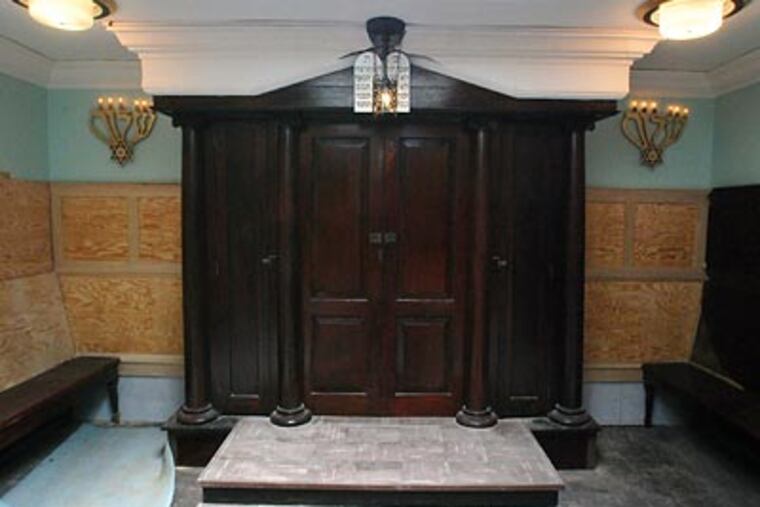
A year after crowds of visitors were allowed to briefly tour the haunting ruins of Eastern State Penitentiary's old synagogue, the sacred space is about to reopen for real - the first totally restored remnant of the historic prison fortress on Fairmount Avenue at 21st Street.
Reprinted from April 1, 2009
A year after crowds of visitors were allowed to briefly tour the haunting ruins of Eastern State Penitentiary's old synagogue, the sacred space is about to reopen for real - the first totally restored remnant of the historic prison fortress on Fairmount Avenue at 21st Street.
The Alfred W. Fleisher Memorial Synagogue, and a related exhibit suite featuring artifacts, explanatory materials, and video interviews with former inmates and their last rabbi, will be open for public tours starting Saturday and Sunday. Today, the synagogue will be dedicated and consecrated as a holy space with blessings by Rabbi Michael Uram.
The historical reconstruction of the synagogue - which is thought likely to be the first such space built in a U.S. prison - will receive a Grand Jury Award in May from the Preservation Alliance of Greater Philadelphia.
Conservator Andrew Fearon, of Milner + Carr Conservation in Philadelphia, said recently that during the last year he had become more than a little intimate with the synagogue's decayed wood, collapsed plaster, rotted tiles, and crumbling structural elements.
Fearon has removed every dark red tile from the floor; he has measured, cleaned, fashioned, and stained plywood backings, pine and poplar benches, and armrests; he has rebuilt some of the synagogue's Torah ark and the platform, or bima, on which it sits; he acquired period lighting and rebuilt the Populuxe-style Hebrew sconces installed during an overhaul half a century ago.
"We have got great documentation for interpretation from midcentury to 1960," Fearon said. "We have great photographs."
The $250,000 restoration project amounts to a radical departure for the stewards of Eastern State, a National Historic Landmark designed by John Haviland, opened in 1829, and closed in 1971. Sean Kelly, Eastern State's program director, said that in general the prison has been kept in a stabilized state of "architectural ruin." But the synagogue posed a conundrum.
"It was almost certainly the first synagogue in an American prison," Kelly said. Its state of ruin, however, was so extensive that it had moved beyond the evocative and into the dangerous.
After much discussion, staff and various consultants formalized a plan for restoration. "The significance of the spiritual space made a compelling case for conservation and restoration," said Sally Elk, head of Eastern State. "We needed to stabilize this space."
Alfred Fleisher, a Philadelphia philanthropist and president of the prison's board of trustees, had launched the effort to build the synagogue behind cell block seven in the 1920s. Fleisher attended services there until his death in 1928, when Jewish inmates named it in his honor.
A complete makeover of the synagogue took place about 1960, and the current project restores the space to its more elaborate appearance at that time - hence the curvilinear sconces, the milky glass lamp fixtures and deep red floor tiles, all reminiscent of the period.
Fearon said original materials were retained whenever possible. Since the room had been constructed by inmates, the same woods were used - plywood, poplar, and pine, which were inexpensive and stained by prisoners to give the feel of richer, more expensive mahogany.
Small details, such as a tin can recessed into a wall - to prevent doorknob damage from a door thrown open too robustly - were preserved. Wood that had to be replaced was not sanded but hand planed, in inmate fashion, Fearon said. The ark, which had fallen to pieces, was painstakingly rebuilt.
"There are really cool details," he said. "It's a folk vernacular and prison-built interior. They did great turnings. They utilized plywood and did their best to make it look like mahogany."
In the exhibit rooms next door, the original outside door to the synagogue is on display, with its blistering, peeling paint and the shadowy outlines showing where two Stars of David once hung.
One of the stars was discovered last year in the foot-deep plaster and debris on the floor of the collapsed synagogue. That star also is on display.
While there were never more than about 80 Jewish inmates recorded at Eastern State in any year from 1920 to 1940, there were many more practicing Catholics, and Elk and Kelly are now considering what to do about the prison's equally evocative Catholic Chaplain's Office suite.
That four-room complex, built near the prison's central rotunda, became an inspiration - and a canvas - for inmate Lester Smith, a Catholic convert. In the mid-1950s, Smith painted eight wall murals throughout the complex that depicted scenes from the life of Christ; around a skylight, he painted 15 smaller panels with similar themes.
Smith was self-taught and approached his subjects with fervor and imagination. He depicted many resonant scenes - including the Nativity, Christ and John the Baptist, the Crucifixion, Resurrection, and Ascension - and signed them all "Paul Martin," after his two favorite saints.
Some of the murals have suffered severe damage from humidity, light, and temperature changes, and much paint has peeled and flaked away over the decades. Several years ago, Kelly said, emergency stabilization slowed the process of decay.
Now, with the synagogue project behind them, the Eastern State officials believe it is appropriate to move on to restoration of the entire suite of offices. An initial study of what that will require was completed about four months ago.
Conclusion? It will, said Kelly, be very expensive.
And, appropriately for a prison, it involves a term of some duration. "This will be a multiyear project," he said.
Visiting Eastern State
Guided tours of the synagogue will be offered weekdays at 3:15 p.m., limited to the first 25 people, no reservations. Unguided visits will be available Saturdays and Sundays, 1 to 5 p.m., and also Wednesdays in June, July, and August, from 5 to 8 p.m.
Eastern State is open seven days a week, 10 a.m. to 5 p.m., with last entry at 4 p.m. From June through August, hours are extended Wednesday evenings until 8 p.m., with last entry at 7 p.m. Admission is $12 for adults, $10 for senior citizens, $8 for students and children seven to 12 years old. Children under 7 are not admitted. No reservations necessary.
For more information, go to the prison Web site, www.easternstate.org, or call 215-236-3300.
EndText