100 years later, polar fete to be re-created
OK, quick: Who discovered the North Pole? Give up? Don't worry, no one else is sure, either. And hey, it's only 100 years today since Adm. Robert E. Peary (1856-1920), born in Cresson, Pa., supposedly did it in the company of four Eskimos and his assistant, Matthew Henson.
OK, quick: Who discovered the North Pole?
Give up? Don't worry, no one else is sure, either. And hey, it's only 100 years today since Adm. Robert E. Peary (1856-1920), born in Cresson, Pa., supposedly did it in the company of four Eskimos and his assistant, Matthew Henson.
History has more or less sided with Peary since Congress officially credited him in 1911 with "reaching," if not discovering, the pole. But a 1988 study by the National Geographic Society, a sponsor of Peary's expedition, concluded his claim might be false. That reopened the case of Peary's rival, Frederick Cook (1865-1940), who declared he had reached the pole in 1908, igniting one of the great public spats of the early 20th century.
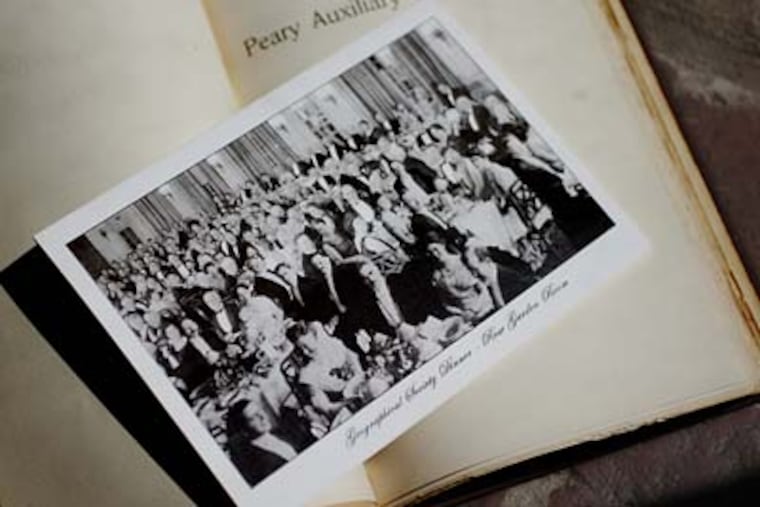
No matter - an anniversary is an anniversary, and tonight the Geographical Society of Philadelphia will re-create, in the Rose Garden Room of the Park Hyatt at the Bellevue, the historic dinner that honored Peary with a gold medal for going where no man - except maybe Cook - had gone before.
(Henson, an African American originally from South Philadelphia, will himself be honored today with the noon dedication in Camden of a statue in front of the forthcoming Camden Shipyard and Maritime Museum.)
The original dinner, which took place in the same hotel room eight months after Peary's feat, brought together storied Philadelphians, among them Isaac H. Clothier and J.N. Pew, some of whom helped finance Peary's expedition.
And tonight, thanks to the sleuthing of Ted and Nancie Burkett, the current and former presidents of the geographical society, respectively, a few descendants of the original dinner guests will honor their families' participation by attending.
"I'll have an Arctic parka on," promises Sandy Cadwalader, whose great-grandfather, John, attended in 1909. "My father gave it to me when I was about 16. . . . He was in the Navy and spent a lot of time in the Antarctic, and later in the Arctic, on various projects. . . . I have no polar bear skins."
For Cadwalader, the dinner fits with family lore from her naval-captain father's career. "I did grow up to a certain extent hearing the stories of Amundsen and Peary."
By contrast, lawyer Arthur Newbold, the incoming chair of Audubon Pennsylvania whose identically named great-grandfather was a guest at the 1909 affair, admits to a weaker link.
He's going because pal Robert Peck - the longtime senior fellow of the Academy of Natural Sciences who will impersonate Peary at the affair and accept a cardboard medal - "put a note in" with an invitation to the 120-person event. He has no idea whether his great-grandfather helped finance Peary.
"I have given it less thought than this conversation has already taken," he says.
The two locals who have given the whole anniversary enormous attention are the Burketts, world travelers together since their days at IBM. They joined the society, whose tiered memberships range from $25 to $195, in the 1970s. The two remain instrumental in keeping the 300-plus-member organization vibrant, with regular lectures, films, and trips.
"The whole Peary situation was really the beginning of the society," Ted says in the living room of their 1880 expanded gatehouse in Haverford, furnished with Mexican folk art from trips south of the border.
He notes that an early Philadelphia expedition to Greenland led by Henry Bryant, the 1909 head of the society whom he will impersonate tonight, delivered supplies to Peary. Although the Burketts have never been to the Arctic, their interest in polar exploration, an activity at the heart of the society's founding in 1891, is plain.
On a wall near the living room hangs a large photo titled "The Three Polar Stars": a portrait of Roald Amundsen, discoverer of the South Pole; Sir Ernest Shackleton, who nearly died trying to win that title; and Peary, at a 1916 Academy of Music event.
Elsewhere, books on Arctic explorers - The Lost Men by Kelly Tyler-Lewis, The Noose of Laurels by Wally Herbert - lie on reading tables about the house.
Both Burketts say it's difficult today to recall the "Arctic Fever" that infected America a century ago. Providing context tonight will be dinner speaker Michael F. Robinson, author of The Coldest Crucible: Arctic Exploration and American Culture.
Robinson, Ted explains, makes the point in his book that polar exploration "started out as a scientific activity" connected to the aim of finding a northwest passage: "Then the media barons got involved. . . . They found they could sell lots of newspapers with stories of explorers. So it shifted rather rapidly to a matter of national pride."
The race to discover both poles, Robinson argues, most resembles the continuing international space race that began in the 1950s.
"Nobody really knew at that time whether there was land at the North Pole or not," says Ted. (It's now known that only shifting sea ice awaits the intrepid visitor.)
"Think of how much easier it's been to get to the moon," muses Nancie. "Hundreds of people died trying to get to the North Pole." One Italian tried getting there in an air balloon with a device hanging off the bottom to cook his steaks. "He didn't get very far," says Nancie.
The Burketts, with greater culinary panache, are allowing the seven-course dinner of 1909 (cost: $4) to inspire tonight's (cost: $80).
Whereas Peary and company dined on Cape Cod oysters, flanked bass, potatoes parisienne, and "a roast guinea fowl currant folly," tonight's guests will start on grilled tomato parfait with Tasmanian crab and sturgeon caviar, move to an oxtail consomme with sherry and garlic shoots, then welcome a second course of roasted cedar plank salmon and (of course) baked Alaska.
Ted Burkett acknowledges the lingering uncertainty about Peary and Cook: "History has not determined that either one got to the right point. Maybe Peary thought he was there."
Cadwalader's short-term concern for tonight is more atmospheric: "Let's just say I hope it won't be too warm."