Interest grows in Rutgers childhood-studies doctoral program
Doctoral candidate Thomas Holmes sees himself on a kind of archaeological dig, searching for children's voices. "Childhood is missing from history because it's all about adults," said Holmes, an associate pastoral leader at Beloved Community Church in Trenton. "What's in the best interest of the kids? We don't know because we bring to it our bias."
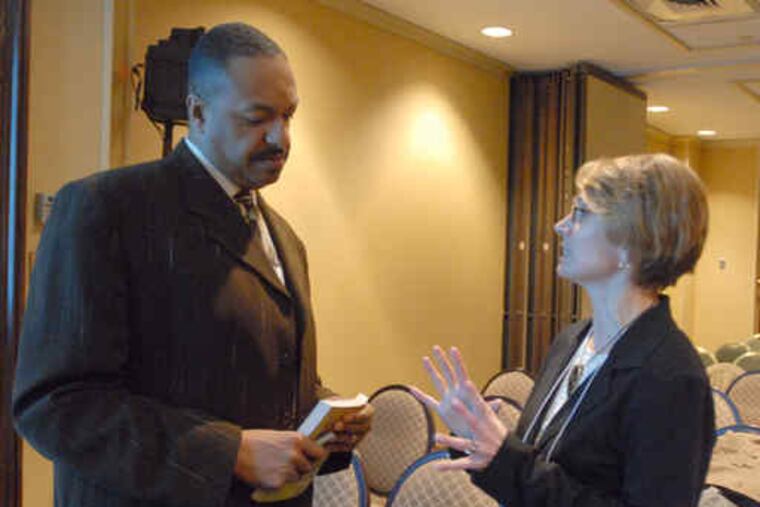
Doctoral candidate Thomas Holmes sees himself on a kind of archaeological dig, searching for children's voices.
"Childhood is missing from history because it's all about adults," said Holmes, an associate pastoral leader at Beloved Community Church in Trenton. "What's in the best interest of the kids? We don't know because we bring to it our bias."
Also on the quest at Rutgers University-Camden are a children's author, reference librarian, guidance counselor, former prosecutor, and folklorist - all pioneers in the first childhood-studies doctoral program in North America. It's also the first Ph.D. offered on Rutgers' Camden campus.
Over the weekend, the department hosted its first international conference, "Children and War," featuring high-profile speakers such as former Sierra Leone child soldier Ishmael Beah, author of the best-selling autobiography A Long Way Gone.
And during the next school year, despite tight higher-education budgets elsewhere, the university will add three faculty members to the two-year-old inter-disciplinary program, doubling its full-time teaching staff.
Camden, where 35 percent of the population is under age 18, is known as a city of children. In making childhood studies its initial doctoral program in Camden, Rutgers has created "something that unites the campus and its larger community," said Lynne Vallone, an English professor who moved from Texas A&M to become department chairwoman.
Graduates will likely become academics, early-childhood educators, child protection or government policy workers, children's-rights advocates, and authors, Vallone said.
"Wherever it leads us, that's where we'll go," said Diane Marano of Medford, who entered the program after retiring from the Camden County prosecutor's juvenile unit, which she headed for 20 years.
Marano, now a full-time student and law school teaching assistant, wanted to better understand the youths she prosecuted, she said. On the job, she could rarely delve deeper than the facts of a case.
Holmes, who has worked 26 years as a financial-aid administrator at Rutgers-New Brunswick, aspires to be a principal at an alternative school. His wife, Denise, teaches at Davis Elementary School in Camden. She's working toward a master's degree in childhood studies. They live in Eastampton.
"As a minister and public-policy advocate, I want to train future leaders," he said. "You hear so much negative - people just give up."
Rutgers-Camden interim chancellor Margaret Marsh imagined a childhood-studies program as early as the 1980s, when she taught history at Stockton College. Back then, she thought, "in the first part of the 21st century, children's rights will be as important as women's studies are today."
The first undergraduate children's-studies program in the United States was founded in 1991 at Brooklyn College by sociology professor Gertrud Lenzer. Faculty drew on arts, humanities, social and natural sciences, education, medicine, and law for a holistic view of the issues affecting children from birth to age 18. Other colleges followed, creating degrees up to the master's level.
"Children in different neighborhoods can have very different childhoods," said Lenzer, whose research has been used to lobby for a New York child advocate and to campaign for laws against child prostitution.
Rutgers-Camden established the Center for Children and Childhood Studies in 2000 to support faculty research, community service, and undergraduate courses. A separate academic department, offering bachelor's, master's and doctoral degrees, was created in 2007.
"The center allows the research that's done on campus to get out to people who work with children directly: child-welfare workers and juvenile-justice advocates," said associate director Nyeema Watson, a doctoral candidate studying images of minority children.
Psychology professor Daniel Hart runs the center and teaches many childhood-studies courses. Students take classes in statistics, psychology, sociology, urban education policy, children's literature, and the history of childhood. About 55 undergrads have declared majors; there are 25 grad students.
Deb Valentine of Philadelphia, a graduate of Wheaton College with a degree in educational ministry, searched 12 years for a doctoral program that suited her desire to integrate history and education.
"A lot of what's happened in education comes from the late 19th and early 20th centuries. Let's see if those interventions still make sense," said Valentine, whose thesis on access to outdoor recreation will focus on Smith Memorial Playground in Fairmount Park.
Pursuing an emerging field isn't easy, the students say.
Lara Saguisag, author of four children's books, tires of constantly having to define childhood studies, she said. And discussions among students from such different academic backgrounds sometimes end in a stalemate.
But the excitement of doing cutting-edge research outweighs the frustration, she said.
"I'm challenged to constantly know more about how artists, writers, medical doctors, social scientists, governments, and different cultural groups understand and conceptualize children," said Saguisag, a Filipino native who lives in New Brunswick.
Two more doctoral programs are in the final stages of approval for the Camden campus: public affairs and computational biology. Like childhood studies, both will be interdisciplinary.
Academic subjects "as we have them were all created 100 years ago," Marsh said. "The problems in society can't be solved by looking at one discipline."