A rare Jewish ceremony to bless the sun
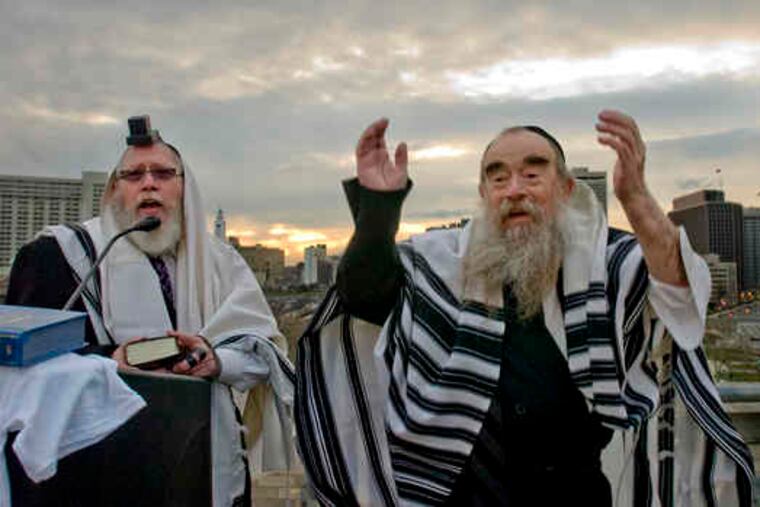
INQUIRER STAFF WRITER The dark sky was graying faintly on the horizon yesterday as dozens of bearded men in wind-whipped prayer shawls stepped onto the roof of Fels Planetarium to await a rare dawn.
INQUIRER STAFF WRITER
The dark sky was graying faintly on the horizon yesterday as dozens of bearded men in wind-whipped prayer shawls stepped onto the roof of Fels Planetarium to await a rare dawn.
There atop the Franklin Institute, with their tefillin, or prayer boxes, exactingly centered on their foreheads, they bowed and murmured, mystifying the small sons and grandsons shivering beside them.
In a centuries-old tradition honoring both Creation and Creator, observant Jews worldwide marked the return of the sun to what they believe is its original place in the divine inception of the heavens - an event that, according to Jewish tradition, occurs just once every 28 years.
The Birkat Hachamah ceremony, a special blessing of the sun, preceded the start of Passover at sundown yesterday, when Jews celebrated with a seder their ancestors' exodus from Egyptian slavery. This time around, the sun returned to its initial position on the 14th day of the month of Nisan, the first day of Passover; that is said by sages to have happened only 11 times in the last six millennia.
The ceremony at Fels Planetarium, sponsored by the Lubavitch Center of Greater Philadelphia, drew hundreds of Hasidic and Orthodox Jews. With the women standing off to one side, the men - nearly all wearing the leather prayer boxes and a traditional fringed prayer shawl known as a tallith - began praying about 6 a.m. Five stories above the Benjamin Franklin Parkway, a cold wind kicked up.
"It's supposed to be spring," one boy of about 10 complained to a friend. Many of the smaller children wore T-shirts bearing an image of the sun that read "The Moment."
Official sunrise in the Eastern United States was 6:34, but layers of pale pink started appearing on the horizon around 6:15 - about the time Logan Square's Swann Fountain splashed to life.
Rabbi Abraham Shemtov, head of both the Philadelphia-area and international Lubavitcher movements, reminded the observant that although they face the sun and bless it, the prayers are directed to God, whom he referred to as Hashem, "The Name."
When the sun appears, he told them, they are to glance only briefly at it, with feet together, and then turn their attention to their prayer books "and think of the Creator."
Broken clouds and the urban skyline delayed the Philadelphia moment to 6:49 a.m., when rays broke through a seam in the clouds to the east.
At that, Rabbi Yehudi Shemtov, the senior rabbi's son, led the crowd in reciting the Hebrew blessing.
"Praise the Lord from the heavens; praise him in the celestial heights," it began. "Praise him, all his angels; praise him, all his hosts. . . . Praise him, all the shining stars. . . . Let them praise the name of the Lord, for he commanded and they were created."
Later, the elder Shemtov called on the assembled to carry the sun blessing into their seder celebrations that evening "and into the world."
The Lubavitchers are an 18th-century Eastern European sect of Hasidic, or ultra-observant, Jews, now headquartered in Brooklyn, N.Y. The New York ceremony took place outside the United Nations.
Charles Schnur, who works in the academic dean's office at Drexel University and is Orthodox but not Hasidic, said he had come to the Fels rooftop to partake in the blessing "because it's once every 28 years. I just like this."
The event was a mix of ancient belief and modern wonders.
Before it started, 18-year-old Josh Levin of Wayne struggled to center the prayer box on his forehead. He pulled out his BlackBerry and snapped a photo of himself to make sure it was in place.
On the rooftop, webcasts from ceremonies in New Zealand and Australia were shown on a big screen. Hundreds more down in the Franklin Institute lobby could watch the proceedings above on TV monitors.
By coincidence, the planetarium last week began an exhibit that includes one of Galileo's telescopes.
"Galileo would be rolling over in his grave if he knew what we were doing up here," the elder Shemtov joked privately.
After more prayers, psalm readings, and a kaddish - a prayer for those who have died - many of the men gathered in circles on the rooftop, laughing and dancing and singing.
"It was a once-in-a-lifetime moment," exclaimed one young man.
"It better not be," his friend replied. "I'm hoping to be around for the next one."