Labors of love at Newlin Grist Mill
As he was pointing out features of the 18th-century beehive oven he built, Rick Fellows noticed cracks in the mortar around the oven door and in the chimney that poked through the cedar-shake roof.
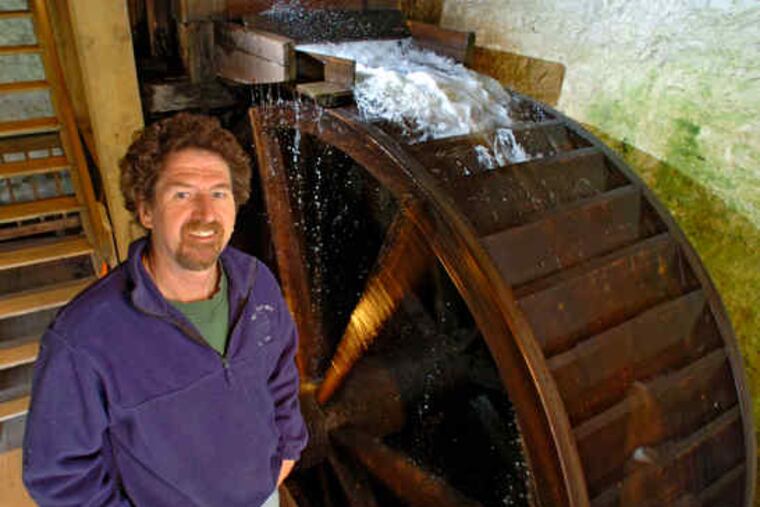
As he was pointing out features of the 18th-century beehive oven he built, Rick Fellows noticed cracks in the mortar around the oven door and in the chimney that poked through the cedar-shake roof.
A man who prefers to speak in deeds rather than words, he didn't say much. But his preoccupied demeanor clearly revealed that he didn't appreciate nature's assault on his perfect craftsmanship.
"I like doing things right, I'll admit," Fellows says. "I'm picky."
Fellows struggles to describe what he does at the Newlin Grist Mill, the only operating 18th-century mill in Pennsylvania.
"Special projects manager," he finally offers. The title seems too bland and narrow for this man of Edisonian ingenuity and pioneer practicality, a jack-of-all-trades and master of all.
"We wouldn't be able to operate without his skills," declares Tony Shahan, director of the 160-acre historical and environmental preserve in Glen Mills, Delaware County, which thousands of people, including numerous school groups, visit annually.
"He does everything, from carpentry and masonry to landscaping and forestry. . . . I don't think he's ever met a project he didn't jump into, research thoroughly, figure out how to do properly, and then go do it."
Lanky, with a full head of curly hair and a ring in his left ear, Fellows, 49, is most comfortable expressing himself with his hands. He is modest and shy, at ease with solitude, needing no further affirmation than the quality of his labors. He shuns publicity and considers talking about himself especially disagreeable.
Of his metier, he says simply: "I just see something and make a replica of it."
For Fellows, that statement is a veritable gusher of loquacity. His projects talk most eloquently. Countless examples adorn the park - a timber frame for a Franklin-era printing press, a shaving bench for making barrel staves and wheel spokes, new leathers for the huge bellows in the blacksmith shop, 20 examples of timber-framing joints that visitors can examine and disassemble, a wooden scale model of the millworks, and, last but hardly least, an outhouse.
"A two-seater," Fellows notes proudly.
His chief responsibility and passion is the mill itself. Built in 1704 by Nathaniel and Mary Newlin, it is powered by the converging waters of Concord Creek and the west branch of Chester Creek. Despite several changes of ownership, the mill ran continuously until 1941, grinding wheat, corn, oats, buckwheat, and rye into flour and meal. In 1957, E. Mortimer Newlin, a ninth-generation descendant, established the Nicholas Newlin Foundation and bought and restored the mill as a museum and preserve of 18th-century rural life.
Fellows is the resident molinologist - a scholar of mills - and a term he'd be the last to use. He knows the mill intimately, stemming from when he worked summers at the park as a college kid. His bible is the book Stronger Than a Hundred Men: A History of the Vertical Water Mill. But mainly he has acquired his knowledge through many adventures in trial and error and visiting, studying, and taking photographs of other mills and mill ruins, at least a dozen on the East Coast.
Millwrights were the rocket scientists and high-tech geniuses of the 18th century. Situating and building a mill were both art and science. To the untutored eye, the construction might seem crude and primitive, but, as Fellows says, "it's all pretty exacting and square. It's pretty impressive."
The same can be said about the Newlin Grist Mill, with its 151/2-foot vertical waterwheel riding on a white oak shaft that is 22 feet long and 24 inches in diameter. Through a series of gears, made of metal and wood, the wheel harnesses the flow of water and the force of gravity to spin an 1,800-pound grindstone. It amounts to a fascinating symphony of wheels, axles, incline planes, levers, and pulleys.
Since 1990, keeping it running smoothly has been Fellows' task and challenge. He has replaced nearly all the teeth on the wooden gears, rebuilt the timber framing surrounding the gearworks, rebabbitted the bearings in the cast-iron journals, and tried, in vain, to keep rodents from attacking the corn and clogging the millstones.
He maintains the stone dam about two-thirds of a mile away, where water from the creeks is banked, as well as the mill race and its gates. With a chisel called a mill bill he periodically dresses and sharpens the stones, which are put to use grinding corn kernels into meal. He supervises the production of enough to fill about 75 two-pound bags a year, which are sold in the park office.
That's one of the perks - plenty of raw material for corn bread and muffins. Fellows, who has a degree in economics from Ursinus College, certainly isn't getting rich. Of the essential joy of his job, he says: "Variety. I see a project that looks like fun and go do it."