Grieving father tells story of the Lady Mary
CAPE MAY - Stories of boats and the sea fill the mind of a mariner such as Capt. Royal Smith Sr. like fish in a gully.
CAPE MAY - Stories of boats and the sea fill the mind of a mariner such as Capt. Royal Smith Sr. like fish in a gully.
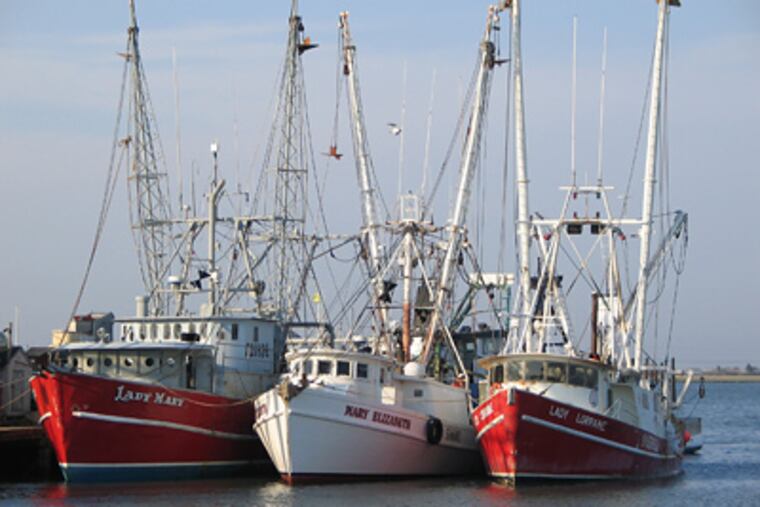
So it was easy yesterday for Smith to talk about his proud Lady Mary, the 71-foot scallop trawler that became the darling of any captain who ever commanded its bridge.
How pretty the boat sat on the water, and how Smith had red peppers mixed into its last coat of paint to keep barnacles from corroding the bottom. Or how mixing sea water with the ice in the holding tanks better preserved the scallops caught in its dredge.
It was only when Smith began to tell a Coast Guard Marine Board of Investigation how he had spent his life on the sea - and then taught his sons to do what his father had taught him - that he began to falter.
Smith's long-awaited testimony came 44 days after he lost his two sons, a brother, and three other crew members when the Lady Mary sank in 211 feet of water on March 24. Only one employee, Jose Luis Arias, survived the shipwreck about 65 miles off Cape May.
"My two boys. . . .," Smith said, then choked up as he tried to tell the story of how he came to own the Lady Mary eight years ago, and the modifications he and his sons performed to make the boat seaworthy for their scalloping business.
Smith tapped his pen on a legal pad, cleared his throat, and fought back the grief that seemed to ooze from his body as he began to perspire and rub the back of his neck.
His long legs twitched beneath the tablecloth of the long banquet table where he sat with his lawyer, Stevenson Weeks Sr., a maritime expert from Beaufort, N.C.
"Our condolences on your loss," Coast Guard Cmdr. Kyle McAvoy offered.
Smith began to speak again, this time mentioning each of his boys by name, but stopped again, this time for more than 30 seconds. Most in the hearing room looked away, to give him a moment of privacy.
"When we decided to get the Lady Mary, it was Roy Jr. and Timothy," Smith said. "They own the corporate shares, so they named [the company] Smith & Smith Inc. We worked on it three years . . . started to do one little simple thing."
Their elaborate renovations to the Lady Mary apparently began with the desire to install air-conditioning and a better system for preserving its haul of scallops until the boat returned to port. Fishing trips for the North Carolina-based business could last up to 10 days, Smith said.
The panel, comprised of four members of the Coast Guard and a representative from the National Transportation Safety Board, began its inquiry into the sinking on April 14. It recessed after two days, then picked up this week, interviewing nearly a dozen people since Monday in an attempt to determine what caused the sinking. Following adjournment yesterday, the hearing recessed for several weeks for additional fact-finding and investigation, McAvoy said.
For a few moments, Smith appeared too overwhelmed to continue his testimony about the ship and his children, Capt. Royal "Bob" Smith Jr. and Timothy Smith.
The men's bodies were recovered by a Coast Guard search-and-recovery team about three hours after the Lady Mary went down in a scalloping area known as the Elephant Trunk, where it had been for six days. The bodies of four crew members have not been found.
"She was one of the most seaworthy boats on the East Coast, and when she left that dock, there were four captains on that boat," said Smith, referring to his experienced crew. His voice cracked as he recalled seeing his family members depart for the last time as the boat left the dock in Cape May on March 18.
Some of the testimony this week has provided more questions than answers: Why were no mayday calls reported from the doomed Lady Mary? Why did none of more than two dozen fishing vessels in the Elephant Trunk come to its rescue? And why did it take the ship's EPIRB emergency beacon more than two hours to provide rescuers a fixed location for the sinking?
Surprising testimony yesterday morning indicated that a clerical error may explain the mystery of why it took nearly two hours for the Coast Guard to learn of the Lady Mary's sinking.
The first signal from the ship's EPIRB beacon was detected by a remote satellite at 5:40 a.m., according to Dan Karlson, a senior analyst with the National Oceanic and Atmospheric Administration's search-and-recovery satellite program.
Arias, the survivor, has said the ship went down about 5.
The signal could not be traced to the Lady Mary, Karlson said, because a clerical error improperly recorded the registration of the beacon.
The EPIRB signal that gave rescuers a fixed position for the Lady Mary was not received until 7:07, when a lower-orbiting satellite was able to zero in on its location.