Children going outside to meet up with nature
First grader Mikayla Gilham prefers Barbies to most outdoor games. She lives in a townhouse in Logan Township, and a pool occupies her entire backyard. Most days kids aren't around to play outside anyway, said her mother, Danielle.
First grader Mikayla Gilham prefers Barbies to most outdoor games.
She lives in a townhouse in Logan Township, and a pool occupies her entire backyard. Most days kids aren't around to play outside anyway, said her mother, Danielle.
"Nature is not part of a kid's life growing up these days, especially in the suburbs," said Marc Rogoff, an education specialist with the New Jersey Department of Environmental Protection. "They go from school to a car to a game to a car to music lessons to a car." Many, like Mikayla, spend their afternoons in supervised care.
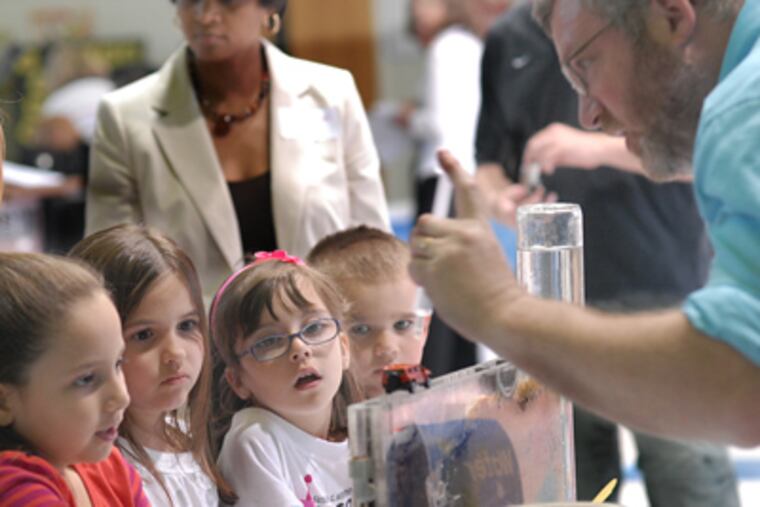
At Mikayla's after-school program Monday, Rogoff taught the cycle of water - one of hundreds of lessons planned in the state this week to reintroduce children to nature. In classrooms and on the surrounding grounds, students have planted gardens, painted rocks, performed experiments, and just played.
"A long time ago, kids could just play outside in nature," director Lorin Powell told about 20 children in the Just Kids after-care program at Center Square Elementary in Logan. "We're bringing nature in here to you."
"Celebrating Afterschool: Outdoors in the Garden State," a weeklong festival sponsored by New Jersey School-Age Care Coalition, also gave program directors a forum to lament possible state budget cuts.
Gov. Corzine's fiscal 2010 budget proposes a roughly 25 percent cut to the state's largest program, New Jersey After 3, which serves 14,000 children. The state's growing budget gap also could mean cutbacks to county subsidies that help parents afford tuition to other programs, Powell said.
"If anything, there's a greater demand for our services," said Jim McElynn, director of development and policy initiatives for New Jersey After 3. Beyond an academic and social boost, he said, the after-school program's outdoor component helps fight childhood obesity.
"We're trying to develop habits - engaging in a conversation about a healthy lifestyle," McElynn said. "A culture of being outside is part of it."
New Jersey's outdoor theme is part of a national "No Child Left Inside" movement that is sweeping schools and nature centers, including some in suburban Philadelphia. Research on children interacting with nature dates back decades, but interest in the potential benefits has soared since publication of the book Last Child in the Woods, by Richard Louv, in 2005.
"There's very little in the book that is news," said Louv, who coined the phrase "nature deficit disorder."
Researchers continue to find correlations between exposure to nature and academic achievement, increased creativity, cooperation, social skills, problem-solving and self-esteem, he said this week. Since 2006, Louv has cataloged ideas and academic studies in an online depository called the Children & Nature Network (www.childandnature.org).
Interest in the environment has grown, but to many, nature is an intellectual rather than a sensory experience. Nature centers have responded to the need for greater interaction by rethinking their onerous rules, said Mike Weilbacher, executive director of the Lower Merion Conservancy and author of an article on environmental literacy in this month's issue of the journal Education Leadership.
Historically, the message to children has been "don't": Don't pick the flowers. Don't leave the trail. Don't touch the rocks.
"You were supposed to enjoy nature but not climb on stumps," said Stephanie Evans, curriculum specialist at Briar Bush Nature Center in Abington.
Evans' center and the Silver Lake Nature Center in Bristol, Bucks County, are creating "playscapes" where children can climb, dig, balance, and crawl. Silver Lake volunteers are finishing work at a shallow stream, where children can manipulate water flow. The honeycomb-themed park at Briar Bush includes a pile of sticks to build a fort.
"By creating this space, we're saying to the kids and parents, 'This is a free-play area.' It's not a delicate area where we're trying to preserve an ecosystem," Evans said.
Similarly, after-school programs give students more freedom to enjoy nature than exists during the school day.
They "can work with children in creative ways that aren't bound by high-stakes testing goals or by 45-minute blocks of time," said Diane Genco, executive director of the New Jersey School-Age Care Coalition. "They can use a local park or even a parking lot."
Today in Haddonfield, students in the Central after-school program plan to create a garden of plants that existed in prehistoric times to commemorate the 150th anniversary of the Hadrosaurus foulkii discovery. Camden's LEAP Academy held an environmental fair Tuesday.
"We feel the kids need to be outside," said Denise Sellers, executive director of Haddonfield Child Care, which has served the town for 24 years. "We take walking trips around the neighborhood. We go to Hopkins Pond. Some kids need it more than others."
People need to relearn how outdoors can be good for children, Louv said. "There's a whole generation of young parents who don't have much experience in nature."
"All over Lower Merion I see exquisite playhouses but never anyone in them," Weilbacher said. "It's the seduction of technology: The laptop is inside. But also parents are a little freaked out by Lyme disease."
Louv said nature is never without risks, "but there's a huge risk in raising our children under virtual house arrest."