Phila. says farewell to beloved elephant pair
With Kallie and Bette, the Philadelphia Zoo's last two elephants, off to a new home in Somerset County, primary caretaker Jen Robertson said she will miss bath time especially.
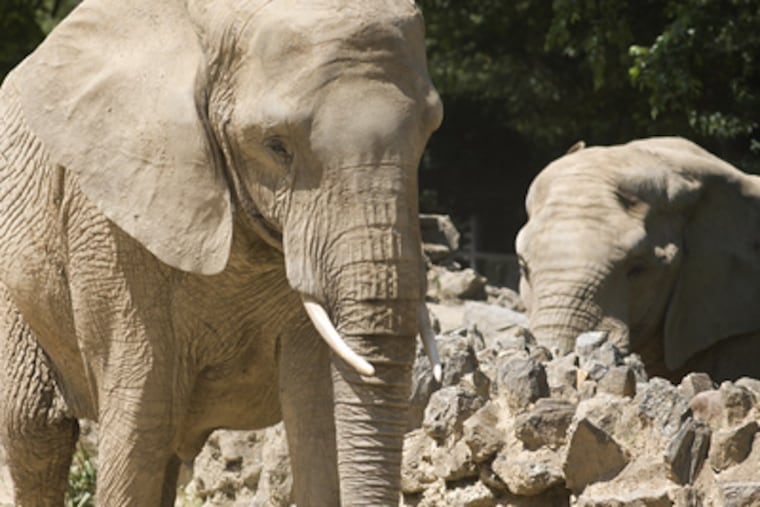
With Kallie and Bette, the Philadelphia Zoo's last two elephants, off to a new home in Somerset County, primary caretaker Jen Robertson said she will miss bath time especially.
The morning hose-down three times a week brought Robertson face to face with the two elephants, each standing about twice Robertson's height and more than 70 times her weight.
"We scrub underneath their eyes, under their feet, under their tusks," she said. "It's a good bonding moment."
The two elephants were set to leave last night for the Pittsburgh Zoo's International Conservation Center in Somerset County, according to the Pittsburgh Zoo. They were expected to arrive via an 18-wheel trailer late last night or early this morning.
Robertson and zoo veterinarian Chris Montgomery are traveling with them and will stay at the ICC for two days to help with the transition.
"It's bittersweet," Robertson said. "I will miss them, but they're going to a great place."
Robertson, 36, arrived at the Philadelphia Zoo five years ago, just a few months after Kallie and Bette moved in permanently. Before 2004, they worked for a few summers at the Philadelphia Zoo, giving rides to visitors. They were permanently integrated into the Philadelphia Zoo elephant herd in April 2004.
Since then, Robertson has been their primary caretaker along with two other zoo staff members, washing, feeding, and learning their distinct personalities.
She knows that Kallie is "the boss." She takes her food first - watermelon and bamboo are among her favorites - and sometimes stands guard over Bette while she sleeps.
The more petite Bette, weighing in at just 8,600 pounds to Kallie's 10,100 pounds, is "the smart one." When Bette is trying to reach tree branches with her trunk, she puts hay down on the rocks to cushion herself.
"She's always thinking," Robertson said.
Earlier this week, Kallie and Bette spent their final days in the city like many Philadelphians in the summer - sunning, swimming, and eating.
News of Kallie and Bette's departure sparked both an outpouring of goodwill from zoo visitors and protest from several animal-rights groups, which argue the ICC is bad for elephants.
Fans of the elephants and other zoogoers gathered Monday around the zoo's Pachyderm House to watch Kallie splash around in the pool. Bette, who doesn't like to swim as much, roamed around looking for a snack.
Visitors left messages for the duo in a book set out by zoo staff members. Sketches of the elephants, handprint tracings by some too young to write, and hundreds of "I will miss you" notes filled the pages.
"Don't forget to write and come back," wrote one visitor.
Kallie and Bette's new home at the ICC - once a deluxe hunting ranch - features 724 acres of woods and pasture. But the elephants won't have access to most of that land when they arrive, said Barbara Baker, president and chief executive officer of the Pittsburgh Zoo.
The lack of elephant-proof fencing around the facility means the elephants will be limited to a two- or three-acre space. Baker said they plan to outfit more acres of land with elephant-proof fencing, but do not know when that will happen.
Two or three acres will provide more room to roam than their current home, which offers about a quarter-acre of space, said Philadelphia Zoo elephant manager Jason Bell.
At night, the elephants can choose to stay outside or sleep inside a 10,000 square-foot barn facility at the ICC, Baker said. Each elephant has its own, 1,200 square-foot stall, complete with heated floors.
The only other animal at the ICC is Jackson, an 11,000-pound male African elephant who arrived from the Pittsburgh Zoo last December.
"They'll be well taken care of," Robertson said, citing the facility's "top-notch team" of elephant caretakers.
Still, several animal-rights groups are protesting the transfer, contending the ICC offers too little space and uses harmful training practices.
One such practice is the use of a "bullhook," a rod used to beat elephants and then use the threat of violence to control them, said Suzanne Roy, program director of California-based In Defense of Animals.
Baker said the zoo uses "guides" to lead elephants, but at no time do handlers use them to harm the elephants or threaten violence.
"These groups . . . use information from 20 years ago and make it sound like it happened yesterday," Baker said.
In a joint statement, In Defense of Animals, People for the Ethical Treatment of Animals, and Born Free USA also wrote that they were concerned Kallie and Bette might breed. Both elephants are nearly 30 years old, an age when the risks of breeding become high, Roy said.
Zoo officials said they were considering breeding, but won't make a decision until a reproduction specialist and an external advisory group evaluate Kallie and Bette, Baker said.
The elephants' old home will soon become the Hamilton Family Children's Zoo, replacing the existing Children's Zoo. Although the ICC will take charge of maintaining the elephants, the Philadelphia Zoo still owns the duo, and Andy Baker would not rule out a return.
"We'd love to see elephants back at the zoo," he said.
Robertson will return to the Philadelphia Zoo, but she doesn't know which group of animals she'll be assigned to next.
Working with animals other than elephants will be "fine," she said. "I love them all."