Daniel Rubin: Phila. driving: Often unlawful but not lawless
On the day Allstate announced that no big-city drivers were worse than Philadelphians, I called Rick Shnitzler to ask how his little survey was coming.
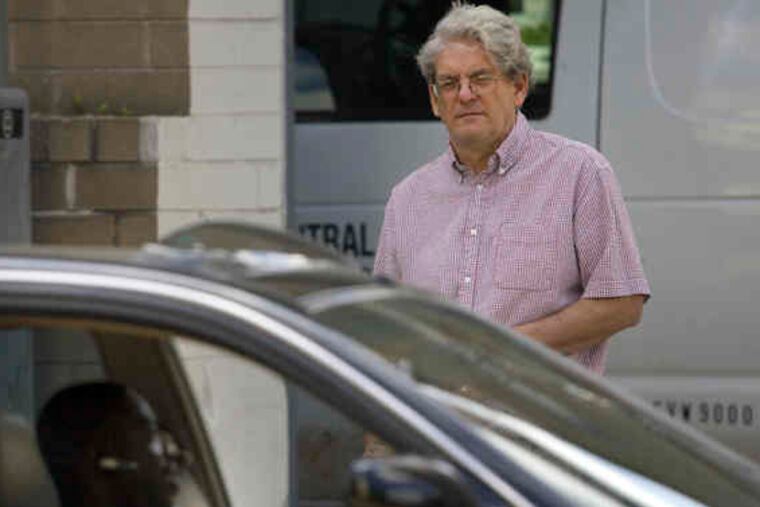
On the day Allstate announced that no big-city drivers were worse than Philadelphians, I called Rick Shnitzler to ask how his little survey was coming.
"I've got some interesting data," he said.
Shnitzler's a semiretired city planner with a love of antique cars and a new stake in auto safety: His 16-year-old daughter, Julie, just got her learner's permit.
Shnitzler's scared to death.
So for the last week or so he's been walking out his door to 20th and Hamilton in Franklintown and taking notes.
His subject is driver distractibility. Cell phones in particular.
There's a new law on the books that says if you're going to drive in the city, you've got to put down the phone. Police won't start enforcing the ban on handheld devices until November, when tickets will cost $150 for the first offense, then $300.
This looks to be a guaranteed moneymaker for the city.
For his study, Shnitzler stood on the west side of North 20th Street as drivers approached the stop sign at Hamilton.
He observed drivers in batches of 100, but reports that no one paid him the least bit of attention. They were busy.
Knees on the wheel
One of every seven drivers was on the phone. That's just one of the distractions he jotted down.
There was the woman eating takeout with a fork, an act that required two hands.
A guy (he thinks) driving with a Chihuahua on his lap.
A Paratransit driver filling out some sort of log as he drove.
Some guy reading a paperback.
And then Shnitzler's favorite - the woman who applied her eyeliner as a very elderly couple navigated the crosswalk in front of her. She stayed there until her job was done, a full minute, as cars idled behind her.
Shnitzler's sensitive to phones in particular. He thinks the woman whose car rear-ended his family station wagon on the Ben Franklin Bridge in 2002 was making a call.
He invited me to make a survey of my own Thursday afternoon, watching the cars just north of the Whole Foods Market approach the Hamilton Street stop sign.
It's a mixed-use neighborhood - condos, rowhouses, day-care centers, neighborhood shopping, lots of joggers, strollers, and seniors.
"Count 100 cars," he advised.
My task was to note those who stopped versus those who slowed and those who speeded up to beat anything else to the intersection.
Not seeing red
After watching seven cars, I was impressed to find one that actually stopped. Six others performed an act of continual motion known to local law enforcement as the "Jersey roll." Then a second car came to a full stop.
Props to drivers for Staples, Olde City Taxi, the City of Philadelphia, and St. Joe's Prep, and four motorists who kindly let pedestrians go before them.
Out of 100 drivers, 72 blew through the stop sign.
Shnitzler seemed deflated by my results. "I would have thought it was worse," he said.
My appraisal tends to back up the findings of Allstate Corp., whose 2009 "Best Drivers Report" found us the most accident-prone of the 10 biggest cities. (That excludes Boston, where Shnitzler learned to drive.)
So what does Shnitzler, a man who's been paid to study traffic in London, make of his data?
Not what you'd think.
"All the time you've been out here, you haven't heard a horn, have you?" he asked.
He was right. The ritual I observed was lawless, but functional.
"People find a way to negotiate," he said. "I think that's what my daughter needs to learn. It's not so much following the letter of the law as it is understanding other drivers. It's figuring out what hand signals mean. It's making eye contact.
"We've lived here 21 years and I think there have been only two accidents, one of which I caused."