Annette John-Hall: Nice beat, nasty ban: 'Bandstand' kept them apart - but no longer
Hairspray, the uplifting musical about a group of forward-thinking teenagers who integrate a Baltimore dance show in 1962, continues to be one of my all-time favorites.
Hairspray, the uplifting musical about a group of forward-thinking teenagers who integrate a Baltimore dance show in 1962, continues to be one of my all-time favorites.
After all, who can resist a good civil-rights message with a beat you can dance to?
Alas, if only real-life rhythms could have been as harmonious.
American Bandstand, the iconic dance program that broadcast right here in Philadelphia from 1952 through '63, did not allow black teens to dance on camera until 1965, after the show had moved to Los Angeles.
Especially ironic since American Bandstand's studio, at 46th and Market, was right in the heart of the black community.
Yet the African Americans who applied for the coveted golden ticket - the AB membership card, which allowed access to the dance floor - never stood a chance of receiving one.
So it was the white kids who came from all over the region in bobby socks and sport jackets to go through the green studio doors and into an exciting wonderland to dance to that brand-new sound called rock-and-roll.
Kathleen "Bunny" Gibson was one of them.
If you watched the program in the early '60s, you couldn't miss her. It was only a matter of time before Gibson - beautiful and voluptuous, with her raven locks teased in a trademark beehive - became a star in her own right.
Gibson, dance partner Eddie Kelly, and all the other AB regulars received bags of fan mail and were featured prominently in national teen magazines.
Host Dick Clark called them the first reality stars.
Today, Gibson's Bandstand popularity makes her a favorite on the nostalgia circuit. A part-time actress who lives in Los Angeles, she was even featured in Peter Jennings' historical volume, The Century.
American Bandstand, says Gibson, "changed my life."
Still, for years she lived with a curiosity about the West Philadelphia neighborhood, which for her was so magical, yet so alien.
And it was that curiosity, that inexplicable urge, that propelled Gibson to get on the right side of history after 46 years.
A few years ago, Gibson, 61, decided to write a book about her years on American Bandstand.
"In my search to understand my whole experience, I started knocking on doors" of the old twins that dotted 46th Street across from the Bandstand studio.
Which is how she stumbled on Miss Billie and Mr. Sylvester, two forgotten witnesses to pop-culture history.
Back in the day, neighbors Billie Williams and Sylvester Taylor had a bird's-eye view of all the AB action.
They'd watch as the dancers would go in the front door and the entertainers in the back, through the parking lot.
The show was broadcast live five days a week back then. They saw a parade of stars: Chuck Berry. Little Richard. Buddy Holly. Chubby Checker.
"We'd sit on our porches and watch," Williams says. "I saw everything seeable."
Afterward, they'd go into their houses and watch the teens stroll, pony, twist, and fly on their black-and-white TVs.
Neither Miss Billie nor Mr. Sylvester will admit how old she or he is. "I could be 70. I could be 90," says Mr. Sylvester, ever the sly one.
But you get the sense that both would have been a little too old to dance on American Bandstand, even at the beginning.
Still, Mr. Sylvester is stung by the injustice. How could a show feature black entertainers and broadcast in a black neighborhood, yet not allow a single black kid to dance?
"I think it belittled the kids, but it ain't nothing new," he says. "We learned to move on with life. Otherwise, you stay stuck."
Miss Billie never let things like that upset her. "That's not how I was raised," huffs the former clerical worker.
Besides, in those early days, she was too busy watching the stunning Bunny Gibson to notice anyone - or the absence of anyone - else.
"My eyes stayed on her because she also sat in the front row, at the end of the bench," she says. "Those were the good old days."
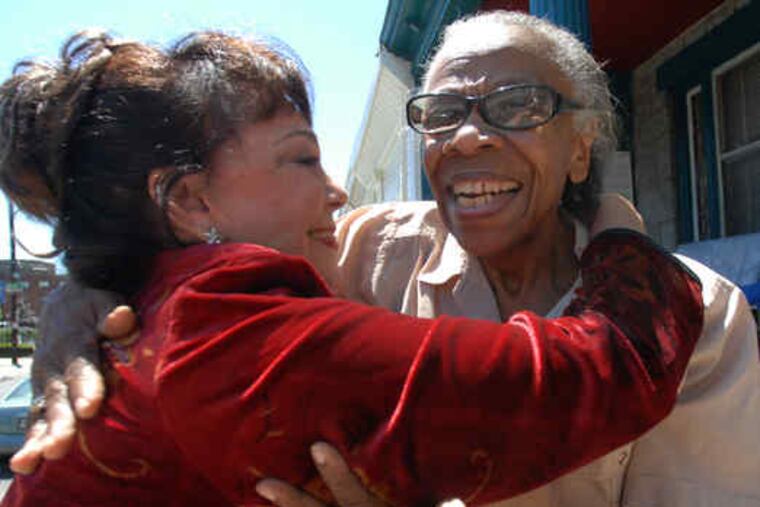
Over the years, Gibson and Miss Billie have become close friends. So when Gibson came back to town recently for an American Bandstand reunion, the first person she invited was Miss Billie.
She took Miss Billie's hand and walked with her across the street to the old site, now home to the newly renovated Enterprise Center, which provides support to minority businesses, and into the restored American Bandstand studio.
"Billie didn't dance, but I introduced her to everyone, and she had a wonderful time," Gibson reports. "You should have seen the sparkle in her eyes. It was like she was 16 and I was taking her to the hop!"
On the rate-a-record scale, I'd give that a 100.