Fallen officer's daughter grieving in peace
MAYAGUEZ, Puerto Rico - Pat Rodriguez leans on the porch rail of her nearly completed house and takes in the view that once promised so much peace. A dusty road leads to her brother's chicken farm. The stippled green domes of Mayaguez's mountains rise from the valley.
MAYAGUEZ, Puerto Rico - Pat Rodriguez leans on the porch rail of her nearly completed house and takes in the view that once promised so much peace. A dusty road leads to her brother's chicken farm. The stippled green domes of Mayaguez's mountains rise from the valley.
After 35 years as a dietary technician, the last 20 at Temple University Hospital, Pat was going to retire here. But in September, her daughter Isabel Nazario, a Philadelphia police officer, was killed when a kid in a stolen SUV plowed into her patrol car.
"I wanted a place for my children to come on vacation. But with Isabel gone," Pat says, "everything changed."
She has been taking care of Isabel's 16-year-old daughter, Jazmin, so during the school year she will remain in Philadelphia.
The summers, though, still belong to Puerto Rico.
Jazmin and her 11-year-old cousin, Bryanna, have been coming down here for vacation the last few years. They shop and stroll the beach and linger over sweet Malta soda with their grandmother's vast extended family.
"But it's not the same," Pat says. She misses Isabel's voice, her daily phone calls. But worse, she watches helplessly when Jazmin cries or withdraws from conversations to send text messages to friends back home. Pat knows about teenage mood swings, but Jazmin is also mourning for her mother. So who's to say what's normal?
"Jazmin doesn't like being around a lot of people. I don't know why," Pat says. "She goes to her room and closes the door. . . . When we go back [to Philadelphia], I want to take her to a counselor."
Her own attempts at comfort have failed.
"The other day, Jazmin was upset, thinking too much, feeling alone," she says. "I told her, 'You're not alone. You have family, friends, your mom's coworkers.' I said, 'Jazmin, you need help, I'm here.' "
Pat closes her eyes gratefully when a cool breeze laps her face. "Every night, I think about my daughter," she says. "I have nightmares that she's calling me. Jazmin feels the same. . . . Sometimes I pray to God and say, 'Look. Give me some answers for what to do for this girl.' "
Adapting to pain
However oppressive her grief may be, Jazmin is still a teenager and occasionally comes up for air. Since June 21, when her braces finally came off, she smiles more often. In early July, she spent a week at El Combate, her mother's favorite beach. And she has thumbed approximately 4,849 million text messages on her red cell phone.
On the surface, this summer's not much different from the last few.
"I'm relieved to be here," Jazmin says. "It's good to get away from Philadelphia, where I'm reminded every day of what happened. This is more peaceful."
But the slow pace gives her too much time to brood. "I have my good and bad days," she says, cracking her knuckles. "I'm not going to overcome the pain. I've learned to get used to it."
Since her mother died, Jazmin has been thrown into strangely adult and public roles. She has graciously accepted condolences from the mayor and police commissioner; spoken with poise before several hundred police cadets; sat patiently through long, official memorials; and made thoughtful decisions about her mother's burial.
Every other day, they all visit the cemetery.
Jazmin chose this small family plot a few blocks from the elementary school her mother attended in Mayaguez. "I wanted one of those houses," she says, meaning the mausoleums she'd seen over other graves, "but it was too complicated, and too expensive." Instead, she chose a white marble slab and headstone engraved with a crucifix and her mother's maiden name, Isabel Santiago.
"When my time comes, I want to be buried there, too," Jazmin says. "Not that I want to think that far ahead."
Yet she feels her future weighing on her with an indistinct obligation.
"My mother used to tell me, 'When you grow up, I want you to be an orgullosa Boricua,' " a proud Puerto Rican woman. "She was an orgullosa Boricua," Jazmin says. "And I want to carry that on."
If her mother were here, she could ask her how. What kind of career would be worthy? If her mother were here, she might tell Jazmin not to worry so much about the future. Instead, Jazmin strains to hear her mother's voice in her head and wonders how to live up to her legacy.
"Some cops do things wrong and don't work hard. But my mom had all these positive qualities. I want to carry that on. I want to show that. But sometimes it's overwhelming."
Now and then, Pat catches Jazmin acting, for better and worse, just like a teenager.
"I need a new hairstyle," the girl says, fiddling self-consciously with her bangs. She checks her Myspace page for updates. She gets a call from her Aunt Mimi, laughs, and then groans.
"I love Puerto Rico," Jazmin says one afternoon, "but I can't get used to the lifestyle. I like more action."
Throughout the languid afternoon, the senatorial grilling of Supreme Court candidate Sonia Sotomayor is being televised. For Jazmin, this "wise Latina" might be a role model, the kind of orgullosa Boricua her mother might want her to emulate. It is too hot, though, to sit indoors, so the TV is turned off.
Fleeting memorial
At a local cantina, Jazmin leans on the counter and dips a spoon into a snack-size container of Nutella. "I might go to the mall this afternoon," she muses, "when my cousin gets back from work."
Bryanna, puppylike, follows Jazmin almost everywhere. Although Bryanna says she misses Isabel, her Aunt Titi, all the time, lately she has other, happier preoccupations. Her father's new wife is expecting a baby girl in October. Bryanna keeps a journal and writes letters to her new sister.
"I feel like I am close to her already. I can't wait to see her, I bought her something and I am going to buy her more and more. I love you sister!!!"
One afternoon, after etching ISABEL in the sand with a stick, Bryanna stands back to admire her work. Within seconds, people walking along the beach trudge across the letters.
Bryanna scowls. "No respect!" she says, shaking her head. "No respect."
Somber visit
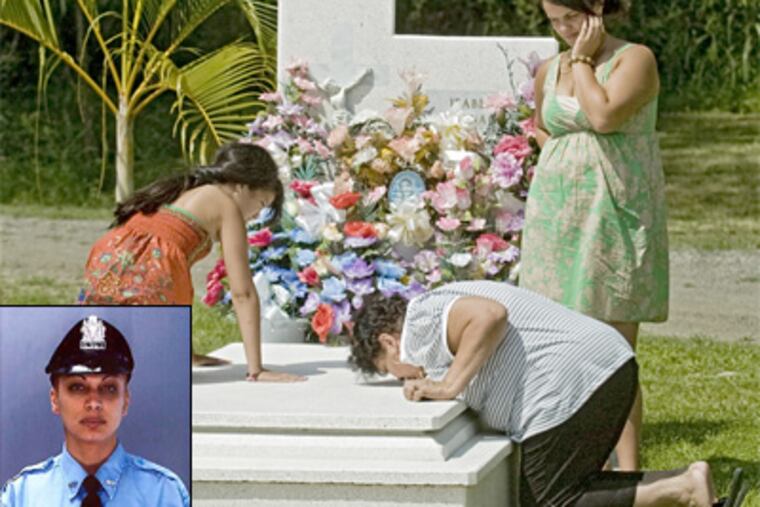
In late afternoon, Pat and the girls get a ride to Isabel's grave. The sun hammers down as they walk through coarse, dry grass to the grave, which is smothered in so many plastic flower arrangements that all you can read on the headstone is "Isab."
Pat crosses herself, praying, "En el nombre de el Padre," and tears up. Bryanna sits on the slab, stroking the smooth, hot stone.
Jazmin puts her arm around her grandmother and rests her head on her shoulder. Heading back to the car, she says, "I don't know what to feel anymore. I'm going through a lot. If anything, I'm, like, blank."