Offer would spare La Ronda in Bryn Mawr
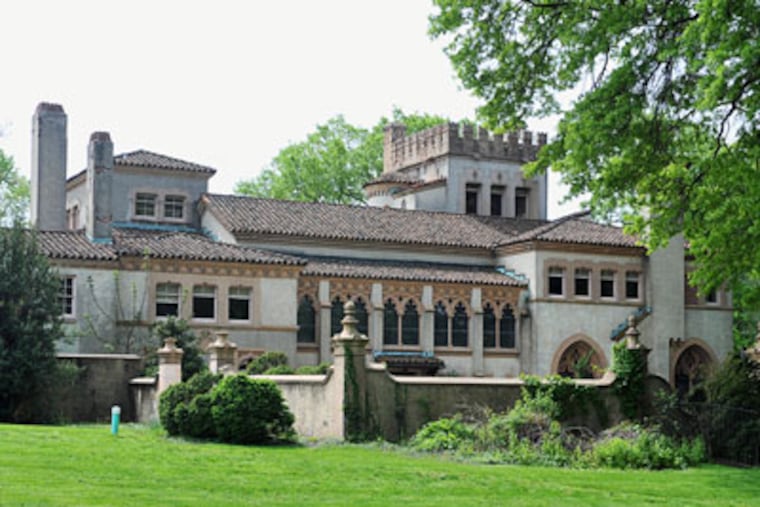
The owner of Bryn Mawr's immense La Ronda mansion still plans to spend $300,000 to raze the historic Spanish-style villa, but a preservation-minded Floridian has arrived with a counteroffer: paying for the privilege of hauling the house away.
The owner of Bryn Mawr's immense La Ronda mansion still plans to spend $300,000 to raze the historic Spanish-style villa, but a preservation-minded Floridian has arrived with a counteroffer: paying for the privilege of hauling the house away.
"I'm saving them money," Benjamin Wohl, 41, said yesterday. He wants to buy the imperiled La Ronda and move it to an adjoining lot to be his second home.
Wohl lives in a Palm Beach house designed by Addison Mizner, the famed architect of the Bryn Mawr mansion. He had bought and moved his own Florida home to save it from demolition, and was alarmed when he read in a Palm Beach newspaper that Mizner's final work could be torn down in Bryn Mawr.
"There are not many homes left around the world like this," Wohl said. "It is the epitome of Mizner."
The 18,000-square-foot, castlelike Bryn Mawr mansion, built in 1929 for the fur-tanning magnate Percival Foerderer, could be demolished as soon as Sept. 1. It is to be replaced with a 10,000-square-foot house, according to Lower Merion Township records.
La Ronda's owner paid $6 million for the property in March behind a corporate front and has not publicly commented on the matter.
Wohl, a real estate developer, said he sent "a six-figure offer" to Joseph C. Kuhls, the owner's lawyer, on Tuesday to offer to buy the house off the lot and move it away.
Wohl said he had a purchase agreement with the owner of an adjacent lot, which is where he would move La Ronda.
Kuhls wrote via e-mail yesterday that Wohl "has not made any real or credible offer regarding relocation. He has merely suggested payment of a nominal fee." The demolition plan is still on track, Kuhls added.
Although the preservationists who have been fighting the demolition plan for months would love to see the mansion remain intact where it was built, they are excited about the possibility of moving it.
"That's certainly preferable by far to losing it completely," said Lori Salganicoff, historic preservation coordinator for the Lower Merion Conservancy.
Wohl, a native Floridian, had never visited the Main Line when he read about La Ronda's possible destruction. After talking to his wife, he flew up Sunday, gave the mansion a long look - from outside its locked gate - and decided it could be a second home for his family.
"I don't need to see the inside," Wohl said. "I know that it's a special home."
Wohl said he saw enough of Bryn Mawr to believe his four children would love the Pennsylvania elements Florida lacks, including hills, creeks, and a groundhog he encountered near La Ronda.
For himself, the attraction is Mizner's architecture. His family lives in a 10,000-square-foot Mizner-designed house that Wohl moved because its owner planned to demolish it to build anew on the lot.
With his experience moving one, albeit smaller, Mizner house, Wohl estimated moving La Ronda onto adjacent land could take three months. The concrete-and-steel framework should endure a move well, Wohl said.
"You might get some cracks," he said. "You might have some issues. But those are things that are all manageable and repairable."
Jona Harvey of Media, chief executive officer of the Architectural Salvage Network, a national building-moving company, toured La Ronda this summer and said the building could be moved safely. She aided earlier efforts to find a new owner for La Ronda but learned only yesterday of Wohl's idea.
Harvey said the disassembly and reconstruction, which ordinarily might take five months or more, could be faster and safer if La Ronda were moved to a nearby lot.
"Generally speaking, the packing and care of the pieces is pretty pristine," Harvey said, "but I would imagine it would just be logistically terrific to move the pieces a short distance."
Moving the house would require a permit for its new site. Bob Duncan, Lower Merion building and planning director, wrote in an e-mail yesterday that "there appears to be sufficient space, but it would be tight."