Willingboro youths learn about police work
Robert Boyd starts out doing everything right. After leaving the Willingboro police cruiser to approach a stopped vehicle on a potential traffic violation, Boyd puts his hand on the pulled-over car. He asks the driver for his license and registration.
Robert Boyd starts out doing everything right.
After leaving the Willingboro police cruiser to approach a stopped vehicle on a potential traffic violation, Boyd puts his hand on the pulled-over car. He asks the driver for his license and registration.
What he doesn't see is a man who climbs out of the motorist's trunk, creeps up, and pretends to strike him from behind.
"It's too late," Patrolman Bennie Langford, Boyd's partner on the stop, tells him. "You're dead now."
Boyd, of course, isn't really dead, and he's not a police officer. He's only 16.
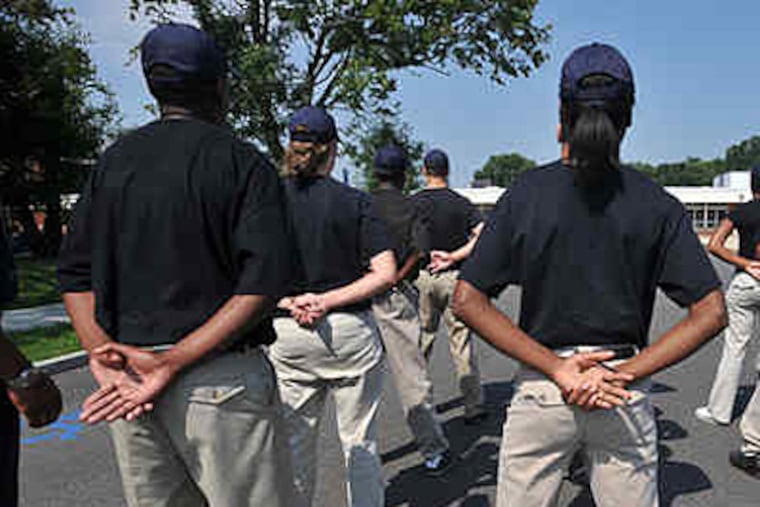
But the Willingboro teen is one of more than a dozen young people who have toughed it out over the last week as part of a new youth police academy in the township.
The program, which began Aug. 10 and ends Friday, offers youngsters a window into the world of law enforcement.
Participants start and end each day with physical training, learn about criminal investigations and police procedures, and engage in role-playing exercises such as yesterday's, in which Boyd learned the hard way the importance of staying alert.
Officials say it is the first program of its kind in Willingboro, whose police force of 74 is one of Burlington County's largest. The group has been meeting from 8 a.m. to 4 p.m. on weekdays at the township's Kennedy Center.
"It leaves you optimistic for the future, because you deal with bad kids all the time, and it's nice to see some good kids," said Lt. Timothy Ryan, who spoke to the group yesterday about criminal investigations.
The program is a mini-version of training at the county police academy, which runs between 23 and 26 weeks, according to Sgt. Ian Bucs. Participants also take trips - they saw the county's dispatch center in Westampton last week, and today they are set to tour the Trauma Center at Cooper University Hospital in Camden.
A graduation ceremony for the group of 16 - some have dropped out - will be held Friday with a reception for parents.
The participants, who range in age from 12 to 17, wrote essays over the weekend reflecting their thoughts on the program. The children noted in their papers that they enjoyed the academy, but that "in the beginning, they didn't realize it was going to be that difficult," said Bucs.
Police instructors aim to instill the importance of teamwork. Youths who act out of line must do additional exercises or other tasks - along with everyone else. Yesterday, for example, one teen's goofing off led to an extra 20 minutes of exercise for the whole group.
The participants also get to hear about bizarre police encounters, such as the time Willingboro authorities were staking out alleged drug dealers and recognized one of them as an applicant to the department's orientation for new officers.
Some of the lessons instructors have passed down: Don't lose your cool or your professionalism. Have the mentality that you will survive and go home to your family.
Those qualities matter when a police officer uses deadly force, students heard yesterday.
Bucs walked the group step by step through a 2008 shootout that began with a woman's calling authorities from a Route 130 restaurant to report the man she had just broken up with had kidnapped her at gunpoint and dropped her off there. He was in a car outside, she reported.
Bucs and a partner located the car in the parking lot; the man had run behind a garbage bin. Bucs said he heard shots being fired and believed the man was shooting at his fellow officer. So he fired at the man, learning only later that the man had fatally shot himself in the head before Bucs fired at him.
Was Bucs sad? asked a girl in the audience.
The officer's answer: not as long as the shooting was justified.
"It may sound heartless, it may sound like I don't have any feelings, but the guy was trying to kill me and my partner," he explained.
Even then, an officer's job isn't over, Bucs said. In such instances, officers have to call medics, seal off a crime scene, and get the victim to the police station.
The same attention to procedure goes into matters as routine as traffic stops, the students learned yesterday.
Instructors taught how police officers position their vehicles (it depends on whether it's a routine or a felony stop), how to take a driver's information (never put your head or hand through the window), and how to address a driver who hurls insults (never make it personal).
Part of the instruction was talking tough to the youths, from the physical workouts to the officers' role-playing sessions on vehicle stops (Bucs repeatedly pretended to be a rude driver).
The idea was to parallel what a real officer hears on the job.
As Langford explained, "We yell and scream at you guys because, out on the street, that's what you guys are going to hear."