Congregation joins dragon boat race to help child
As breezes rippled across the sunlit Schuylkill yesterday morning, sending two 40-foot dragon boats tugging at their dock lines, Rabbi Lawrence Sernovitz just couldn't hold back his feelings.
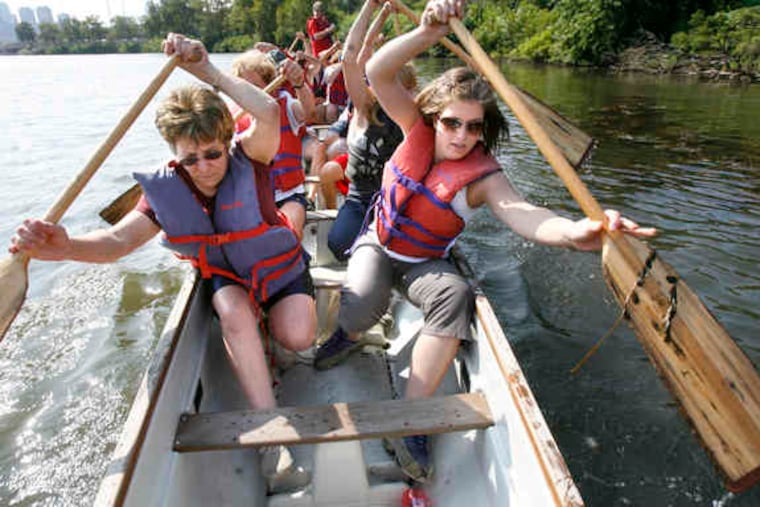
As breezes rippled across the sunlit Schuylkill yesterday morning, sending two 40-foot dragon boats tugging at their dock lines, Rabbi Lawrence Sernovitz just couldn't hold back his feelings.
"It's overwhelming what you have done together to support my family and my son," he told the small crowd gathered around him at Lloyd Hall boat club on Kelly Drive.
Six months ago, the junior rabbi at Old York Road Temple–Beth Am in Abington had never even heard of dragon boats.
But at next month's Philadelphia International Dragon Boat Festival, Sernovitz will squeeze into a slender, tippy reed of fiberglass alongside his father, his brother, and 19 other men and women. At the sound of a horn, they will flail their paddles 500 grueling yards upriver for the sake of his baby boy.
For Sam.
Born one year ago, Samuel William Sernovitz failed to flourish, could not keep his food down, shed no tears, "and really was in pain," his father explained last week.
Sernovitz and his wife, Rebecca, took Sam to a feeding specialist when he was 4 months old, only to learn he has familial dysautonomia: an exceptionally rare and potentially life-shortening disease unique to Jews of Eastern European ancestry.
"My wife broke down," the rabbi recalled, but the news galvanized the congregation.
"As soon as we heard about it, we knew we had to do something," said Alison Dryer, who, with friend and fellow congregant Peggy Robertson, conceived the idea of assembling a team for this year's race on Oct. 3.
The response was so great that they assembled two teams: "Hope United" and "Hope United II." Each of the 40 paddlers is donating $118 - nearly $5,000 - to the Familial Dysautonomia Foundation, which is funding research at New York University Medical Center.
"I've never, ever paddled," Pam Schuessler, 55, of Glenside admitted with a nervous laugh yesterday morning. "In fact, I've only been in a boat once or twice in my life." But when her friend Dryer told her of her plan, Schuessler - who is not a member of Beth Am - "thought it sounded wonderful."
Begun in China 2,000 years ago, dragon boat racing caught on in the West about 20 years ago and has proved especially popular in Philadelphia. Next month's competition will draw 152 teams and more than 4,000 paddlers to the Schuylkill, according to Carol Lee Lindner, founder and director of the festival.
"Some of the teams are for charity," said Lindner, who has agreed to coach the synagogue's teams, "but we don't keep track of how many."
Western dragon boats typically hold 20 paddlers who sit two abreast and stroke with what look like short paddles. A helmsman at the stern steers with a long paddle while a drummer at the bow keeps time.
"A Jewish congregation with an Irish drum in a Chinese boat," joked Mimi Ferraro, the team's drummer and the synagogue's education director, as she headed for the dock yesterday.
Minutes later she was in command, her rabbi just one of 20 crew crouched on the boat's hard, narrow benches and gripping paddles.
"OK, friends, we're gonna do 10 hard, slow ones to get us out of here," Ferraro called out, and then banged on her broad, goatskin bodhran. "One! Two! Count with me. Threeee. . ."
Difficult to manage
A happy, brown-eyed boy (his father calls him a "huge flirt"), Sam Sernovitz is only the 647th person ever diagnosed with familial dysautonomia, which until recently claimed the lives of most youngsters before their fifth birthdays.
"It is a neurological condition that affects the sensory and autonomic nervous systems, and can cause severe gastrointestinal, cardiac, pulmonary, orthopedic, renal and ophthalmologic problems," Sernovitz, wrote to the congregation's 900 families soon after his son's diagnosis.
Nowadays, more than half can reach age 30 thanks to therapies and surgeries, but it is an extremely difficult disease to manage. Sam's feeding can take hours, Sernovitz said, and there is still no known way to prevent it.
But he said NYU Medical Center is preparing to test a gene therapy on adults with dysautonomia that could relieve its symptoms.
Although the Oct. 3 race will take place on a Saturday, the Jewish Sabbath, Beth Am's senior rabbi, Robert Lieb, gave permission for Sernovitz to take part.
"There is a Jewish principle that you may do certain work on the Sabbath to save a life," he said, "and Rabbi Lieb decided this [fund-raiser] was about saving lives."
Team "Hope United II" looked better coming back down the river yesterday than it did when it started an hour before. As it rounded the bend and Ferraro's drumming echoed across the water, the paddlers were roughly in unison and their strokes steady.
"It doesn't matter if we come in first or third or whatever - we're going to win," Sernovitz told them after they returned to shore. Then he let them in on a secret.
"For Rosh Hashanah and Yom Kippur, I'll be talking about community - what it means and how you find it in this day and age," he said. "I will be eternally grateful for what you're all doing."