Tight auto market makes training tough
Trying to diagnose an ailing Ford F-150 pickup last week, 16 Gloucester County College students took as much time to stare at a laptop as they spent under the hood.
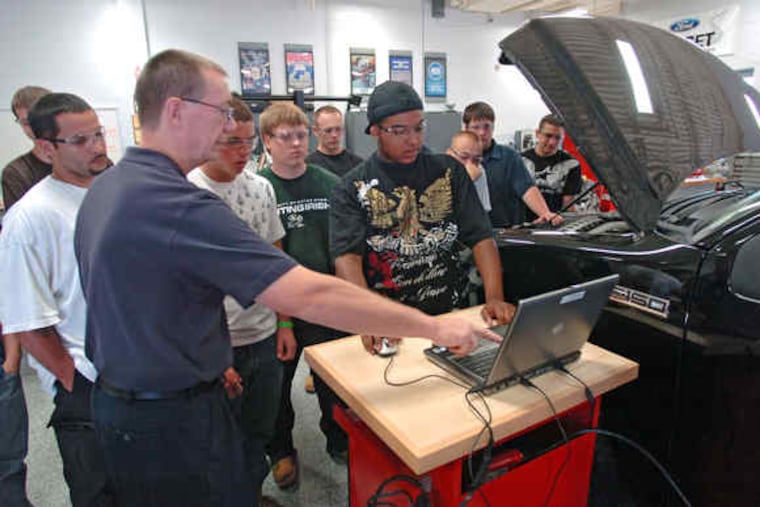
Trying to diagnose an ailing Ford F-150 pickup last week, 16 Gloucester County College students took as much time to stare at a laptop as they spent under the hood.
Forget mechanic. These are today's aspiring auto technicians, studying math, computers, and applied physics, as well as auto-service fundamentals.
But another phase of the program may be even more challenging - and not just for students.
The recession and car-dealership consolidations have schools scrambling for cooperative-education opportunities for automotive students, say administrators at GCC, where the novices will take on their first "real world" assignments this month.
The GCC program, launched in 1989, once placed students with nearly 40 Ford-Lincoln-Mercury dealers within 50 miles of the Sewell campus. Now it works with 15 - just two in Gloucester County, according to Jeff Silvestri, program coordinator for 18 years.
"There are times in history when dealer cooperation has waned, and this is one of them," said Jim Kelly, a Philadelphia-region field-service engineer for Ford Motor Co.
Gloucester County College's five-semester associate degree program, sponsored by Ford, alternates between 10 weeks in the classroom and 10 weeks on the job. Sixteen students began in July; a dozen in their second year are finishing their third co-op.
Unlike neighborhood auto shops, dealerships offer students a predictable progression of learning experiences, from predelivery inspections to oil changes to brake repairs to diagnostics, educators say.
"Many students opt for independent shops, but you never know what to expect. Today you're doing oil changes, and tomorrow you're putting in a new transmission," said Siobhan Kelly, director of job development at Camden County Technical Schools.
Nine of the 28 auto technicians at Holman Ford Lincoln Mercury in Maple Shade graduated from GCC's Ford ASSET program, said service manager Roy Harris.
But Holman - which once wanted to sponsor an entire class of 20 students, according to Silvestri - accepted no GCC trainees this fall.
"We had a consolidation last November of two of our stores," Harris said. "We didn't have a need to bring on guys."
Such economic fallout will force more students at area programs to obtain hands-on experience at private full-service repair shops.
"We still have many students in the remaining dealerships, and they are our priority," John Byrne, automotive technology director at Montgomery County College, wrote in an e-mail. Specialty shops and outlets that deal exclusively in tires, batteries, and accessories don't provide the same range of opportunities, he said.
Historically, dealers have liked to groom auto technicians, said Mary Lynn Alvarino, director of operations for the 200-member Automotive Dealers Association of Greater Philadelphia.
But after the worst 12 months in automotive-sales history, she said, "they're laying off their own employees."
The Philadelphia School District used grant money to preserve student co-ops at 14 dealerships this summer, she said.
In addition to repair skills, co-ops teach students to "go to work and be on time," said Kevin Mazzucola, executive director of the dealers association. No matter what's going on in the economy, he added, "there's always a place for a good service technician."
Ken Kehler, 18, and Niko Ambrosia, 17, have chosen to spend their high school senior years at Gloucester County Institute of Technology in GCC's Ford ASSET program. The secondary school and community college have a joint agreement.
They'll take English, math, physics, first aid, sociology, and computer literacy, as well as intensive automotive technology. If all goes well, they'll have completed a year of college when they graduate from high school in the spring.
In high school, the two worked mostly on older used cars.
"It was, 'Here's a problem; go to it,' " Kehler said. At GCC, "they're all newer cars. It's preparing us for real work. It's diagnostic."
In a couple of weeks, Kehler, of Deptford, will go to Echelon Ford in Stratford to begin his first co-op. Ambrosia, of Williamstown, will work at Delsea Motor Co. in Clayton.
Steve Alper, owner of Alper Automotive Inc. in Northeast Philadelphia, knows the advantage of hands-on learning. He graduated in 1994 from the GCC program.
Dealership co-ops can be "really good as long as they don't use you as cheap labor - a sweep-the-shop kind of job," he said.
Alper got a technician job at the trucking company where he worked in college, then moved to an auto dealership. He opened his shop in 2000.
He would like to take on a student, but business "is slower than it used to be," he said. Alper just downsized by one, leaving a staff of two full-time technicians, himself, and a secretary.
Though he was trained on Fords, Alper said, the knowledge he acquired applied to all makes.
"All cars are basically the same - same principles, same parts," he said. "It's unbelievable how much technology there is now. Even a cheap car has six computers talking to it."
Kelly, the Ford field-service engineer, said computer software has replaced shop manuals, and a laptop is as important as a socket wrench.
Associate degrees give students entrée to four-year programs in automotive management, such as the one at Pennsylvania State University-Williamsport, he said.
"It used to be that you could graduate from high school having had a shop class and get a job, but now, unless you have an education from a reputable school, you're not really going to be able to advance in the business," said Holman's Harris.