City retailers are on edge about a rise in sales tax
Suburban businesses already charge a lower levy. If the gap widens under a budget plan, merchants near the border fear customers will cross over.
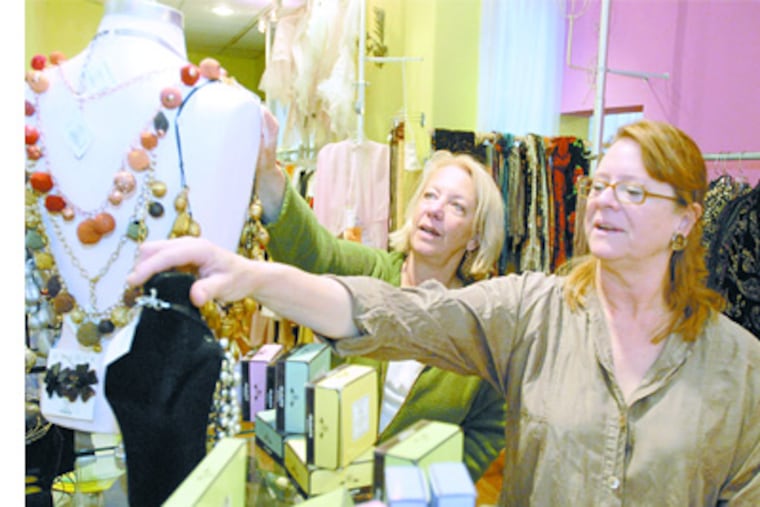
It's a cool, breezy weekday morning in Chestnut Hill, but the businesspeople who run the boutiques along Germantown Avenue are generating plenty of heat.
"They're going to ruin us!" said a riled Barbara Caplen, an associate at the Antique Gallery.
Why the upset?
The Philadelphia sales tax. And not just the fact that it's poised to go up by 1 percentage point. What has businesspeople fuming is that the increase would create a 2-point gap between the city and the suburbs.
That would mean the larger the purchase, the higher the potential cost or savings - and the greater the incentive for consumers to shop outside the city.
"They're going to do the calculation," said Fran O'Donnell, Chestnut Hill's Main Street program manager and owner of the O'Doodles toy store.
That's particularly vexing to businesspeople in border areas, such as Chestnut Hill, where suburban shopping is minutes away. The 125 shops and restaurants in the leafy, cobblestone-street neighborhood draw customers from - and compete with - nearby areas including Plymouth Meeting, Lafayette Hill, Springfield, and Blue Bell.
Somebody buying a $3,600 big-screen plasma TV would save $72 by crossing the city line.
But Philadelphia's government faces miserable choices. Its budget is a shambles, staggered by a once-in-a-generation recession and a 10-week state budget stalemate in Harrisburg.
Pennsylvania imposes a 6-percent sales tax on goods and services, with exemptions including food, clothing, medicine, and textbooks. Philadelphia and Allegheny Counties have collected an additional percentage point, raising their totals to 7 percent.
Mayor Nutter's proposal to raise the city sales tax to 8 percent and defer pension payments would provide $700 million in revenue. Without that money, he said, he'd have to lay off 3,000 workers and close libraries, health clinics, and recreation centers.
The sales-tax increase is advertised as temporary, to last five years, though skeptics question whether that will prove true. Taxes tend to be permanent. The move requires legislative approval, which appeared near last week.
One tax expert estimated the tax increase could cost Philadelphia retailers hundreds of millions of dollars.
Why? The border effect.
That's how economists describe the migration of consumers across government boundaries in search of lower-priced goods.
"You'll go over the border to the extent that it's easy and convenient to do," said Robert Inman, a professor at the Wharton School of the University of Pennsylvania and an authority on taxes.
He estimated that raising the sales tax would reduce store sales by 3 percent to 7 percent, based on economic studies of similar situations. Here's what that could mean:
In the 12 months that ended June 30, 2008, Philadelphia collected $137 million in local tax on sales of $13.7 billion. If estimates cited by Inman hold, taxable sales would fall to between $12.7 billion and $13.3 billion - a loss of between $416 million and $961 million.
However, the city would still come out ahead. Even on that lower base, the extra tax would bring in $255 million to $266 million, more than the $137 million the city collected in 2008.
Of course, not every business is subject to sales tax.
Life's two certainties may be death and taxes, but in Pennsylvania the latter is not imposed on the former. The increase wouldn't affect companies like Gallagher Memorials Inc., at Cheltenham Avenue and Ivy Hill Road in the city and bordered on two sides by suburbs.
And not every shopper sees a 2-point difference as significant.
"If you shop in Center City now, I think you'll continue to do that," said Susan Barr-Toman, who lives in Center City and teaches writing at Temple University. "If you go on shopping binges to the King of Prussia mall, you'll probably still do that."
For Philadelphia residents, she noted, "the other option is not having services that we desperately need or want." Are city dwellers prepared to see 3,000 friends and neighbors thrown out of work? And what happens to those agencies - and the services they provide?
Some consumers point out that in a way, paying sales tax is optional: If you don't spend, you aren't taxed.
"Those big-ticket items, I wouldn't be shopping for them in the city anyway," said Susan Magee, who teaches at Chestnut Hill College and lives in Conshohocken. "And when I do shop in the city, 2 percent is not going to deter me."
These days, she wondered, when people need a new laptop or high-priced piece of electronic equipment, do they really browse from store to store, weighing city against suburb? Or do they go online and have a company like Dell ship the product?
In buying one of the biggest of big-ticket items - automobiles - Philadelphia residents are going to get stuck. Because the sales tax on cars is based on the residence of the buyer, not the location of the dealer. So if you live in Northeast Philadelphia, you can't save money by skipping north to Bucks County.
"It'll cost more for Philadelphia residents to buy cars," said Kevin Mazzucola, executive director of the Automobile Dealers Association of Greater Philadelphia. "And in these times, that's never a good thing for consumers."
One thing about taxes, experts said, is that people get used to them. People still buy in Pennsylvania even though they could travel to Delaware and pay no sales tax at all.
On City Avenue, another major shopping district on a border, reaction to the sales tax has been muted.
"We haven't heard too much rumbling," said Terrence Foley, chief executive officer of the City Avenue Special Services District, which serves both sides of the boundary.
That might be because while City Avenue bustles, most of the retail businesses sit on the city side while most of the office buildings stand in Lower Merion Township. The Bala Cynwyd Shopping Center houses numerous chain stores, which compete on a different level from local retailers, Foley noted.
Still, people like State Rep. Brendan F. Boyle fear the sales tax is reaching a point where it sharpens the city-or-suburb choice.
Nobody is going to travel to save $1 in tax, he said. But for a $1,500 laptop, buyers may well go to the suburbs to save $30.
Boyle, a Democrat who represents part of Philadelphia and Montgomery County, introduced an amendment to save consumers money while helping the city generate revenue. His plan would have created two categories of purchases: Goods costing more than $1,000 would be taxed at the current level, and goods costing less than that would be taxed at 8 percent.
Boyle's amendment went nowhere, but his concern remains. "Eight percent is a decent chunk," he said.
The downturn in the economy has hammered business districts across the country and around the state - and Chestnut Hill is no exception. The Melting Pot fondue restaurant closed in April, and Chico's, a popular women's clothing store, departed for the Plymouth Meeting Mall.
Along Germantown Avenue, everybody who runs a store or a restaurant is thinking about the impact of the sales tax. The area strives to be a destination, not merely a district. Sure, business owners put out corn husks and scarecrows at Halloween, but they also pounce on opportunities for unusual promotions.
Yesterday, stores celebrated Beatlemania to mark the rerelease of the group's CDs. Drake's Gourmet Foods & Catering sold "Lonely Hearts Club" sandwiches, and Campbell's Place served "Lovely Rita" Margaritas.
"We have to keep promoting," said Lisa Howe, who with Georgia Doyle runs Artisans on the Avenue.
Caplen, the Antique Gallery associate, worries for the future. Unlike food or clothes or even a car, antiques are a completely optional purchase, she noted. A purchase that people can forgo, or seek elsewhere, if the price is too high.
"How do they expect people to make it?" she asked, exasperated. "Businesses are closing."