Daniel Rubin: Ridiculopathy as a life pursuit
When the houselights rose and the audience at the Society Hill Playhouse on Tuesday evening roared, Tina Brock stepped forward for a bow and the chance to catch her breath.
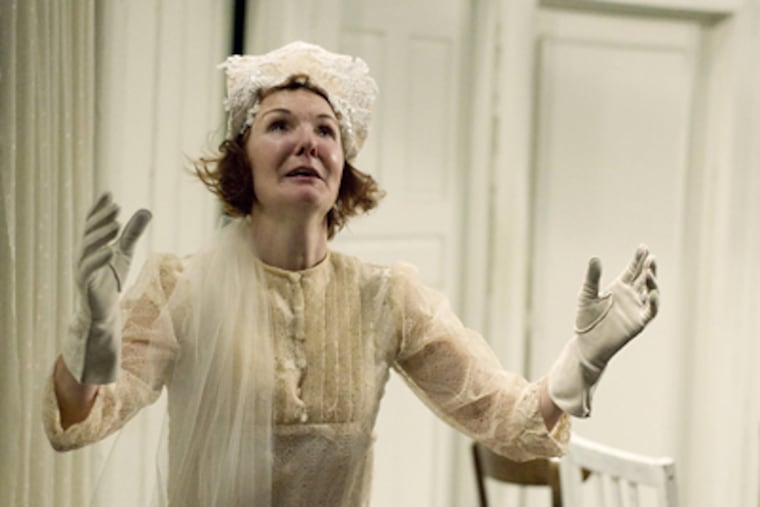
When the houselights rose and the audience at the Society Hill Playhouse on Tuesday evening roared, Tina Brock stepped forward for a bow and the chance to catch her breath.
As the Old Woman in Eugene Ionesco's play The Chairs, she'd sprinted for 80 minutes, dragging furniture, climbing window ledges, and seducing imaginary guests in a tattered wedding gown and scarlet athletic socks.
"Brilliant," The Inquirer's Toby Zinman wrote of Brock's direction, "breathtakingly brave" of her acting.
What's amazing to me is that Brock wasn't asleep on her feet.
Her production, one of the stars of this year's Live Arts/Philly Fringe Festival, is testimony to the idea that it's easier to dedicate your life to the theater of the absurd if you have a steady day job.
Brock's workday Tuesday had begun 14 hours before at the National Board of Medical Examiners in University City, where at 7 a.m. she was meeting with doctors and preparing test cases for future physicians.
By day and by night she creates puzzlers of the human condition.
The office job "is the discipline," she says. "It provides the social support, it gives structure to the whole catastrophe, as it's consistent and, of course, it pays my bills."
The catastrophe she refers to? It might be that it took 200-plus hours of rehearsals to make the show a success, or that although her company, which produces two pieces a year, has a $25,000 annual budget, she's always paying herself last.
We were talking in the garden of 3750 Market St., where the National Board of Medical Examiners is based. Brock has worked there for three years. Before that she created similar cases for its osteopathic equivalent.
And before that, she starred as a standardized patient - remember Kramer's temp job on Seinfeld? - acting out maladies for medical students at the University of Pennsylvania.
That work provided more than funding for her artistic life; it provided a name for her three-year-old theatrical company, The Idiopathic Ridiculopathy Consortium, which goes by the motto: "We bring good nothingness to life."
"Idiopathic ridiculopathy was actually a diagnosis I was given to act out," she said. "Basically, it means you have a problem with your arm, and we have no idea why."
This specific generality appealed to a lover of dense wordplay.
"The name suggests how wonderful it is that we can communicate and have no idea what we're saying," said Brock, 50, who lives in Bella Vista with her 14-year-old son, Liam. "Language can bring us no closer to understanding."
That's a theme expressed in many of the plays by Ionesco, Beckett, and Albee that she favors. "So many words, so little meaning," she said brightly. "The works I like are often about the banality of everyday conversation. You know when you go to a party and people aren't really talking to each other?"
Brock is tiny, with large pale blue eyes and bobbed hair that she dyes bright red. She looks a little like the blonde with pin-straight hair I used to see on WHYY TV12 fund-raisers.
That was when she worked for the station in public relations and had so much fun on camera during its marathon pledge breaks that in 1990 she signed up for an acting course at the Wilma Theater. That led to more classes and shows and commercials in Philadelphia and New York, a life that wound down five years ago, when she started working full time on medical cases.
Growing up in Indiana she used to stage summer extravaganzas in which reluctant friends, relatives, and family pets starred. But in school she charted a more practical course, studying journalism, then communications.
Finding her love late in the game - she was 47 when she started her theater company - might help explain the sort of theater that grips her.
Ionesco was nearly 40 when he wrote his first play, The Bald Soprano.
These difficult pieces make more sense as you get older, Brock said. "You have to have lived a bit to get them."