Pa. guardsmen back home after Iraq stint
At 9:41 a.m., the scream of police sirens signaled that, for the men of Alpha Company, their eight-month, 12,000-mile journey to Iraq finally was coming to an end.
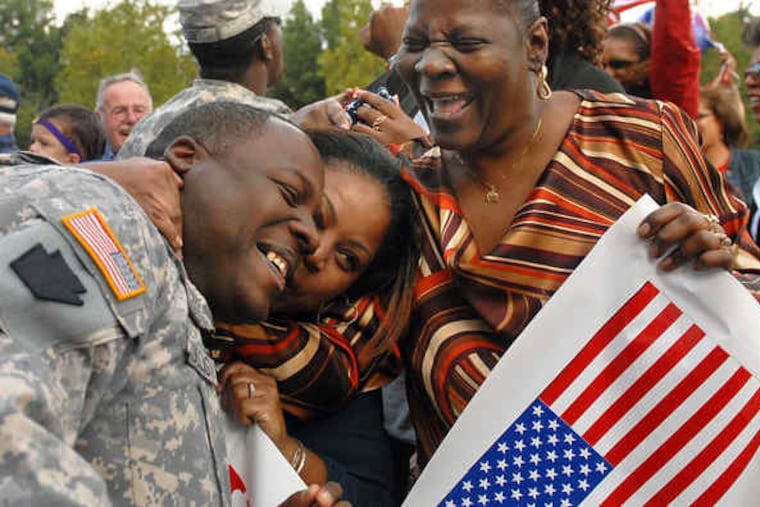
At 9:41 a.m., the scream of police sirens signaled that, for the men of Alpha Company, their eight-month, 12,000-mile journey to Iraq finally was coming to an end.
With a blue-jacketed officer on a motorcycle leading the way, a convoy of three buses turned off Roosevelt Boulevard at Southampton Road. Four police cars brought up the rear.
As the buses turned into the National Guard Armory, passing through a gate in the chain-link fence, an honor guard of older veterans in denim motorcycle vests stood at attention and saluted. Up ahead, at the door, the soldiers' families whooped and clapped.
"There he is! There he is!" Lee Grim of Whitehall, Pa., shouted as the bus doors opened and Pfc. Nicholas Rasavage stuck his head into the cool Philadelphia air.
Grim's husband, Scott, reached out for Rasavage's hand but slapped him on both shoulders. His face was red as he turned away to let others hug Rasavage. He wiped his eyes with the back of his hand.
"It's great, it's great," Rasavage kept saying, over and over.
Rasavage and the 92 other Pennsylvania guardsmen who returned with him yesterday had departed from the same armory almost exactly one year earlier.
This was the same Alpha Company of the First Battalion of the 111th Infantry that saw six of its men killed over four days in August 2005 while deployed for a year in Iraq with the New York National Guard.
This time, the company had gone to war with the all-Pennsylvania 56th Stryker Brigade Combat Team. It had no fatalities and no serious injuries.
Together with the rest of the 4,000-member brigade, Alpha soldiers trained at Army posts in Mississippi and Louisiana after being called up last September. They got a short break at Christmas, then flew to Iraq in January.
The soldiers returned to U.S. soil last week, but had to spend six days undergoing demobilization exercises, including physical evaluations and back-home adjustment counseling, at Fort Dix.
Relatives had received just a day's notice that, at 8 yesterday morning, the soldiers were to load up at Fort Dix and head for the armory.
Soldiers who had gotten their hands on cell phones sent text messages reporting their progress - We're on the turnpike. . . . We just entered Pennsylvania. . . . - as the buses covered the final miles home.
Rasavage, 21, was born in Russia and was adopted by an American family at age 8. The Grims, with whom he lives, are his cousins.
As he stood grinning and talking with them, the Grims' children, Courtney, 10, and Kyleigh, 8, stood looking up at the brown-booted soldier in gray-green camouflage uniform.
The returning soldiers had just a few minutes before they were called inside the armory. There, in the great hall, they were ordered to stand at attention one last time.
First Sgt. Lewis Walls, who had led them in Iraq, introduced them briefly to the crowd, then said the word they had waited a year to hear.
"Dismissed!"
The men were free.
Some whose enlistments had expired while they were away are done with the Guard. This was their last formation.
The bulk will have about 90 says of leisure before they have to report for regular Guard drills one weekend a month.
Lt. Col. Gary Taylor, a former brigade chaplain who had met with the men at Fort Dix, said in a phone interview that the soldiers face what, for some, could be challenging adjustments to home and civilian life.
Wives, he said, may have grown tired of carrying the whole burden of family life. They may want their man to pick up his share of the load right off. But the soldier may just want to relax before getting back to work, either at home or at his old job.
Soldiers who were college students now find themselves at least a year behind their classmates.
"There's all sorts of things they have to adjust to," Taylor said.
Over the next few months, the Guard is planning some family events to draw the men together socially and help them deal with changes. Discharged from active duty, they are also entitled to veterans' benefits.
Spec. Philip George, 22, of Bensalem, one of the last soldiers to leave the armory parking lot, said he knew what he wanted:
"A beer."
"A beer and a cheesesteak," added his aunt, Lisa Haughton.
"And a girl," said his mother, Darlene Wilson.
George turned a bit red. But he smiled.