Peaceful park fosters a fight in Downingtown
The serenity and scenic vistas that have attracted visitors to Downingtown's Kardon Park for decades are interrupted periodically by whirring bicycle tires or clunking acorns on the paved walking and biking trail.
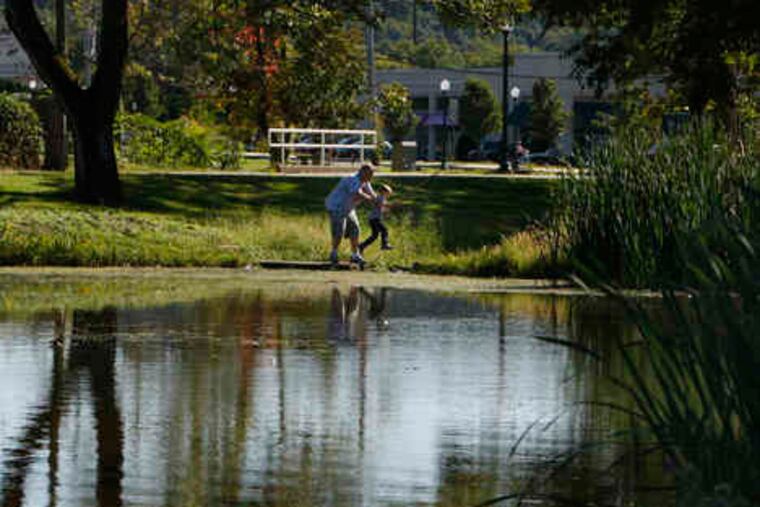
The serenity and scenic vistas that have attracted visitors to Downingtown's Kardon Park for decades are interrupted periodically by whirring bicycle tires or clunking acorns on the paved walking and biking trail.
Such tranquillity belies the poisons beneath the surface as well as the contentious dispute unfolding over the future of the park, an approximately 40-acre swath of fields, forests, wetlands, and waterways that once served as a dumping ground.
The tract stretches from Pennsylvania Avenue to Norwood Road in Downingtown, a borough of about 8,000 residents approximately 33 miles west of Philadelphia.
Today, the conflict will be argued in Chester County Court. Judge Katherine B.L. Platt is scheduled to hear two days of testimony on whether the Borough of Downingtown, where paper mills once prospered, can sell about half the park to a developer.
Under the "public trust doctrine," part of Pennsylvania law since the early 1900s, "actively used parkland" cannot be sold. The borough maintains that users frequent only the trail and pond areas and that, therefore, the rest of the tract should accommodate 345 homes and 20,000 square feet of commercial space.
That assertion is one of many that have sparked spirited dissent, pitting those who favor preserving parkland against those who advocate boosting a weak economy.
"It would be criminal to change this [park]," said Janet Huecker, 49, a former resident who travels from Sadsburyville to use it. "This is a place for people who want to exercise in a beautiful environment."
Across the street in the Mill Town Square shopping center, the owner of Piazza Pizza & Grille has a different view.
"I think it's really good for business," said Antonio Cracchiolo, lamenting the proliferation of pizza purveyors in the borough's 2.2 square miles. "I can't wait for them to start building so I can send over some food."
Because of complex legal issues, which have echoed and stalled in courtrooms across the state, and the ardor of the litigants, takeout orders are unlikely anytime soon.
In December, a Philadelphia judge rejected a bid by the City of Philadelphia to lease part of Burholme Park to the Fox Chase Cancer Center for an expansion project. An appeal is pending.
A 2007 case involving the City of Erie's attempt to sell a golf course that it owns is before the state Supreme Court, and could set a precedent. As a result, both sides in the Downingtown dispute submitted briefs supporting their positions.
Part of Kardon Park's appeal is Lions Trail, a paved connector to the Struble Trail, a popular route that meanders along the Brandywine Creek in central Chester County. The park also features the Victims' Memorial of Chester County, the site of a well-attended, annual vigil to remember crime victims.
Long before Kardon Park, a quarry operated at the site. When that use ended, the Downingtown Paper Co. and Kardon Industries filled the craters with paper waste and chemical dyes until the early 1960s.
The borough began acquiring parcels of the site in the '60s and '70s for parkland, narrowly averting a Superfund designation in the early 1990s. Instead, the companies and the borough funded an environmental study that produced a clearance from the Department of Environmental Protection to use the site as a park.
In January 2000, Bruce Beitler, a DEP officer who oversaw the assessment, included "the caveat that the park remain as it is."
About that same time, the borough began laying the groundwork for future development. Now, backed by most local business owners, the borough says a mixed-use proposal by the partnership of J. Lowe & Associates and Progressive Housing Ventures L.L.C. generates myriad benefits.
Among them: remediation of lead- and PCB-tainted soil; an increase of affordable housing; substantial funds for cash-strapped Downingtown, including up to $2.3 million for a new fire station and a percentage of new-home sales; and improvement of the "usable public park."
Two lawsuits stand in the way. One was filed by residents near the park, the other by Stewart Hall L.P. and Kim Manufacturing Co., a steel fabrication business on property owned by Stewart Hall adjacent to the park.
Samuel C. Stretton, who represents the residents' group Friends of Kardon Park, said that without laws to protect parkland, every municipality would try to sell during hard times.
"Once you do that, you can't get it back," he said.
Stretton, who also represents residents in the Burholme Park case, said visitors enjoyed the park's totality.
He questioned how the borough, after permitting public access for years, could suddenly contend in court filings that the area is dangerous and then propose building homes there.
"Contaminants are not being removed; they're being capped," Stretton said, suggesting the site could become another Love Canal, a notorious toxic-waste case in western New York state in the 1970s.
Downingtown solicitor Patrick C. O'Donnell said he had been surprised by the outcry, especially because the developer plans to increase the acres of usable park area from about 12 to 20.
"There has been a plan to develop this area for 15 years, and no one complained," he said.
O'Donnell said he believed the capping would protect future residents in much the same way the paving has. He said studies showed that most park users stayed on the trail or near the ponds and did not veer into the more contaminated western portion.
If the borough loses the court fight, "we're not going to make that mistake again" and allow access, O'Donnell said. "You're going to see fences."
Absent from the fray is East Caln Township, where Downingtown owns a contiguous parcel of the proposed development. Although East Caln could benefit from tax revenues, it "takes no position" on the issue, township manager Barbara M. Kelly wrote in an e-mail.
In the meantime, acrimony continues in a community that celebrates Good Neighbor Day each summer.
O'Donnell dismissed a suggestion in a recent motion by H. Fintan McHugh, a lawyer for Stewart Hall, that the borough left areas of the site unmowed "in an attempt to interfere" with a proposed visit by the judge, who could have inferred a lack of use.
Seated at a park picnic table perusing National Geographic last week, longtime Downingtown resident Frank Kammerer, 75, described the park as "a needed refuge from the crowds." He said it should be left intact, not loaded with homes that would worsen commuter gridlock.
"It should go on a ballot," he said of the sale. "When in doubt, let the people decide."