Camden groundbreaking marks World Habitat Day
Kadeedra Harrison and Leah Brown, plunging golden shovels into bare earth, broke ground on their first homes yesterday as Camden and state officials - and the international community - looked on.
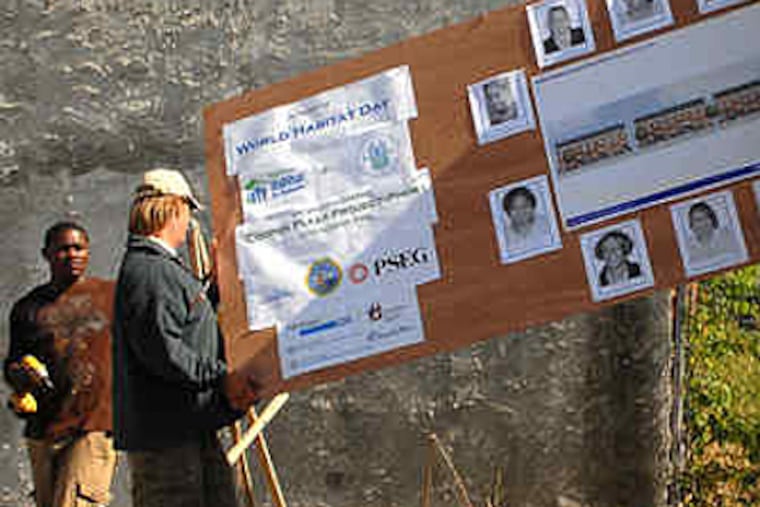
Kadeedra Harrison and Leah Brown, plunging golden shovels into bare earth, broke ground on their first homes yesterday as Camden and state officials - and the international community - looked on.
Camden was one of dozens of cities around the country celebrating World Habitat Day, a United Nations initiative since 1986 to bring attention to the need for adequate housing around the globe.
For Harrison and Brown, housing is not a global problem, but a deeply personal one. In the summer of 2011, they are set to move into two of nine homes to be built at Sixth and Line Streets by Camden Metro Habitat for Humanity.
Harrison, 29, works nights as an aide to autistic children. She and her 10-year-old son Karim live with Harrison's sister.
Harrison said it was eye-opening to break ground on her future residence on the same day events were going on in places as far away as Botswana and Mongolia to promote the need for quality, affordable housing.
"Everywhere, everybody needs housing," she said. "It's a worldwide thing."
This year, the United States was World Habitat Day's host nation for the first time. Previous hosts include Angola, Brazil, and Indonesia. The Camden project was chosen by the state Department of Housing and Urban Development to highlight the U.N. event in the New Jersey-New York region.
"The reality of not having housing security is very distant for the average American," said Douglass Wagner, executive director of the city's Habitat for Humanity branch.
The U.N. theme for the day was "Planning Our Urban Future." In Camden, however, the theme chosen by the regional HUD office was "Rebuilding Communities."
"We perhaps are not aware in the U.S. of the huge global movement of people from rural areas to cities," said Susan Wachter, codirector of the University of Pennsylvania's Institute for Urban Research. "It's the first time in history where the majority of people will live in urban areas, but the question of 'Live how?' is very unanswered."
By contrast, Wachter said, it was interesting that yesterday's event was in Camden, a city that has instead steadily lost residents over the last half-century but still faces many challenges related to housing.
Yesterday's groundbreaking in Camden is another redevelopment effort in Camden's Cooper Plaza neighborhood, an area that surrounds Cooper University Hospital.
About five years ago, Barbara Lowe, 44, moved into one of seven new houses built by Habitat down the street.
"We are homeowners," Lowe said. "We have rights and responsibilities, and we have power."
That project and the nine new units announced yesterday join 32 homes the organization has rehabilitated in the neighborhood in recent years, Wagner said.
Hazel Tuggle, who has lived across the street from the planned site for more than 40 years, said a three-story apartment building once stood there, but fire and decay left it to be demolished around 10 years ago. Next to it were some rowhouses, the last of which came down in 2004, Camden Public Works Director Pat Keating said.
As Tuggle sat smoking on her steps while watching yesterday's event in the now-vacant lot, she wondered if the new properties would raise her taxes and whether infusing new homes in the area would have any transformative effect for her community.
"It's a start," Tuggle said. "It's not just building houses - it's jobs, it's a lot of things."
Monica Leibovitz, Cooper's director of community development, noted that the hospital recently secured funding for three parks in the area. The new, state-funded Lanning Square Elementary School is scheduled to open nearby in 2012.
"We are really moving a mile a minute in this neighborhood," said Leibovitz, one of about a dozen speakers at yesterday's event.
The nine units announced yesterday consist of seven three-bedroom homes priced at $96,000, and two four-bedroom homes at $102,000. In return for "sweat equity" by volunteering between 250 and 500 hours to take classes on finances or build houses, residents are given no-interest mortgages, Wagner said.
The cost of constructing the nine units is about $1.5 million, paid for by public and private partnerships, including $300,000 in funding from energy giant PSE&G through a state tax-credit program.
Harrison and Brown, a 35-year-old mother of three, said they would not have been able to finance their own homes without the deal offered to them through Habitat for Humanity.
"I'm happy because it gives me an opportunity," Brown said.