National Sudoku Championship Saturday in Phila.
It's the biggest puzzle championship in the United States, and on Saturday, there will be a Sudoku rematch between last year's surprise champ vs. past champ, former Google software engineer vs. bioengineering researcher.
It's the biggest puzzle championship in the United States, and on Saturday, there will be a Sudoku rematch between last year's surprise champ vs. past champ, former Google software engineer vs. bioengineering researcher.
Reigning champion Wei-Hwa Huang will face 2007 winner and former world champ Thomas Snyder in the third annual Philadelphia Inquirer National Sudoku Championship at the Convention Center. They'll again share a hotel room during the contest, but not to worry - they're friendly foes.
"It's not as if there's an 'I must destroy the other person' or 'I'm going to poison him in his sleep,' " said Huang, 34, of Mountain View, Calif.
Sudoku may seem complicated, but it's not. The game involves filling in numbers 1 through 9 in boxes on a grid, so that each number appears only once in any column or any row. Solving the puzzles requires logic and skill, not math prowess.
Sudoku has evolved from a sizzling fad whose endurance some questioned when it took the United States in 2005, to a perennially popular puzzle with its own established championship.
"Like crosswords, I think Sudoku will be with us forever," said puzzle master Will Shortz, who returns as the contest's moderator.
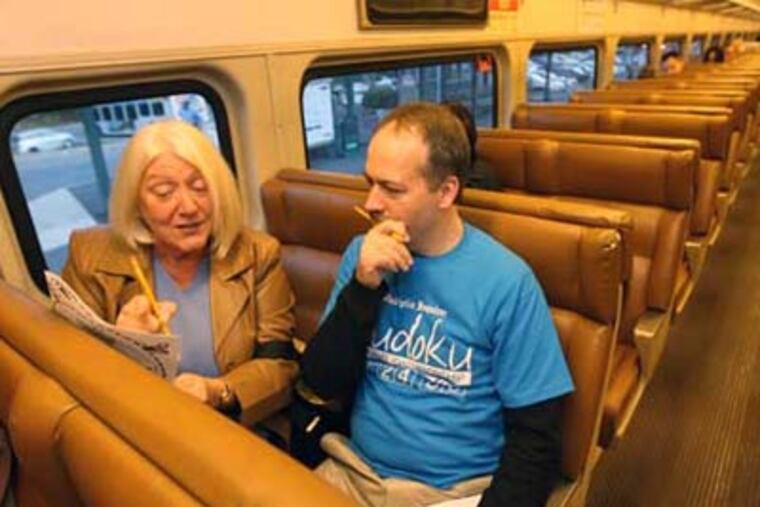
Just look at SEPTA commuters who were on the R3 line this month when Shortz, puzzle editor of the New York Times, hopped aboard to promote the Sudoku tournament.
"When we rode the train the other day, there were a lot of people doing Sudokus even before we started going up and down the aisle handing out our materials," Shortz said.
As of yesterday, 743 people have registered for Saturday's tournament, with more expected to show up at the door on game day. Players range from 8 to 93, and they sign up to compete in easy, intermediate, or advanced brackets. An additional competition is by age. Winners must complete the puzzle more accurately and quickly than their opponents.
A total of $25,000 will be awarded in cash prizes overall, with the winner of the advanced division taking home $10,000, the intermediate $3,000, and beginner $1,000. The advanced winner also earns the title of national champ and a spot on the U.S. team that will compete for the international championship next year - which will be held for the first time in Philadelphia next spring.
"We're already the Sudoku event in the country," Shortz said of Saturday's competition. "It gives us even more credibility that the world Sudoku championship will be in Philadelphia."
Sudoku's name is Japanese, but the game's roots are in Europe, where an 18th-century Swiss mathematician developed a grid puzzle in which any one number appeared only once across, up, or down.
In the 1970s, U.S. puzzle maker Howard Garnes built on the Swiss concept, using a nine-by-nine grid. In the 1980s, a version of that puzzle became a hit in Japan and its popularity later migrated to the United States.
"It's very logical and I just get it," said Rachael Hart, a 12-year-old from Telford, who signed up as a beginner.
She and her father, Greg Hart, participated in the first two contests in Philadelphia. Rachael entered the intermediate division, but last year the puzzle seemed more difficult and less fun, she said.
Her dad isn't playing this year, but he will be at the Convention Center to cheer on Rachael.
"I think I panic too much. There's a lot of pressure," Hart said of the contest.
Besides, he said, with equal measures of pride and self-pity, "my daughter beats me too badly."
Rachael and her dad go head-to-head most mornings by photocopying the Sudoku puzzle from The Inquirer and seeing who can finish first.
Harold Jacobs, 81, is participating in the contest for the first time. The retired accountant from Chesterbrook also will play in the beginner bracket.
Jacobs isn't in it for speed.
"Actually, I never tried to get more proficient at it. I just enjoyed doing them the way I did them," he said.
Current champion Huang and Snyder not only are proficient, they each have their own Sudoku style.
Snyder, 29, who does his research at Stanford University, said he can remember what numbers he has tried in which squares to help him figure out the correct placement. Huang scribbles notes.
Huang, 34, didn't expect to win last year.
"I was very surprised because Thomas has been consistently better than me," he said.
Snyder says playing is not just about winning. It's about successfully manipulating numbers, even if you can't balance a checkbook. Finishing a Sudoku puzzle makes the solver feel smart in under an hour.
Said Snyder: "There aren't many things in life that have that return on your time."
More Information
For details on registration and fees, rules, schedules, and spectator fees, go to www.philly.com/sudoku. Deadline for online registration is noon Thursday. In-person registration opens at 8:45 a.m. Saturday at the Convention Center, 1101 Arch St.
EndText