Riverfront prison property can be sold directly
New Jersey will be able to sell the 16-acre Riverfront State Prison property in Camden directly to a developer, bypassing an auction process among interested companies, as a result of a vote this week in Trenton.
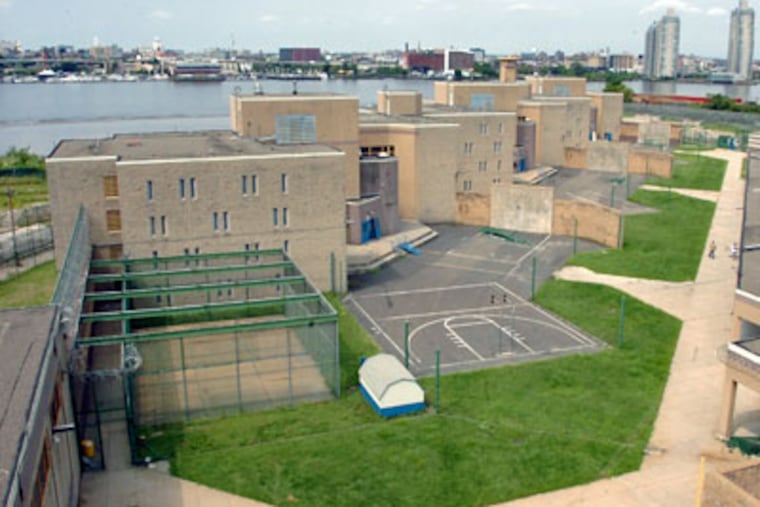
New Jersey will be able to sell the 16-acre Riverfront State Prison property in Camden directly to a developer, bypassing an auction process among interested companies, as a result of a vote this week in Trenton.
The State House Commission, created by the Legislature to control the sale and leasing of state-owned properties, voted Tuesday to allow the property to be sold through either a negotiated sale or a request-for-proposals procedure.
The state Treasury determined that a third way to sell a property, an auction process, "is not suited to the disposition of Riverfront because of the complex economic development concerns," according to an administration document distributed to members of the commission.
Instead, the Treasury recommended a "modified sales process" that officials believe would increase revenue to the state and eliminate the need for the state to advance demolition funds.
Gov. Corzine ordered Riverfront State Prison shut in January. The closing of the prison - which has a direct view of the Delaware River and Philadelphia's skyline - is intended to help draw housing and jobs to Camden's waterfront.
Under the new procedure, the state would turn over the Riverfront property to the state Economic Development Authority, which would sell it. In addition, the zoning for the property, which is industrial, could be changed before it is sold, which would give a potential buyer more certainty about how it could be developed.
Tom Vincz, a spokesman for the Treasury Department, said the procedure would ensure that the property was not sold to a real estate speculator who could allow the property to languish for years, or to "another party with intentions or an agenda that are not in sync with what the residents of Camden have wanted for years and years."
The two Republican lawmakers on the commission objected to the changes. Sen. Gerald Cardinale (R., Bergen) said a negotiated sale would amount to a no-bid contract.
"The governor has opened the door to corruption by refusing to let the sale of the prison property be conducted by public auction," Cardinale said. "That he would even think that a no-bid contract is appropriate in this prison sale makes it clear he's learned nothing from [the] conviction of so many political bosses and elected officials over the last eight years."
Cardinale said the governor's appointees can essentially choose the winning bidder and then go to the Legislature for a rubber stamp. Under the new procedure, before the sale of the property is finalized, it must be approved by the State House Commission. In addition, if it is valued at more than $500,000, its sale must also be approved by the Legislature.
"Only an auction guarantees that taxpayers get the best price for the land and that the process is conducted fairly and with transparency," Cardinale said.
Assemblyman John Wisniewski (D., Middlesex), who voted in favor of the change, said that if the state's objective were simply to dispose of the property for the best price, a simple auction would make sense. But in this case, the goals include spurring economic development activity in Camden, Wisniewski said. He added that the new procedure includes several layers of checks and balances to ensure a good result for taxpayers.
According to the new procedure for selling the prison, the state Economic Development Authority will determine whether a direct sale is appropriate. Among the factors the authority is to consider are the number of jobs expected to be generated, the amount of state and local taxes expected, state and local economic development objectives, and the return to the state.
Angel Fuentes, the City Council president, whose ward covers North Camden and the waterfront, said he had confidence in the transparency of the state.
"The Republicans . . . are making a big issue out of nothing," said Fuentes, a Democrat running for an Assembly spot in November's election.
He said he hoped any developer awarded the land would stay in line with the plan for North Camden laid out by Save Our Waterfront, a group working to revitalize North Camden. Calling the prison site a "golden opportunity," he said it was crucial for the city to have ratables there and businesses would be preferable to housing.
"Commercial development is very critical for the heart of the city when it comes to jobs," he said.
Rod Sadler, president of Save Our Waterfront, said he thinks the option of a direct sale is merely intended "to take the chance out of the equation."
"An auction can go to someone who has a lot of cash and doesn't give a hoot about the needs of the community," he said.
Sadler said he had been in talks with EDA officials to put together a group of community stakeholders, including the Delaware River Port Authority and the Cooper's Ferry Development Association, that would have a say in which developer gets the property.
In December, a study is set to be commissioned by Save Our Waterfront and others and presented to the EDA that would explore development options "to figure out what can really grow here," Sadler said. A previous study suggested using the site and adjacent land to build 2,800 housing units and a recreational complex, such as a theater, he said.
"I believe the EDA is committed to a development process that includes the community," Sadler said.
Frank Fulbrook, a civic activist who lives in the nearby Cooper Grant neighborhood, argued for market rate housing before commercial development to make sure businesses would not be isolated at the former prison site.
"I wouldn't want to see business fail for the lack of a customer base," he said.
Fulbrook said his primary focus was the use of the land, not who develops it. He said a politically connected sale would not necessarily mean the chosen developer would be wrong for the area.
"They might make the right decision for the right reason, or the right decision for the wrong reason. I hope the result is a responsible developer who will do the right kind of project," he said.