Prison guard teaches the art of beauty
Whether at her 6-year-old daughter's gymnastics class or on a Caribbean vacation with a girlfriend, Jackie Wescott inevitably ends up chatting with somebody. But she hesitates when the conversation turns to work because Wescott's job takes some explaining.
Whether at her 6-year-old daughter's gymnastics class or on a Caribbean vacation with a girlfriend, Jackie Wescott inevitably ends up chatting with somebody. But she hesitates when the conversation turns to work because Wescott's job takes some explaining.
"When I tell them what I do, they get all confused," says Wescott, 30, of Clementon. "They ask if I'm a cosmetologist, why don't I work in a salon?"
In a crisp, standard-issue navy-blue uniform with her hair pulled back in a fashionable bundle of tresses, Wescott reports each day as a corrections officer to the county jail in downtown Camden.
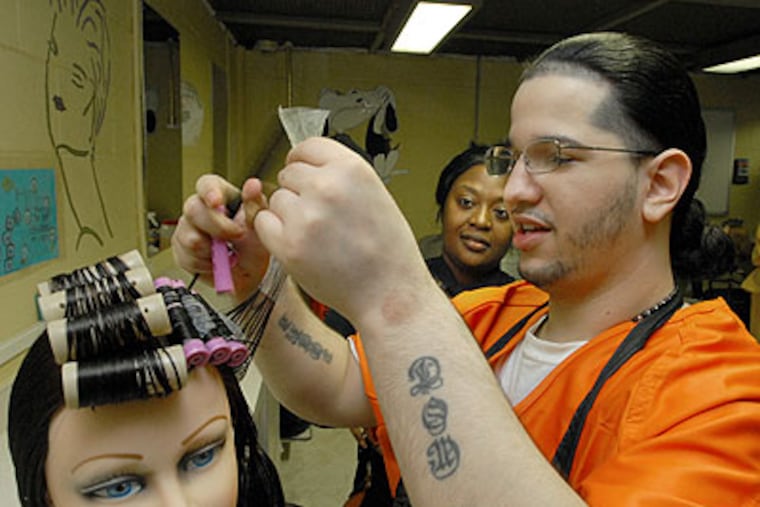
But instead of watching for contraband and breaking up fights, Wescott teaches male and female inmates how to style and color hair and give facial massages, manicures, and pedicures - procedures she sometimes lets them practice on her.
Sitting behind her desk in the jail's ground-floor salon, Wescott pointed at one of her favorite students, George Lopez, a 38-year-old recovering drug addict who has been in and out of jail for 23 years, and said with a laugh, "George gave me a foot bath three weeks ago. He did a nice job."
Lopez, who said he had been clean since getting locked up nine months ago, chuckled to himself and continued working on the hair-styling techniques that he and his classmates need to master to earn their cosmetology licenses - the goal of the program once the inmates are released.
This sort of relaxed exchange is fairly typical. Wescott, whose older brother served time in prison, says that during class she tries to take on the role of teacher rather than corrections officer, a distinction that blurs when one of the students mouths off, and Wescott tells him they will discuss his behavior later.
"I have my outside voice and my inside voice," she said. "I really am trying to create a school atmosphere in here. I want them to be comfortable. We talk a lot. You hear all about what's going on on the cell block, their parents, their girlfriends, the other girl, the other, other girl."
The cosmetology course began in 2003 as part of the jail's larger vocational training program, offering an alternative to GED courses and auto-repair instruction. In each four-month session, six students submit to a combination of book and practical instruction, with plenty of willing heads to practice on in the form of corrections officers and fellow inmates happy to get a free haircut.
For each session, Wescott gets 40 to 50 applicants and puts them through a reading and writing assessment before interviewing them to determine whether they are "just trying to get off the block."
For much of his adult life, Walker Clinton, 28, earned a living selling crack cocaine in downtown Camden. He took home about $500 on a good day, he said, but most of that money would go to clothes and the PCP and cocaine habit he developed when he started dealing.
Earlier this year, Clinton was selling on the street outside his house when the police rolled up.
"I was high on PCP when I was arrested," he said.
Like others in Wescott's class, who are awaiting trial or who will go before parole boards in the next couple of years, Clinton said he had reformed himself and planned to give up his old lifestyle.
"There's a lady my mom knows in Cherry Hill who wants to hire me when I get out," Clinton said. "I want to be a hair colorist. You can get $150 a head. I wish I would have figured this out a long time ago instead of sitting on the corners."
With every new class, Wescott hears the same stories. And though she has her share of successes and a list of salons and barbershops willing to hire her students, she said she was fully aware of the statistical reality: Many of them will end up back in jail.
Wescott recently heard that a student who left the cosmetology program early when she was released had just returned to jail and wanted back into the class.
"You ask what happened and they say, 'Ah, I fell off,' " Wescott said. "You hear it all the time, and you say, 'You said that last time.' "
Not one to discourage an eager pupil, Wescott said she planned to teach the student again.
Raised in South Jersey with her four brothers and sisters, Wescott graduated from high school and promptly enrolled in the correction officers academy in Delaware.
Her brother had gone to prison the previous year on drug-dealing charges, but Wescott isn't one to reflect on the implications, explaining, "I was just young. I wanted to explore."
Within a few months she was homesick and returned to New Jersey to enroll in cosmetology school.
She worked at a salon in Blackwood for five years, but when she became pregnant with her daughter in 2003, she decided she needed a job with benefits. A return to corrections seemed like the right move.
When she heard about the cosmetology program, she enrolled in a course to get her teaching license, and after two years of working the cell blocks, attending night classes, and raising an infant daughter, Wescott was the jail's new cosmetology teacher.
In four years of teaching, she says, she never had so much as a fight break out and had to throw only one student out of class – "because he wanted to be the teacher."
This latest class is set to graduate in December, when some of the inmates will return to their normal jailhouse routines of working out or playing dominoes, and others, like Clinton, will transfer to a state facility to serve out their sentences.
Lopez, awaiting trial on a charge of drug possession with intent to distribute, said that when he gets out, he plans to get his cosmetology license and "get married to my girl and live happily ever after. That's how the story goes, right?"
In a moment of levity, Lopez recently suggested to Wescott that she buy a building for all her former students to open salons, in effect recreating the class atmosphere in the outside world.
As Wescott recounts the story, she can't help but laugh.
"When they leave, I say, 'Good work. I hope I don't see you again.' "