Change coming early to Trenton
Democratic lawmakers will elect leaders tomorrow, with a new role: Party spokesmen amid a GOP administration.
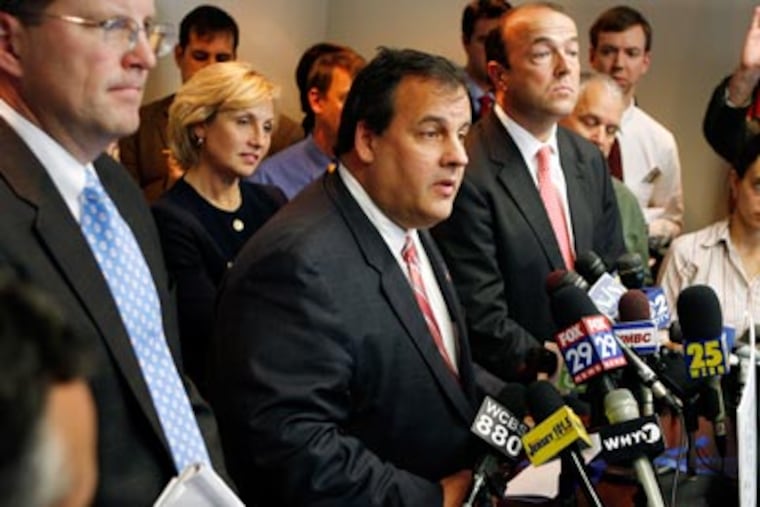
When Democrats return to Trenton tomorrow and choose Senate and Assembly leaders, their new chiefs will gain power, influence, and a role they didn't expect: party spokesmen during a Republican administration.
After Gov.-elect Christopher J. Christie takes over in January, the Democratic message from the capital will emerge from the Senate and Assembly chambers, where the party retains control, instead of the executive suite.
Democratic leaders in the Statehouse - with Gloucester County State Sen. Stephen Sweeney expected to be at the top - will set the tone for the party in public and serve as point people for negotiations with Christie.
The behind-the-scenes maneuvering for leadership slots was largely completed in the summer, before it was known that a Republican would hold the governor's office.
The Democratic heads in the legislature could have "a higher profile than they would have if their party had the governorship," said Jon Shure, communications director under Democratic Gov. Jim Florio, the last New Jersey governor who faced a Legislature controlled by the other party.
When their collaborations with Christie are successful, the legislative officers will be able to claim credit alongside the governor. In debates, they will be the first line of Democratic opposition.
The Senate president and Assembly speaker can put legislation crucial to Christie's agenda on a fast track or stop it from coming up for a vote.
They also will confront emboldened Republican lawmakers who have been stuck in the minority for years and now have a high-placed ally to put political muscle behind their ideas.
"It was a very simple story line when it was the governor, Senate president, and Assembly speaker all in the same party and all in the same philosophy," said Senate Minority Leader Thomas Kean Jr. (R., Union). "I think that going forward there will be a lot more moving parts, and I think that's good for the people of New Jersey."
It is early - the Democratic leaders take office Jan. 12 - but the incoming Senate officers have stressed bipartisanship and cooperation, while at least one ranking Assemblyman has given Christie a rougher reception.
Sweeney, who is in line to become Senate president and the top Democrat in state government, has emphasized his similarities with Christie on issues such as overhauling state employee benefits and controlling taxes and spending. More socially and fiscally conservative than many of his fellow Democrats, Sweeney has said lawmakers should focus on the economic woes that fueled the Republican victory.
"It's actually more important to find areas of compromise," Sweeney, now the Senate majority leader, said Wednesday.
Sen. Barbara Buono (D., Middlesex), the budget chair expected to move up to majority leader, said she also shared Christie's goal of streamlining government.
"Philosophically there may be more agreement with some of us in the Legislature than there had been in the past," Buono said.
Sweeney and Buono hail from blue-collar, middle-class areas that had supported Democrats for years but swung to Christie. Both see the election as a message on fiscal restraint.
The Assembly leadership will come from urban strongholds, where views on spending, taxes, and services tend to be more liberal. Assemblywoman Sheila Oliver, likely to become the new speaker, is from East Orange in Essex County, while Assemblyman Joseph Cryan, in line to step up to majority leader, is from a Union County district that includes Elizabeth, the state's fourth-largest city.
Cryan, who is also state Democratic chairman, put his name on the hardest-hitting shots at Christie during the campaign. Last week he emerged as a continued voice of opposition.
"Having watched the campaign, where I thought there were a ton of unrealistic promises, I intend to hold [Christie] to it," Cryan said. "I'm doing nothing more than the people's business."
The governor's office and 100,000-vote win will give Christie a strong platform for his ideas, but Cryan noted the power Democrats still hold in the Legislature.
"What's going to define the governor out of the gate is the budget, and that's going to come to us," he said.
Florio worked with a Republican Senate and Assembly in 1992-93. In such situations, Shure said, the governor must work with members of the other party, but risks angering his base. And there is a danger that either party might posture in preparation for the next election, when it hopes to gain - or retain - total control.
"For it to work in the best interests of the public, both sides have to want to make it work, and that's not a foregone conclusion," Shure said.
Even one-party rule doesn't guarantee political peace. In Gov. Corzine's first year in office, fellow Democrats in the Assembly rebelled against his sales-tax increase, leading to an ugly public feud.
With the challenges that this state has faced for years, "there's always been a conflict between the front office and the Legislature," said Assembly Budget Chairman Louis Greenwald (D., Camden). "None of us alone can solve these problems."
But in an independent-minded Legislature whose members have divergent opinions and values, individuals do have power to slow down an agenda. A combative committee chair, for example, could begin inquiries into administration activities. Others could stall Christie appointments.
The heads of those key committees will be part of the shake-up that comes with tomorrow's leadership votes. The votes are expected in closed caucus meetings, but are mainly a formality.
The races for Senate president and Assembly speaker were effectively decided over the summer when power brokers in the north and south agreed on a split that will give each region of the Democratic power base a say. While Assembly Speaker Joseph J. Roberts Jr. (D., Camden) is retiring, the Senate transition is expected to come through a coup to oust President Richard J. Codey (D., Essex).
Christie has taken a pragmatic approach, reaching out to key Democratic legislative leaders before he takes office.
In his first major speech since the Nov. 3 election, Christie shared a dais with top Democrats and told hundreds of municipal officials Thursday in Atlantic City that the time had come to "drop the political labels" worn during campaigns. He said that he expected fights on real disagreements, but that there were many areas of agreement, particularly on the need for "change" in government.
"I absolutely believe that I have partners in the Legislature who are ready to help me make that change happen," he said.
In the 1980s, Republican Gov. Tom Kean worked with a Democratic Legislature and succeeded, Christie noted. And Kean "showed me the secret handshake" to make it work.