Sledding his way to success on ice
The players twist around on the ice, leaving behind a trail of snowy white powder. They propel themselves forward, using two miniature hockey sticks to gain speed.
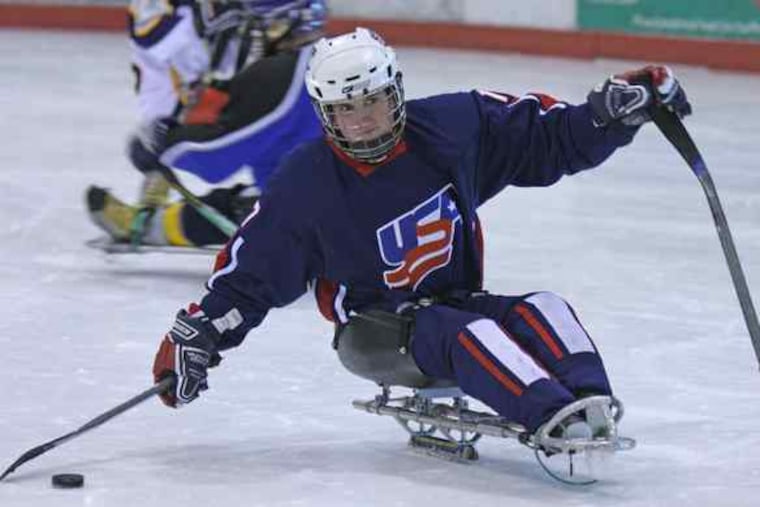
The players twist around on the ice, leaving behind a trail of snowy white powder. They propel themselves forward, using two miniature hockey sticks to gain speed.
This is hockey on sleds, not skates, and Dan McDevitt, a 19-year-old double amputee from Abington, is good enough at it to be captain of the junior national team.
Sled hockey, created in Stockholm, Sweden, is for disabled athletes. McDevitt, who was born with a deformity and had both legs amputated by the time he was 10, began playing eight years ago with a local team called the Hammerheads.
After the 2002 Paralympic Games in Salt Lake City, a junior national team was created for players younger than 20. McDevitt attended tryouts in Rochester, N.Y., and made the team. In March, the team went to Vancouver for the Paralympic Games.
"He's a very personable young man," said Bob O'Connor, head coach of the junior national team. ". . . He's a leader who's concerned about his teammates, and that's why he was chosen captain. He is an exceptional leader."
McDevitt said, "It's just about having fun. To represent your country is a great honor."
The national team players practice occasionally in Rochester. Because the sessions are irregular, O'Connor encourages players to practice shooting and stickhandling on their own and with their local teams.
To play, two regular-size skate blades are attached to the bottom of a metal sled, allowing riders to "skate" on the ice. Each player is allotted two sled hockey sticks, about one-third the length of a standard hockey stick. At one end of each stick is a metal pick, which the player digs into the ice to thrust forward. The rules are mostly identical to standard hockey's.
O'Connor said sled hockey players "probably have more skill than able-bodied hockey players because they have to use two hands. They're ambidextrous, and they go out and compete with explosive skating speed."
In 2001, two of McDevitt's neighbors read an article on sled hockey and told him about the sport.
"I heard about it and thought, 'Oh, cool, a new sport,' " said McDevitt, who graduated from Abington High School in June and is studying electrical technology at the Eastern Center for Arts and Technology in Willow Grove. "I tried it, and fell in love with it."
McDevitt was born with Streeter dysplasia. He was missing all of his toes as well as several bones and tendons in his feet, which were in a "clubfoot" position.
In McDevitt's first nine months, his legs were placed in plaster casts intended to move them into a normal position. When that did not work, he underwent operations every 12 to 18 months that were intended to normalize the shape of his legs.
Because his height and weight became a concern as a result of the defect, doctors amputated McDevitt's right foot when he was 9; at the time, his foot was an infant size 6. When he was 10, doctors amputated his left foot, which was an infant size 3.
McDevitt wears two prosthetics, each up to his knees. Sometimes, the prosthetics chafe against his skin, and he takes them off and uses a wheelchair.
In addition to the national team, he plays on a local team called the "PA Center-Pedes," who practice at IceWorks in Aston, Delaware County.
Unable to play sports before learning of sled hockey, McDevitt recalled the challenges he has dealt with, including learning to walk with prosthetics.
"I looked at myself as an everyday person," McDevitt said. "It was hard blending in with other kids. I couldn't compete with [them], but as I got older, I matured."