Annette John-Hall: Quietly dropping online 'friends'
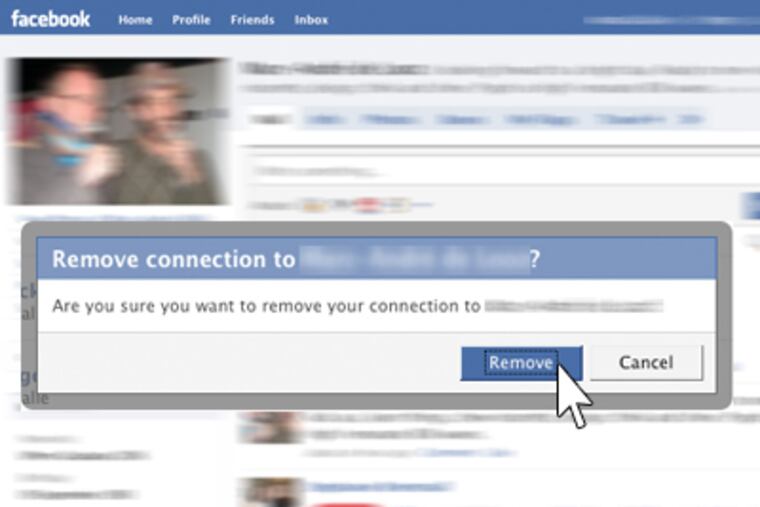
I apologize for not being around last week. I've been busy unfriending. That's right. It's a new year, and I've resolved to put unfriend, the New Oxford American Dictionary's 2009 word of the year, into action.
I apologize for not being around last week.
I've been busy unfriending.
That's right. It's a new year, and I've resolved to put unfriend, the New Oxford American Dictionary's 2009 word of the year, into action.
That's unfriend, opposite of the verb friend, as in: "It just dawned on me that if I don't really know the person who has friended me on Facebook, I can always unfriend him."
With a Facebook friend list closing in on 900, I've been thinking about unfriending a few folks for a while.
Real friend or not, rejection hurts. Having been unfriended myself by a friend of more than 20 years, I hesitate to do it to anyone else.
But this social-networking thing is starting to creep me out.
Not only is it an addictive time drain, but it also can be an intrusion - especially for someone who already has a hard time saying no. Every time I turn around, I'm being asked to join somebody's network at LinkedIn, bombarded by friend requests on Facebook, getting notified that some stranger is following me on Twitter.
I have to admit it must frustrate them anyway, since I haven't tweeted in months. That doesn't mean I won't. For now, I'm just overwhelmed.
Not all bad
Sure, social networking can be a great outreach tool, especially if you're a communicator.
My editor suggested I get a Facebook account two years ago as a way to share my columns. The bigger my network, the more exposure for my work. Sounded like a no-brainer.
And, in many ways, it has functioned better than expected. It's been a great source of information, not to mention an easy way to keep in touch with friends I don't get to talk to often enough.
In fact, a Pew study argues that social media make you more social and involved, partly because you're exchanging ideas with people with whom you have things in common.
But somewhere in the process, the demarcation between friends, acquaintances, friends of friends, sources, and strangers became blurred. Nearly half the people in my network are air-quote friends, that is to say virtual strangers.
It's gotten to the point where it's hard to keep up with real friends if they don't have an online presence.
I'm torn.
How can you feel so connected yet so disconnected at the same time? Feeling the strong pull of technology yet wishing you could jump off the grid?
Especially as private communication gets dispersed into the ether like virtual Post-it notes.
Exhausting
Drew Barrymore's character probably best described it as she tied herself into a technological knot in the romantic comedy He's Just Not That Into You: "I had this guy leave me a voice mail at work, so I called him at home, and then he e-mailed me to my BlackBerry, and so I texted to his cell, and now you just have to go around checking all these different portals just to get rejected by seven different technologies. It's exhausting."
I don't date, but I still feel her pain. Nothing says sincerity like a generic text from an unknown "friend" wishing me a "blessed and prosperous new year." It doesn't feel so good coming from your real friends, either. Imagine, I used to think e-mail was impersonal.
Which is why I'm revisiting old ways of doing things. It's not surprising that crafting undeletable memories through scrapbooking has emerged as the nation's fastest-growing hobby. Sure beats a slide show or a flip through someone's phone.
And I resolve to go back to having real conversations, not shorthand ones filled with acronyms and shared links.
And every once in a while, I resolve to send a handwritten card to a friend - via snail mail.
Go ahead, LOL. Call me old-fashioned.
But what would you rather have? More or meaningful?