When skateboarders grow older
Inside a frigid warehouse in South Philadelphia, where blaring punk music and the thunderous sound of skateboard wheels on birch planks echoes off the metal rafters, Patrick Guidotti is not skating.
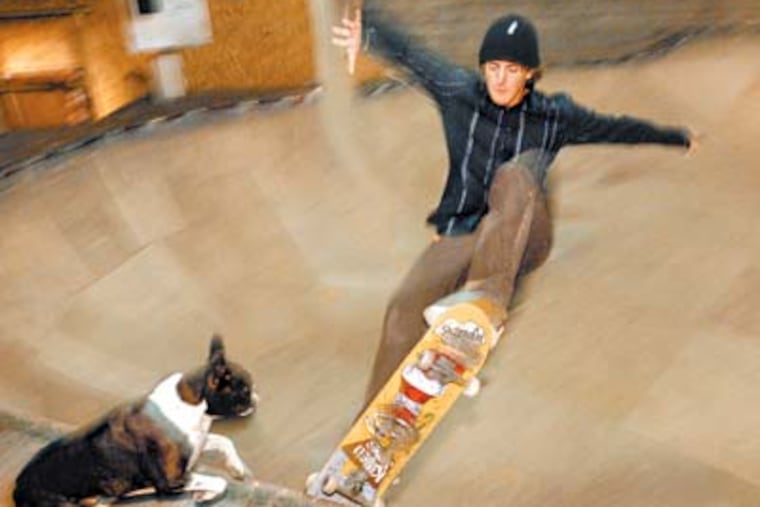
Inside a frigid warehouse in South Philadelphia, where blaring punk music and the thunderous sound of skateboard wheels on birch planks echoes off the metal rafters, Patrick Guidotti is not skating.
He stands on a deck sipping coffee and nursing a foot injury while his friends swoop up to grind the edge of the pocket in front of him. The gaps between the bricks make the coping look like a serrated knife, and the skateboards sound like machine guns firing when they slide over the ragged edge.
At 36, Guidotti is an elder in the skateboarding world. The oldest, actually, of seven guys who showed up last Wednesday night at the winter skate haven known as the Warehouse, a semisecret spot about the size of a basketball court where skaters can duck out of the rain and snow and drop in on wooden ramps, pockets and bowls, built solid as a ship above a concrete floor.
Some of the city's skateboarders pulled together in 2007 to build the obstacles and bowls inside this burgundy building near Washington Avenue. Now, when snow and rain trouble their favorite outdoor spots, they head inside the former cold-storage facility, still a 20-degree icebox on January nights like this one.
About half of the skateboarders are in their 20s, young enough to ride hard and heal fast. A few elders are here, too, recognizable by their wedding bands and the crow's feet visible when they laugh.
Guidotti, whose dark but silvering sideburns peep out from under his hat, is old enough to have a wife, a 3-year-old daughter, and a full-time job working in the printing shop for the New Jersey Department of Health and Senior Services. He's also old enough to carry permanent reminders of skateboarding injuries that didn't quite heal; his right wrist, first hurt at age 17, sometimes pops out of place.
That's why Guidotti is not skating. He fidgets in the cold, his breath crystallizing into fog, as he explains how, a week before, he dislocated his left pinky toe when he pulled up too high on a ramp and twisted himself on the landing.
Got to stay off it, he says, let it heal right.
He stares at a skateboard that rolls up near him, winces, then laughs.
"Skating doesn't make you a skateboarder," he says, quoting Lance Mountain, a skateboard legend in the '80s. "Not being able to stop skating, that makes you a skateboarder."
For men like Guidotti, skateboarding isn't a phase, isn't an urge that goes away with age, injury, or a life otherwise packed with meetings, anniversaries, and play dates. Skateboarding is an escape, a place where he can always feel young.
"Skating is when time pretty much stands still. I'm really not thinking about anything else in my life at that moment," he says.
Another veteran skater on the boards this night is Scott Kmiec, 35, without whom the Warehouse would likely not exist. After all, it costs money. And age and experience are not without benefits.
Kmiec, who runs his own graphic design business and owns a home in South Philadelphia, had good-enough credit to sign the $1,630-a-month lease for the building.
Then he created a corporation to own the building and protect him from liability. To cover the rent, he drew up contracts for 20 "keyholders," who pay $100 a month for full access to the place. They had to agree to his rules, including no graffiti, a regulation that would be considered absurd at skating spots like FDR, a lawless concrete skatepark in South Philly.
"It's really tough to still be cool with everybody but to still hold down some regulations," he said.
Another elder, Carlos Baiza, 37, the mastermind of FDR, designed the Warehouse, a marvel of planning and carpentry, which cost the skaters $14,000.
"You climb the stairs and you're just instantly blown away," Guidotti said. "It's almost like when you're a kid, you fantasize about being able to skate a place like this. Now, you're older, you have the means to actually build it. That's the benefits of age."
Still, getting older makes skating harder, not just the injuries but finding time.
"Now I'm on the clock when I skate," said Joe Operhall, 35, who lives in Mount Airy and has two children, ages 10 and 3. "It's a finite amount of time."
That's how "Old Man Night" or "Dad Night" evolved. When the weekend winds down on Sunday nights, the early- to mid-30s crew - after getting the nod from their wives - heads out for a few hours at the Warehouse.
For guys who are now adapting to a more child-friendly lifestyle - sharp corners padded, hazards locked up - it's freeing to go down a dark alley, rattle a metal garage door, and be greeted by a cacophony of Norwegian black metal music and the whistles and shouts of your friends.
"This is pretty much the way it needs to be," Operhall said.
Tonight, after a couple of hours, the young guys have warmed up and are down to T-shirts, their cheeks rosy. Guidotti sets down his coffee and fusses with the music, putting on the metal music he loves to hear while skating. He sits down. He stands up.
When Kmiec sits down to take a breather, Guidotti grabs his board. He drops in and rolls around the pockets, a serene look on his face.
"Eh, can't hold him back," Kmiec says. "He's taking it easy, though."
But before long, Guidotti is grinding along the bricks, the rat-a-tat-tat of the friction bouncing off the metal beams as the other skateboarders slap their boards on the deck to cheer him on.
Finally, Guidotti sweeps back and hands the board to Kmiec.
"Take this from me. Now."
Did he hurt himself?
"Actually, I didn't," he says, but "I can see where it's going."