Steering driver's ed back into schools
Driver's ed classes, once a mainstay in the teen voyage to a license, have become costly, rare, or nonexistent in suburban Pennsylvania high schools, as they have around the country.
Driver's ed classes, once a mainstay in the teen voyage to a license, have become costly, rare, or nonexistent in suburban Pennsylvania high schools, as they have around the country.
Buffeted by competing educational demands and budget pressures, only four of the area's 64 school districts and the Chester County Intermediate Unit offered a driver's education program that included behind-the-wheel instruction in 2009, according to data from the Pennsylvania Department of Education.
Fourteen districts, including Philadelphia, provided classroom-only instruction.
But new approaches and technology may help jump-start this former rite of passage if funding can be found.
The decline stems from studies in the late 1970s and early '80s that failed to show driver-educated teens had lower crash rates, according to the National Highway Traffic Safety Administration.
The agency dropped driver's education from its list of priority programs, and federal funding disappeared.
"Since driver education is embedded in our culture and relied upon by families as a way to prepare their sons and daughters for licensed driving, this is a disappointing situation," NHTSA said in a report in April.
In 2008, about 3,500 people in the United States ages 15 to 19 were killed and more than 350,000 were seriously injured in motor-vehicle crashes, according to the Centers for Disease Control and Prevention.
Working to cut those numbers, states have turned to options such as graduated licensing, special tags on cars with new drivers, and passenger limits.
But some feel that driver's ed deserves more credit, and that accident rates did not drop decades ago because teens taking the courses were allowed to drive at an earlier age.
"The combination of driver's education and graduated licensing is a good one," said Jim Nichols, a safety consultant and former director of NHTSA's Office of Behavioral Safety Research. "I think driver's ed has a much better opportunity to be effective."
In an era of limited resources, he said, he hopes the "vulnerability" of young people will free up some funding for programs.
"We believe that driver's ed should be an essential element of public education," concurred Catherine Rossi, a spokeswoman for Mid-Atlantic AAA.
Noting that novice drivers still incur more fatalities and injuries per mile than other age groups, Rossi said AAA would like driver's ed reestablished as a federal priority so states could implement standardized courses that increased behind-the-wheel training.
Rossi, among others, said high-tech simulators should play a role.
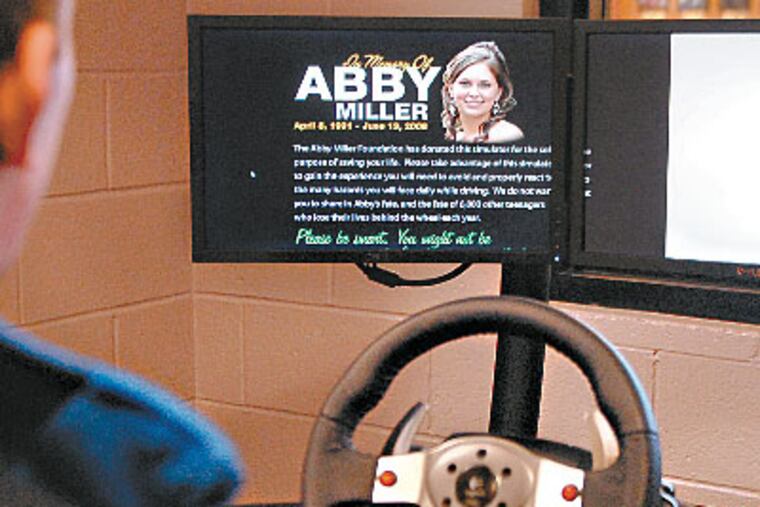
At Unionville High School in Chester County one recent morning, students crowded around a row of three consoles equipped with large monitors, reminiscent of a video arcade.
Within seconds of grasping a steering wheel, a 15-year-old girl was going so fast she veered out of her lane into the path of an oncoming bus.
A few feet away, a 16-year-old observing the speed limit still managed to slam into a pedestrian.
"She walked right in front of me," insisted Richard O'Neill.
Fortunately, the only negative consequence - besides onlookers' gasps - was that the simulation programs aborted, forcing a restart so students could learn how to avoid such accidents.
The $15,000 machines were donated last month by the Abby Miller Foundation, a tribute to the Unionville High junior and volunteer softball coach, who died June 13, 2008, when she swerved to avoid a deer.
Investigators attributed the crash to "inexperienced driving." The 17-year-old had had her license less than nine months.
Miller's parents, Brian and Cheri, said the genesis of the foundation had come during her memorial service.
"Between 1,300 and 1,500 people showed up. That's how many lives Abby touched," Brian Miller said. "We realized we needed to continue her work."
Like the family of Ryan Fitzpatrick, a Burlington County teen who died in April after losing control of his SUV, the Millers were drawn to simulators as a way for teens to get driving experience in a safe setting.
The Fitzpatrick family has donated three machines to Shawnee High School in Medford and plans to buy more; the Millers have delivered three machines to Unionville and three to Garnet Valley High School in Concord Township, marking the start of their crusade to save lives.
(The Methacton and Perkiomen Valley School Districts, both in Montgomery County, and the Palisades School District in Bucks County offer complete driver-training programs at a cost to parents of $150 to $290; Unionville charges $275.)
Brian Miller, who works in the environmental-services industry, said the foundation was fostering the return of driver's ed to schools.
"People are amazed when I tell them what's happened to driver's education."
He said it's only common sense that the more practice students get, the safer they will be on the road.
Extensive research on the benefits of simulators has yet to be done, but many experts tout their benefits.
Safety consultant Nichols, who stressed the value of practicing high-risk scenarios, called them "an effective complement to a comprehensive driver's ed program."
Steve Cebulka, who ran the driver's ed program for one of Delaware's largest school districts for 38 years before retiring in June, said he was also a huge fan.
He's convinced that driver's education - a state mandate since 1967 - has made a positive difference in Delaware, where only driver's ed teachers determine which drivers younger than 18 get licenses.
Simulators are now used in half of Delaware's schools.
"It's not a Mickey Mouse program," he said. "And if you don't pass it, you don't get a license."
Cebulka said the chances that a 16-year-old from Delaware would be involved in an accident were more than 60 percent below the national average.
Dave Listman, Unionville's technology support specialist, who oversees the simulation project, was initially skeptical.
"I was afraid it was going to be like a video game," he said. "It's not."
The program opens with Abby Miller's story, presents practical lessons such as proper mirror alignment, then challenges students with ever tougher conditions such as darkness and snow, Listman said.
By the lesson's end, the 16-year-old who'd had a slew of accidents in 15 minutes skillfully slowed to avoid another mishap when a roadside deer caught his eye.
"It's very realistic," O'Neill said. "I think it's going to be helpful."
That kind of attitude - and the knowledge that they are keeping their daughter's spirit alive - helps the Millers endure her loss.
"We want to help other people avoid the agony we've had to go through," Cheri Miller said.