A poetical snowy day in Chestnut Hill
On a fairy-tale day, hushed and ethereal, Chestnut Hill played the snow queen of the city. Elegant and self-possessed, the enclave, in the northwest corner of Philadelphia, rarely appears in public looking anything less than lovely. But yesterday, she was exquisite beyond words.
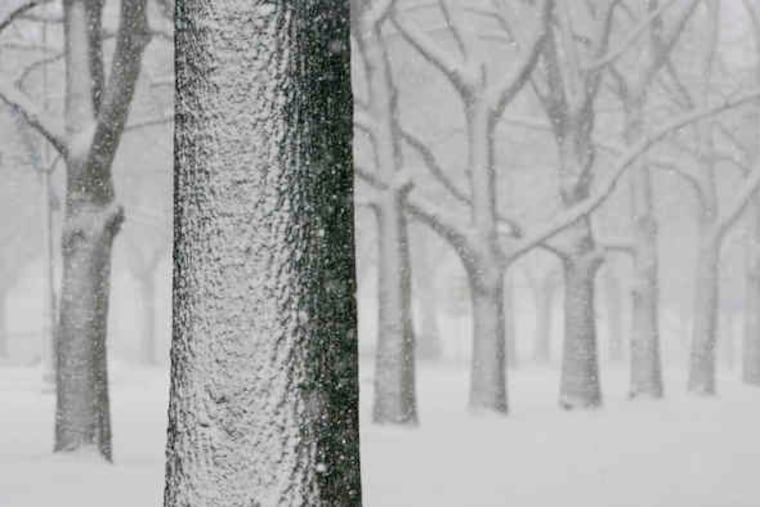
On a fairy-tale day, hushed and ethereal, Chestnut Hill played the snow queen of the city.
Elegant and self-possessed, the enclave, in the northwest corner of Philadelphia, rarely appears in public looking anything less than lovely. But yesterday, she was exquisite beyond words.
Trees curtsied deeply in her royal presence. Her knights rode plows to clear paths through her domain.
And Josiah Albrecht repaired one of her forts.
Josiah, 6, and his sister, Evangeline, 2, had worked hard earlier in the week to build the defensive post outside their house. With help from their father, Jim, a 42-year-old freelance writer who had grown up in Anchorage, Alaska, they went to work on its resurrection.
Under the direction of their mom, Alena Villari, E dug with her hands and Josey with a baseball bat.
Although the family returns each summer to visit relatives, the children have never seen Anchorage in the snow.
"Josey's been wanting to go to Alaska all winter," Villari said. "Now, it's like Alaska came here!"
Next door, Mary McFadden, stepped out onto the porch. A frail woman in her early 80s, she hugged her heavy coat and watched the snowfall.
"Hi, Mary!" Villari said. "Are you OK?"
The woman nodded, and after a moment asked, "Did you shovel my sidewalk?"
Villari couldn't take credit, she said. Other neighbors had pitched in.
Unlike South Philadelphia, where every shovelful holds the potential to create a diplomatic crisis (one person's cleared sidewalk is another's blocked car), in Chestnut Hill storms like yesterday's can create more goodwill than tension.
"It's good to be a good neighbor," Jack Kelly said as he plunged his ergonomic shovel into the drifts leading to the house next door. Next door being the rough equivalent of 46 rowhouses.
Kelly, 52, associate chairman of the emergency department at the Albert Einstein Healthcare Network, has lived on Seminole Street for 16 years and considers it "the best street in the city." The woman whose sidewalk he was clearing is in her mid-60s, he said. "Her husband died a few years ago, and she's sweet," he said. After he shoveled the snow away earlier in the week, she'd come over with a fresh batch of homemade fudge.
"We all trust each other and look out for each other," said Kelly.
He stopped to appreciate the view. The wide road was empty, except for a lone figure walking under the high arch of trees, retreating into the distance, his black coat a silhouette against the scrim of snow.
Glistening flecks caught in Kelly's white mustache. "It looks like we're deep in the wilderness," he said.
Several streets farther east, Jim Querry took his dogs for a run in Pastorius Park. The park's scuzzy pond, a favorite swimming hole for Chestnut Hill's golden retrievers and black Labs, was glazed with ice. Only a few dogs and their obedient owners dotted the field, which is normally overrun by packs chasing tennis balls, sticks, and Frisbees.
Querry, 45, does computer mapping for the city. "We map everything," he said. "Including the tree that just fell down over there. And there's another one that's about to go."
On cue, a loud crack could be heard in a grove of tall pines. "There it goes!"
He proceeded to tell the long, complex stories of how his mutts, Molly, 3, and Indy, 7, had come into his care. (Abridged versions: He met Indy, a black-and-brown terrier-ish survivalist, in a North Philadelphia SEPTA station and won his trust with liverwurst over several months. "He's the best dog ever," Querry said, then patted Molly. "Present company excepted." Molly, skinny, short-haired, and currently shivering, came from the streets of her native Sicily with help from Querry's brother, who was posted in Italy for the Navy.)
Holding the dogs' leashes in his thickly gloved hands, Querry started toward home. His usual route, however, would have led them under a massive evergreen that was listing at a 45-degree angle.
He pulled out his cell phone to dial 311.
"I'm just calling to report a tree that's about to fall down. . . . OK. . . . Yes. . . . A large pine. Close to the street. When it goes, it will block the whole street, taking the wires with it. They could be power lines. Some of the branches are already touching the ground."
The dispatcher said she'd route the call to Fairmount Park.
"Terrific!" Querry said, leading his dogs in a wide, prudent circle around the tree.
Passing by stately stone houses, one could see bright flashes from wide-screen TVs. The smell of smoke from fireplaces filled the neighborhood. The only sounds were the rustling of nylon sleeves on down jackets and the occasional weird rumbling of thunder.
On Germantown Avenue, businesses had been valiant. The lights were on in Starbucks and Chestnut Hill Coffee, Omaha Steaks, and the Antique Gallery. Other than the cafe crowd, not many customers showed up, though.
The busiest cash register in town was behind the counter at Kilian, the village's traditional hardware store. By noon, about 30 customers had come in to buy ice-melting salt, lightbulbs, and a shovel.
The Postal Service carried on. Letter carrier Mark Chernyk could be heard whistling Jethro Tull as he drove his white, half-open truck past the recently shuttered Borders bookstore. He stopped to greet one of his customers, who asked if she could take her mail from him then and there.
"No problem," he said, handing her the small stack.
"I love the snow," said Chernyk, 47. "It actually makes the job easier. There are fewer people driving."
Snowy winters, he said, "break the monotony of cold, gray days. And Chestnut Hill is beautiful."
But by late afternoon, the snow queen seemed to disappear under the sweep of a white cape.