Kevin Riordan: COAH face-off not nearly over
His life's work is under fire, if not siege. Again. Peter O'Connor, the lawyer whose eloquent advocacy of affordable housing is enshrined in the New Jersey Supreme Court's Mount Laurel decisions, sees a "knockout attempt" coming. So he's already counterpunching.
His life's work is under fire, if not siege. Again.
Peter O'Connor, the lawyer whose eloquent advocacy of affordable housing is enshrined in the New Jersey Supreme Court's Mount Laurel decisions, sees a "knockout attempt" coming. So he's already counterpunching.
"A lot's going on right now," he says wryly, noting that the Republican governor and a bipartisan duo of legislators are pummeling away at the state's Council on Affordable Housing (COAH).
Last week, Gov. Christie issued an executive order freezing the council's operations and proclaiming the end of the "COAH nightmare." O'Connor's Fair Share Housing Center filed a motion yesterday, seeking to invalidate the order.
Meanwhile, Sen. Raymond J. Lesniak (D., Union) and Christopher "Kip" Bateman (R., Somerset) aim to legislate COAH out of existence ("unconstitutional," objects O'Connor). Their proposal would give municipalities more say in affordable-housing decisions.
Why not get rid of a cumbersome bureaucracy and trust local communities to do the right thing, counselor?
"COAH is just a scapegoat," he says. "The crux of the problem is that the suburbs and the political people in them do not want to open their doors to low- and moderate-income families."
COAH-bashing, O'Connor insists, provides cover for politicians to say they favor affordable housing - while hoping to impede it. "They're only in favor if it's not in the suburbs. People feel that if they have the money to live where they want to live, they can pull up the drawbridge and exclude other people."
The Mount Laurel rulings of 1975 and 1983 not only prohibit exclusionary zoning, but require municipalities to actively provide for affordable housing. The state's Fair Housing Act of 1985 essentially set up COAH as an enforcer.
"I'm not sitting here saying no progress has been made," says O'Connor, who was 25 and fresh out of Georgetown Law School when he began fighting for affordable housing in New Jersey in 1967.
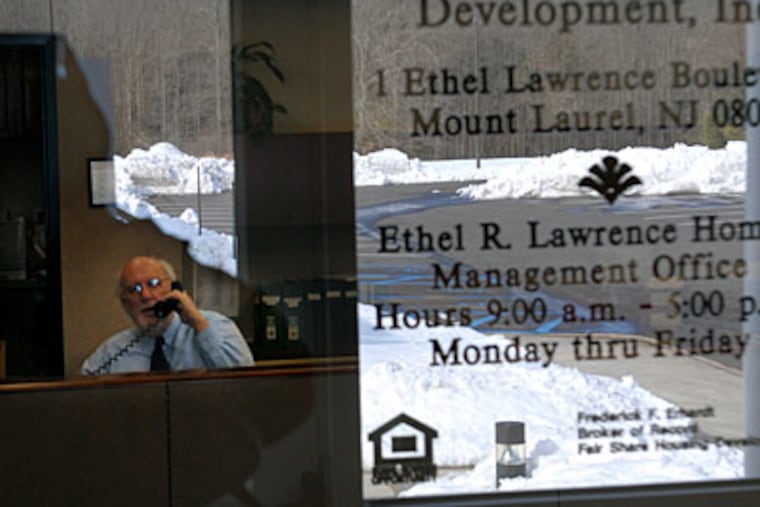
Now a 67-year-old Haddon Township resident, he heads an organization that has built and manages 656 affordable rental units, including Ethel R. Lawrence Homes (named for an original plaintiff) in Mount Laurel. An additional 338 units are in the pipeline.
More and more people need affordable housing, O'Connor says, especially in today's economy.
While public opposition is nothing new, "for the first time we've got a governor expressing total opposition to the Mount Laurel doctrines themselves," he says. "But the New Jersey Supreme Court has not wavered in standing behind these doctrines, and we expect ultimately to ask the court to do two things: to knock down these challenges and assume more control."
In other words, stand by for more litigation.
"I never thought it would be easy," O'Connor says. "I also never thought it would take this long. And I also thought that once there were some positive examples of affordable housing, like the Ethel Lawrence Homes, this would be seen as a path forward."
What blocks that path is not the real or imagined shortcomings of poor people, he says, but the failure of elected officials of both parties to tackle the state's property-tax, school-funding, and pension-obligation issues.
"You ask me if I'm frustrated? I'm more upset that no one's sitting down to try and solve these problems," O'Connor says. "It's just: Who can cut more, and who can we blame for the sins of the past?"
The fact that affordable housing is still a public issue in 2010 "suggests to me a lack of moral leadership," O'Connor says. "It suggests a failure to recognize that we're all brothers and sisters, and that the moral thing to do is to open one's doors to help families get to better schools and have a better chance of becoming productive citizens."
I don't for a moment doubt O'Connor's sincerity. I do wonder whether another epic court battle will get the needed homes built any time soon.
Not just for "them." For us.