A tough judge takes on flash-mob cases
There were two brothers, sons of South Philly. One grew up to be a tough-talking union leader, political power broker, political candidate.
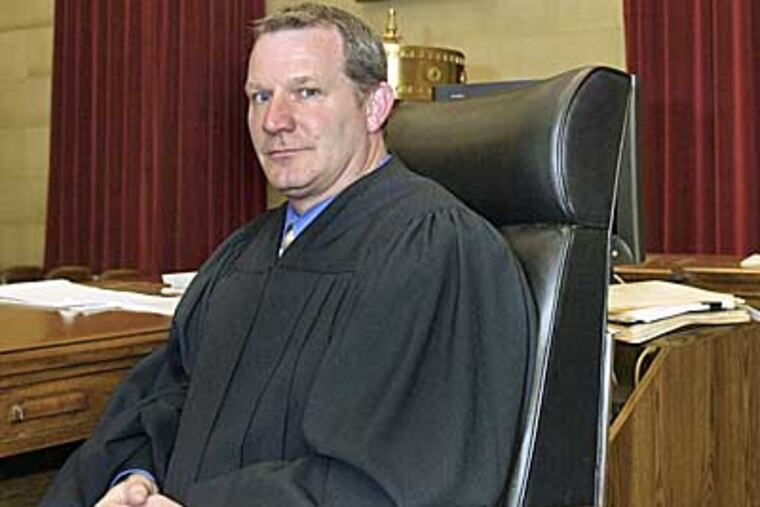
There were two brothers, sons of South Philly.
One grew up to be a tough-talking union leader, political power broker, political candidate.
The other took a quieter route, went to law school, and ultimately became head judge of Philadelphia's juvenile and family courts.
After the last few days, however, few would dispute that Judge Kevin M. Dougherty shares a few candor genes with older brother John "Johnny Doc" Dougherty Jr., business manager of Local 98 of Electrical Workers Union.
"I'm not playing. The days of civil unrest are over," the judge warned 10 teenagers Monday.
He found all 10 guilty of felony rioting and conspiracy for their roles in a Feb. 16 "flash mob" in Center City. That incident - teenagers drawn to one location by text messages or other social media - was one of a series of flash mobs over the past 10 months, and it featured 150 teenagers who had been expelled from the Gallery shopping mall later rampaging through Macy's, fighting and breaking items.
"You all want to play me and say you went down there shopping," Dougherty told the teens. "I'm not believing you."
If Dougherty's stern candor recalls his outspoken brother, those who know him say the comparison is superficial.
"I am not confusing him with his brother," said Lynne Abraham, the former long-term city District Attorney. "This was all Kevin. He is a totally different entity."
Dougherty, 46, worked in Abraham's office as a prosecutor from 1990 to 1995, after he was admitted to the Pennsylvania bar.
Dougherty's former boss describes him as one of those judges who combine legal and administrative skills with a love of the city and a well-traveled knowledge of the streets and the scams they generate.
"You know he's a man who speaks his mind," Abraham added. "He runs his courtroom, and he is not out there for somebody who wants to trifle with him or the system."
Abraham's successor, Seth Williams, has a similar assessment of Dougherty, whom he met in 1992 when Williams joined the District Attorney's Office.
"He's a very passionate person about this city," Williams said. "He knows stuff about the neighborhoods. These kids couldn't lie to him because he knows the truth about growing up in the city."
The juvenile-court system is an odd mix of crime and punishment that gives judges extraordinary ability to take control over juveniles and try to prevent them from becoming criminal adults.
Though the court's mission is to protect and rehabilitate children who have fallen into criminal activity, judges can also incarcerate youths until they turn 21.
One 15-year-old student from Simon Gratz High School learned that on Monday when Dougherty warned him he would get a year in the juvenile system for every lie he told. The youth left in handcuffs with a three-year sentence.
"I think what he's done is spectacular," said Lynne Z. Gold-Bikin, a veteran Montgomery County law and expert in family law and a former chair of the American Bar Association's family law section.
"I think it's about time we start taking strong action against some of these kids who are out of control," Gold-Bikin said.
If Dougherty is taking a tough stance with the flash-mob juveniles, his nine years as a Family Court judge - six as administrative judge - demonstrate a comprehensive view of juveniles who get in trouble with the law.
A graduate of Temple University and the Antioch School of Law, Dougherty has long been involved in juvenile justice, including two years before he was named judge as a special master in the city's Family Court Truancy Program.
Last March, he and Abraham held a news conference announcing an anti-gun-trafficking program focusing on adults who make "straw purchases" of guns for children.
Four years ago, Dougherty was with Mayor Street and then city schools chief Paul Vallas in sending 6,000 letters to the parents of 12- through 18-year-olds with eight or more illegal absences. The letters ordered the parents to appear at Temple University's Liacouras Center for a lecture on parental responsibility and truancy - or face fines or jail.
And even when he committed teenagers to state institutions during this week's hearings, Dougherty made sure they understood that he was not sending them there as punishment, but in hopes they could turn their lives around.
He told one mother that her son, after his sixth arrest, was on his way "to an early grave."
"I can't have that," he assured her.
To a 17-year-old Bartram High School student, Dougherty said: "You look me in the eye. You have everything it takes to be a success. What can be done with you so that you have a future?"
Marsha L. Levick, legal director of the Juvenile Law Center in Philadelphia, which advocates for children's rights in the justice system, said one of the most important things Dougherty had done was, as the city's top juvenile judge, to take on the flash-mob cases himself instead of wheeling them among other juvenile judges.
"I call that a very good sign," Levick added.
As long as the juveniles' rights to legal representation and due process are protected, Levick said, "it is certainly an appropriate response to what is illegal conduct.
"This is a very high-profile situation and kids need to be held accountable for their actions."
High-profile is the word, and city officials have said they worry about the impact the flash mobs might have on Center City's hard-won reputation as a safe, attractive destination for visitors.
"I think what Kevin makes clear when he speaks to these defendants is that he understands what the community is feeling," Abraham said. "And what the community is feeling is not just what the black community, or the Latino community or the Asian community or the Southeast Asian community is feeling. He understands that the community is frightened."
Staff writer Troy Graham contributed to this article.