Kevin Riordan: Rehabbing Camden's Waterfront South with art
There's a new art gallery on Broadway. In Camden. At the Rescue Mission. "It's got people buzzing," says the Rev. Al Stewart, the mission's longtime pastor.
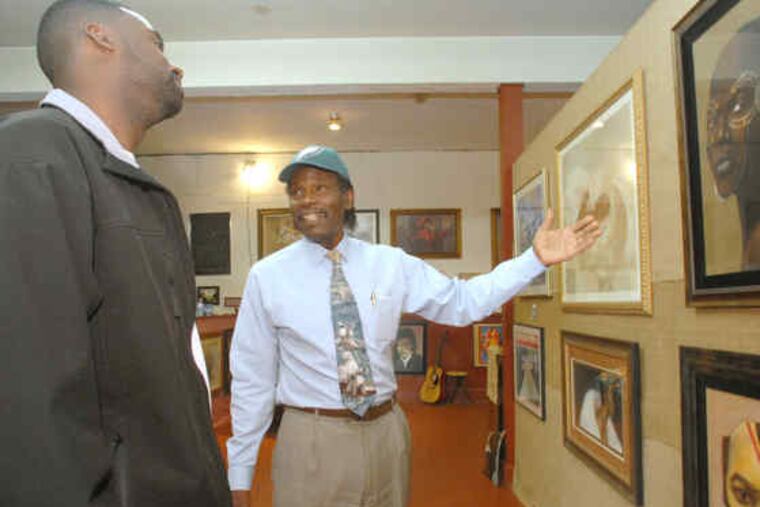
There's a new art gallery on Broadway.
In Camden.
At the Rescue Mission.
"It's got people buzzing," says the Rev. Al Stewart, the mission's longtime pastor.
There's lots more to talk about: the cluster of arts and cultural organizations slowly emerging around Broadway and Ferry Avenue in the city's down-but-not-out Waterfront South neighborhood.
Three blocks from the Camden Rescue Mission at 1634 Broadway, painter Mickey O'Neill McGrath has opened a studio and gallery. He's across Jasper Street from the 96-seat theater the South Camden Theatre Company will debut Sept. 10.
Meanwhile, the Heart of Camden - a catalyst for rebuilding Waterfront South since the 1980s - is renovating the long-moribund Star Theater at 1842 Broadway into a community center. Founded by Sacred Heart Church, the community development organization also is helping convert the former Church of Our Saviour at 1910 Broadway into the Camden Shipyard and Maritime Museum.
"We are transforming the community," Stewart declares. "We can change Camden with art."
With all due respect to the good preacher - and to art, for that matter - it's premature to talk about change of that magnitude. Waterfront South ain't no SoHo (or Manayunk either).
The neighborhood's major industries may be history, but Waterfront South is still home unsweet home to the Camden County sewage-treatment plant.
And let's just say the people hanging out on Broadway after dark aren't there to buy and sell paintings.
Nevertheless, "there is a kind of synergy happening in the neighborhood," says Michael Lang, the Maritime Museum's project director. The handsome old church, constructed of ballast stones from the ships of noted explorers Robert Peary, Josephine Peary, and Matthew Henson, already has become a hive of sailboat-building and other boating-related activities for local youth.
"There's quite a list of things going on when you put all the pieces together," Lang says.
Joseph Paprzycki, SCTC's producing artistic director, sees the arts leading the way to Waterfront South's renewal.
"A lot of rebirth follows the arts," says Paprzycki, who knows a thing or two about making a long-shot dream a reality. The new theater is rising on the site of a long-abandoned bar once owned by his grandparents.
Paprzycki rightly notes the neighborhood's abundance of cheap real estate is an asset - and, indeed, it's one reason McGrath moved his studio there from Philadelphia.
"I'm able to hang all of my work on the first floor," the artist says. "I feel like I've died and gone to heaven."
Stewart, whose bright white-and-aqua mission complex is a Broadway landmark, says the art gallery grew out a conversation with a formerly homeless artist named Jay Fuentes.
"This is one of his," Stewart says, pointing to a portrait of a regal-looking woman. It's one of more than 100 pieces, including 24 works by artists such as Moorestown's Cal Massey and Camden native Dennis Jones, neatly displayed inside the mission's thrift shop.
"Now, every homeless guy has a tall tale, and Jay was telling me about all the fabulous artwork he'd done," Stewart continues. "I had a little wrinkled-up picture of my mother, and I said, 'If you're so good, paint this.' It came out better than what I gave him. That's when I understood that he had art."
The gallery officially opened during Black History Month, and much of the work has African or African American subject matter. Plans include sidewalk sales outside neighborhood churches on Sundays.
Charles Cook, who heads the Sicklerville-based African American Fine Arts Society, sees the gallery as a way to expand the audience for art.
"The main thing is to educate the community," says Cook, who teaches art at Winslow Township High School.
The existence of a gallery - not just in Waterfront South, but in a rescue mission in Waterfront South - has surprised some people (including me).
"People come in and say, 'Wow,' " Stewart says. "We've made a number of sales, and some folks have bought on layaway."
Likewise, rebuilding a neighborhood, particularly one as economically exhausted as Waterfront South, is an incremental process.
"It's slow but sure," Lang says. "It's not a switch you turn. It's not some megaproject. It's people doing things to make it happen."
It's going to take plenty of creativity and imagination, too. Because rebuilding Waterfront South is no paint-by-numbers job.