Daniel Rubin: Pool and pastels for a 99-year-old wonderboy
Leo Weisz has been an artist for 70-plus years.
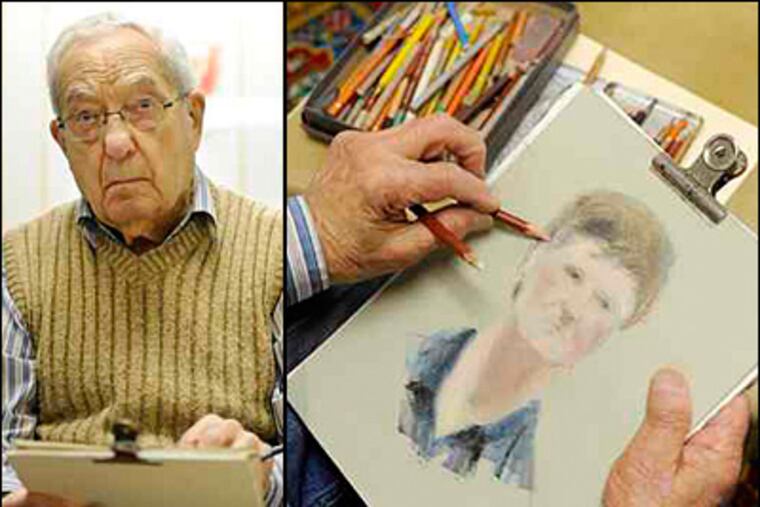
"Let's go to work," Leo Weisz snaps at 10 o'clock sharp, and all talking ends, replaced by the scratch of pencil and pastel against paper.
Eggs take shape on sketch pads, rough ovals that start to bear the likeness of Sheri Keshishian, the model for this morning's drawing class at the Green Hill condo in Wynnewood. She was selected for the honor because at 54, she's one of the building's youngsters and best at sitting still.
Eight artists face her in a semicircle, their ages ranging from 72 to 99. The patriarch of the group is Weisz. No eggs for him. He goes right for the triangle formed by the woman's eyes and nose.
He has four drawings at the Woodmere Art Museum in Chestnut Hill, and has worked for 70 years as a commercial artist. On his next birthday, in February, Weisz will be 100. He's also the condo comedian.
"The only reason I retired from Acme, where I ran the ad department for 40 years, was because they moved the department from Malvern to Phoenix, Arizona," he says, "and that's too big a commute for me."
Monday is his favorite day of the week. After his hour of sketching, he goes upstairs to his apartment for lunch and chess with his friend Alphonso Sattinger, 80. Then they hop in Weisz's gold Toyota Camry and drive to a billiards parlor for a few games of pool. "So I still have a pretty good life," says Weisz, a widower and great-grandfather with a lady friend who brings him soup - a concoction of meat and vegetables he never tires of.
"We've been going together 23 years," he says. "People ask why we don't get married. She doesn't like my furniture."
Weisz's City Avenue apartment is wall-to-wall artworks - all his, of multitudinous subjects, in varying styles, most bearing price tags of a few hundred dollars. He has so many framed portraits and landscapes and still lifes that he displays some in his spare shower.
The pictures without price tags are the sentimental ones - a self-portrait or two, a drawing of his sister Esther. He is the only survivor of seven children.
Weisz is the oldest of 200 Philadelphia-area artists whose works are featured this month in an exhibit called "Celebrate Arts and Aging." His painting Water Break, inspired by a postcard his daughter sent him from Greece, is on display at the Rotunda, an art center at 40th and Walnut.
His Monday class is filled with fellow artists, from those trained at the academy to ardent hobbyists. Weisz holds two instruments at once in his sturdy left hand, pencil and pastel, with the spare resting like a chopstick in the V between forefinger and thumb.
He learned that skill at the Philadelphia Museum School of Art (now the University of the Arts), where he won a scholarship. His father ran a five-and-dime at 60th and Girard for a half-century.
It was there that Leo Weisz's talents were discovered.
"My father used to shave off the wooden bottom of a window shade and use that stick for calligraphy," recalls Weisz, a kindly man with wavy snow-white hair and a face almost free of lines. He'd dip that stick in a barrel of ink and make price placards for the merchandise.
As a boy of six or seven, Weisz used the sticks to copy his father's work. He graduated to pen and then paintbrush, doing such excellent lettering that his father worried his signs would look too fancy for the store and customers would expect prices to rise.
He's worked ever since graduation in 1933, starting out by drawing and laying out posters and advertisements for the old theatrical companies on Market Street, such as Warner Bros. and Fox. To this day he works on projects - the latest for a copywriter who lives in his building.
Thirty years ago Weisz had hired Sattinger, who would become his billiards buddy, to work at Acme Markets. Weisz gave the Romanian immigrant a job as a pasteup man. At first, he could barely understand Sattinger, but he recognized his talent. Sattinger had made book jackets at home, beautiful work. Weisz recommended the man for a commercial artist's job with another company.
Sattinger brought to Monday's class a poem he wrote about his friend. It begins:
Diminished power, increased strength.
Blurry sight, clearer vision.
Shaky gait, firm resolve. . . .
A half-hour into the exercise, Bernie Mason, 90, is done. His drawing is strong. "My knees can't take it any longer," he says, packing up. He worked as a commercial artist, too, and sports a Villanova sweatshirt and ball cap. He got his degree after retiring, and when his wife encouraged him to order a class ring, the girl at the jeweler's asked his graduation year.
Ninety-five, he told her.
She looked at him. "1895?"
As many in the class labor over their lines, Weisz seems more absorbed by shadows, spending much of his time shading the hollow under the model's chin with brown pastel. Others are moving on. He's still working, deep into it.
The last touch he adds is the outline of the model's aviator glasses - the thin white pastel suggesting the rimless edge of her lenses.
"OK, that's it," Weisz announces at 11 o'clock sharp. It's time for lunch and chess and a few games of pool, the remainder of his favorite day.