Historic church, West Chester neighbors at odds, again
Preservationists in Chester County find themselves at odds with an unexpected adversary: a historic church in downtown West Chester. The First Presbyterian Church of West Chester - on the National Register of Historic Places since 1972 - wants to expand, and two mid-19th-century rowhouses on West Miner Street lie in the path of bulldozers.
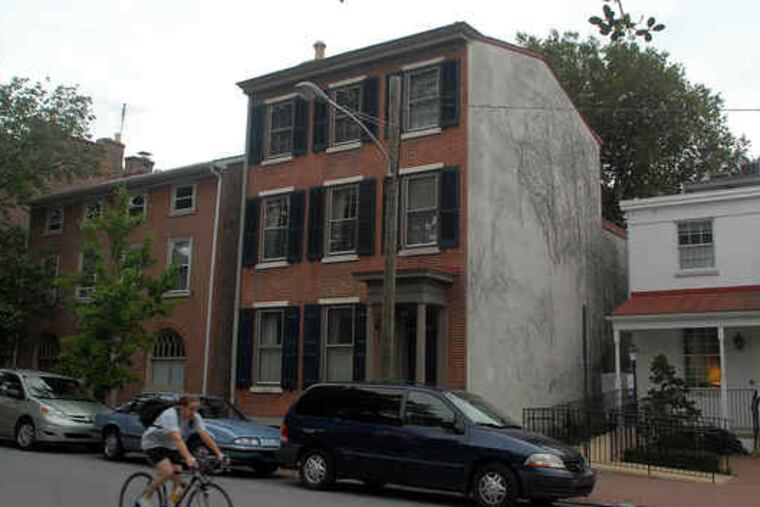
Preservationists in Chester County find themselves at odds with an unexpected adversary: a historic church in downtown West Chester.
The First Presbyterian Church of West Chester - on the National Register of Historic Places since 1972 - wants to expand, and two mid-19th-century rowhouses on West Miner Street lie in the path of bulldozers.
The church, which dates to 1834 and occupies a corner of Darlington and Miner Streets, owns the buildings, which are in a densely populated, residential section of town frequently showcased on walking tours.
The controversy came to light in 2006, shortly after the church, designed by the renowned Greek Revival architect Thomas U. Walter, bought the contiguous properties for a planned addition and promised not to destroy them.
The church expansion plans ran afoul of borough ordinances, particularly over parking, and a protracted battle ensued. The church accused West Chester of unconstitutional zoning and threatened to sue under the federal Religious Land Use and Institutionalized Persons Act if the borough did not change the ordinances, which it did, according to borough minutes.
Now the conflict - complete with lingering acrimony - has resurfaced. Plans to add 18,000 square feet to the church's 44,000 are before the Planning Commission, and borough officials say that parking concerns - less stringent than they were in 2006 - may be all that stand between the rowhouses and a wrecking ball.
"If the church complies with all the borough requirements, there won't be anything we can do to stop the project," said West Chester code enforcement officer Michael A. Perrone, acknowledging the crowds of dismayed residents at recent Planning Commission meetings.
"It's so sad that they can't consider the historic value of these homes," said Laddie Keitch, who lives with her husband, John, across the street from what could become a demolition zone. "We tear down historic buildings and regret it later."
Perrone said the houses are just outside the borough's protected Historic Architectural Review Board district.
Phyllis Kidder, another neighbor, said the proposed design would destroy the integrity and character of an area known nationally for its historic buildings.
"I have nothing against the church, but I'm a preservationist through and through," said Kidder, whose profession is historic preservation.
Kidder said she believed it was imperative to save the buildings without exorbitant cost.
"It's going to look like a Goliath in our town," she said of the architect's plans.
Robert Adams, a parishioner and longtime West Chester lawyer who represents the church, said that he was sympathetic but that the church had no choice.
"I understand the [opposition's] sentiments, absolutely," Adams said.
He said the church also cared about preservation, which is why it commissioned a comprehensive study of the rowhouses' history.
But the church, which has grown to more than 2,200 members, has a more compelling need to preserve its mission and has outgrown its quarters, he said.
Adams said it was unfortunate that the church promised not to raze the buildings during the last go-round with the borough, but he said circumstances had changed. If the church had received the relief it sought from the borough's regulations in 2006, preserving the buildings would have been a condition of the variance, he said.
"I made the representation that we were going to save the buildings because that was our intention," Adams said. "My opinion is, however, we're not bound by representations we made at a zoning hearing."
Since then, Adams said, an architect has prepared a design in which the "casualty" is the two buildings. Saving the facades was not feasible, he said.
Even though the expansion would not affect the church's preschool program, called the Bucket School, Adams said he realized the traffic it generates had been an irritant to neighbors and likely exacerbated the present conflict.
"We're not going to satisfy anyone in the neighborhood," Adams said.
But he bristled at a question about the church's interest in being a good neighbor.
"The church is an integral part of the community," Adams said. "We are a good neighbor. . . . Thirty percent of our budget is spent on outreach."
Neighbor John Keitch said he felt the project was being led by a select group of goal-driven businessmen.
"Does the entire congregation really know the full story?" he asked. "If they knew how upset the community was, I would think they might want to reconsider."
In the meantime, Perrone said, the church has submitted a parking study, which he is reviewing before the issue returns to the borough Planning Commission in July. From there, it will go to the Borough Council.
Margaret Hudgings said she and her husband wished they could undo the sale of 122 W. Miner St. to the church.
"They promised us they would never destroy the historic streetscape," she said, adding that she won't attend any more meetings on the issue.
"It's too stressful," she said.