Philadelphia tourism industry feels a few ripples from duck-boat crash
Eight days later, Lynn Spencer could still see the ripples. Visitors at Penn's Landing snapped pictures, shook heads, pointed to the spot. A massive barge stopped, broke into a U-turn, and repeated the drill.
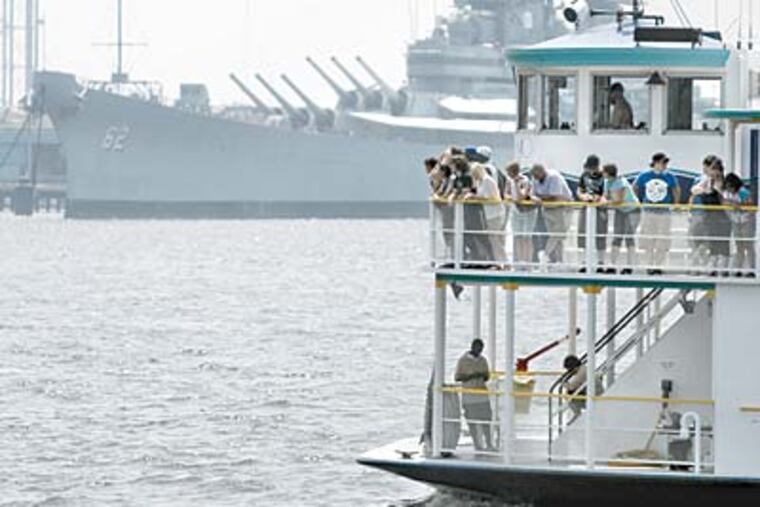
Eight days later, Lynn Spencer could still see the ripples.
Visitors at Penn's Landing snapped pictures, shook heads, pointed to the spot. A massive barge stopped, broke into a U-turn, and repeated the drill.
And earlier that morning, at the Ride the Ducks boarding spot at Sixth and Market Streets - where Spencer and young son William, visiting from Manchester, England, hoped to begin their survey of Philadelphia - a nice lady informed them that their tour had been canceled.
"She wouldn't say why," Spencer recalled.
Some immediate consequences of the July 7 crash, which killed two Hungarian students as a Ride the Ducks vessel was struck by a 250-foot barge, were to be expected: tears, investigations, memorials about 4,500 miles apart.
Others may have been less obvious - from customer-safety concerns about rival nautical ventures, to a bump in Penn's Landing vendor business from voyeuristic visitors, to tourists like Spencer who shifted their spending to other Philadelphia attractions.
"We just wanted to see the city," said Spencer, who learned of the crash Thursday after consulting local newspapers. "But we were pretty much covered."
The Spencers boarded a Phlash trolley from Penn's Landing to Center City to get their sightseeing fill - and they were hardly the only visitors scheming to swap waves for wheels.
Sherry Ashton, director of the Allens Lane Arts Center's summer camp in West Mount Airy, had considered a Ride the Ducks day earlier in the summer "to get some fun in for the kids."
But the accident made the decision - and future ones - for her. Seventy-five campers and 21 counselors spent Thursday at the Independence Seaport Museum on Penn's Landing.
"I wouldn't do anything dealing with the river now," Ashton said. "And I doubt many parents would want us to do it."
Ozzie Maffei, who operates a concession stand just outside the museum, was among the vendors who experienced an uptick in sales last week as curious locals descended on the pier.
"You still have people coming out to look, pointing at the water," he said - even if the water itself is often boat-free behind him.
While tales like these seem to forecast a business bump for land-based attractions, those in the tourist industry insist it's too soon to gauge the accident's full range of effects - especially after a week of revenue-skewing rainstorms.
Jeff Guaracino, vice president of communications with the Greater Philadelphia Tourism Marketing Corp., said the effects would be "too impossible to tell" at least until a few weeks from now, when more substantive numbers are reported for July. Another confounding factor: A tragedy like this - aboard a tourist craft near the height of vacation season - is without clear precedent in the area, Guaracino said.
It is unclear when - or if - Ride the Ducks will resume its tours. Philadelphia Trolley Works, according to director of operations Michael Kates, took on a handful of would-be duck-riders last week. Despite such anecdotal cases of a sea-to-land business shift, Kates is wary of longer-term ramifications.
"It's not good for our industry to have accidents," he said, "on the road, on the water, wherever it is."
Of this fact, American Sailing Tours owner Tom Kirwan is acutely aware. Though no one has canceled a sail on the Delaware River, Kirwan said customers had grown increasingly concerned with the safety protocols of his operation.
"There are a lot of unanswered questions" about the crash, he said. "People ask, 'What will you do if there's an accident?' "
Rob Nicol, owner of Skyline Attractions, which oversees kayak and paddle-boat rentals at the Penn's Landing marina outside the Hyatt Regency, said he was hopeful that customers wouldn't punish all water-based companies for the crash.
"We're in a controlled space, so it's a different situation," Nicol said. "We don't go out in boat traffic."
Many travelers, of course, remain comfortable on the Delaware. Despite its proximity to the crash site, the RiverLink Ferry System - which runs on the hour between Penn's Landing and Camden - has attracted riders during the last week.
Lynn Spencer was one of them. She and William had looked forward to riding on the river on a duck tour - they'd been on a similar vessel in Liverpool - but settled for a ferry in their quest to see the battleship New Jersey.
Delton Clark was another. The 43-year-old West Philadelphian had ridden the ducks with family in the past, but now prefers the placid pace of the Camden-bound ferry.
"People have [the accident] fresh in their minds," he said, clutching a bag of popcorn. "But you can't be governed by fear."
With an inquisitive flock still assembled across the channel, cameras in tow, the RiverLink ferry pulled into Camden in the searing Thursday afternoon heat.
Clark leaned over the ledge, reached into his bag, and rained sustenance on the ducks paddling below.
"The Delaware," he said, smiling, "is still peaceful."