Ceremony marks "rewatering" of the Delaware Canal
EASTON, Pa. - In the festive presence of kayakers, speechmakers, bicyclists, and a straw-hatted woman joyously blatting on a conch-shell horn, a storm-tossed relationship was renewed Friday.
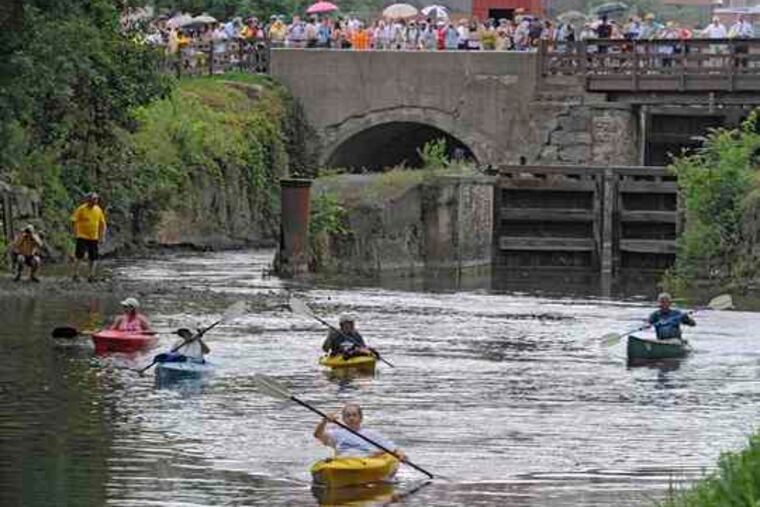
EASTON, Pa. - In the festive presence of kayakers, speechmakers, bicyclists, and a straw-hatted woman joyously blatting on a conch-shell horn, a storm-tossed relationship was renewed Friday.
Water and the Delaware Canal, after a six-year separation, are together again.
Standing at the head of the 58.9-mile canal, by the scenic convergence of the Lehigh and Delaware Rivers, state Department of Conservation and Natural Resources Secretary John Quigley opened a stop gate and the Lehigh current flowed again into the historic waterway.
The "rewatering" ceremony marks the first time the canal - except for a small, leaky span in New Hope - is being filled end-to-end since 2004.
"It is being brought back to life today," Quigley said.
Actually, the vital signs have been strengthening for some time. The Delaware-fed stretch of the canal south of New Hope has held water since spring, and the Easton-to-Raubsville stretch had been test-filled in June.
It will take about a week for the rest of it to fill, said Rick Dalton, Delaware Canal State Park manager.
The festivities capped a $28 million restoration project begun after three devastating floods left gaping holes and rubble where walls and towpaths had been.
"For the first time in six years," Dalton said, "I'm going back to managing a park, not a construction zone."
Completed in 1832, the Easton-to-Bristol canal combined with the Lehigh Canal to ferry anthracite on mule-drawn barges from Northeastern Pennsylvania to Bristol.
After trains took over, the last commercial barge ran in 1931. The canal became state parkland, its towpath a draw for hikers, runners and bikers. Mule-drawn barge rides fast turned into an anchor of New Hope's tourist trade.
That all changed in September 2004, when remnants of Hurricane Ivan dumped more than five inches of rain on the upper end of the Delaware. The resulting flood - at the time, the river's fourth-highest crest - tore up long lengths of towpath, blew out canal banks, and destroyed locks and other structures.
Before repairs could begin, two more devastating floods - in spring 2005 and summer 2006 - ripped even farther into the canal and towpath.
The wreckage, worse than after the record flood of 1955, led some to question the cost of repairing damage that likely would happen again.
Last month, a local editorial dubbed the canal a "money pit," saying the repair money "might just as well be poured right into the river."
After each flood, "the conversation over whether we should fix it grew more intense," Dalton said. "But it never got to the point where we said we're not going to."
Helping matters was that federal emergency funds covered 75 percent of the tab. A lousy economy helped out, too, holding construction costs $12 million below the original $40 million estimate.
Canal proponents argue that the park draws up to one million visitors annually, is a vital greenway link between Philadelphia and Northeastern Pennsylvania, and has irreplaceable historical value.
"It's an absolute pleasure to see people coming back, riding and walking on the towpath, kayaking and canoeing, and to see the wildlife coming back, too," said Susan Martin, executive director of the Friends of the Delaware Canal support group. The Audubon Society has identified 90 species of birds living along the canal, she said, including a nest of bald eagles.
Spending to maintain the canal, said Bill Getchell of Point Pleasant, is no different from servicing a roadway. "It's like River Road; you wouldn't put it in and then not do anything to it for 50 years, but that's basically what happened to the canal."
Besides, supporters say, filling it in would cost far more, because drainage systems that lead into the canal would have to be extended and rerouted to the river.
"Mother Nature was not kind to us, and frankly, the odds are that she won't be kind to us again," Quigley said. "But whether we have a storm next month or 10 years from now, this facility and the connections it provides between communities, the outdoor world, and our heritage is something that we can't afford to lose."
Officials have tried to gird against future flood damage with some back-to-the-future restoration methods.
Eight wooden stopgates, long in useless disrepair, were rebuilt from thick lengths of rot-resistant white oak. During flooding, the gates are lowered to diffuse and slow the eroding rush of water through the canal bed.
Damaged towpath sections were reconstructed with stabilized turf, a compacted mix of cracked stone and topsoil seeded with deep-rooting summer grasses designed to resist erosion. Shortly before the flooding, the original grass-covered towpaths had been resurfaced with a granular, bike-friendly substance.
But workers remain perplexed by a persistent leak in New Hope, where basements on Mechanic Street took on water last spring. That one-block stretch will remain dry - and the mule-barge rides on hold - until the leak is found and patched.
Taylor paid homage to the historic barges by sounding a conch horn as red ribbons across the towpath and canal were cut. The shells were used by barge operators to alert lock tenders of their approach during coal-hauling days.
Adding heft to the crowd were close to 350 bicyclists from 29 states, part of a weeklong Rails to Trails Foundation ride that was passing along the towpath.
"There's a lot of history here that makes it unique," said rider Aura Oldenburg of Columbus, Ohio.
"It seems a lot less costly," added her husband, Eric, "the more that you enjoy it."