A svelter Rendell is winning his battle of the bulge
HARRISBURG - A little more than a year ago, Gov. Rendell weighed a chart-busting 267 pounds. He would down a 22-ounce steak in 11 minutes and curl up with a half-gallon of ice cream before bed.
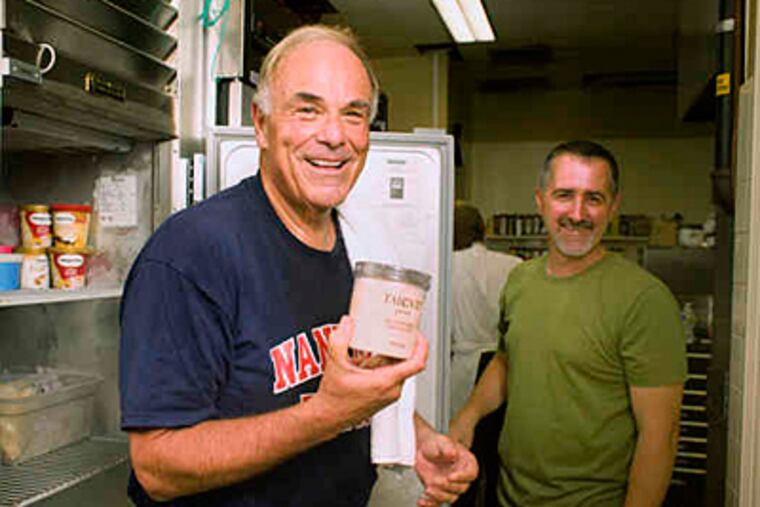
HARRISBURG - A little more than a year ago, Gov. Rendell weighed a chart-busting 267 pounds. He would down a 22-ounce steak in 11 minutes and curl up with a half-gallon of ice cream before bed.
Today, Rendell tips the scales at a svelte 205.
For a man known as much throughout Pennsylvania for his supersize appetite as for his oversize personality, Rendell says he still enjoys a few scoops of ice cream and a good rib eye.
But now he eats only half the steak and takes the rest home in a doggy bag to share with his two golden retrievers.
The essence of his self-designed strategy: Eat less. Work out regularly.
"There is no way to reduce weight without reducing the way you eat, unless you run six or seven miles a day," the 5-foot-11 Rendell says as he cools down on the treadmill in the basement of the governor's mansion after his morning workout.
Diet and nutrition experts say they approve of Rendell's strategy and applaud him for what they call a "significant" achievement.
"Sixty pounds in 14 months is quite an accomplishment," says Thomas Wadden, director of the Center for Weight and Eating Disorders at the University of Pennsylvania. "Many things he's doing are right out of the textbook on weight control."
Rendell, 66, says he runs on the treadmill 30 minutes a day, six days a week, and has cut in half the portions he eats.
No Atkins diet. No personal trainer. No diet docs. No calorie counting. No appetite suppressants.
Gary Foster, director of the Center for Obesity Research and Education at Temple University, says that if the governor's program works for him, then it's the right one.
"What's elegant about the approach is its simplicity," Foster says. "Many people get tripped up by the complexity of calories, carbs, sodium, cholesterol, and we end up asking patients to go through mental gymnastics every morning."
Tuning in
Rendell starts his regimen at 8:30 Thursday morning, tuning in to MSNBC's Morning Joe, where on Tuesday he took President Obama to task for agreeing to go on The View.
In T-shirt and green running shorts, Rendell pounds the treadmill at a steady pace - his workout room covered with photos of Philadelphia sports teams - as he watches the pundits debate.
Rendell briefly ponders a question as he nears the two-mile mark: Can he claim victory in the battle of the bulge?
"It's a lifetime issue," he says. "The goal was to change habits. The question is, can I stay in good shape for life?"
After his half-hour workout, he throws open the refrigerator in the family kitchen at the governor's mansion.
"See?" he says, pointing to a carryout container filled with steak he carted back to Harrisburg from Barclay Prime in Philadelphia.
"In the old days, this would have been gone. Now it's my dinner Friday."
Pleas from family
Rendell says it wasn't red flags from his doctor but pleas from his family that compelled him to slim down.
Even when he weighed 267 pounds, his vital signs were in the healthy range for his age, which he attributes to working out regularly even when his dietary habits were poor.
"Aerobically, I was doing a pretty good job even being heavy. My doctor would say, 'You should lose some weight,' but it was never an imperative," Rendell says.
His wife, Marjorie, and son, Jesse, persuaded him to act.
Rendell recounts the story of his recently married son's imploring him to lose weight so he'd "be around to play sports with his grandchildren."
And his wife's asking him: "How many heavyset 85-year-old men do you see?"
The budget crisis of 2009 - the kind of political stressor that used to send him to the freezer for ice cream - helped motivate him, too.
"It gave me a goal," Rendell says.
So he cut out one meal a day - breakfast or lunch - and started paring back his consumption.
"I'm not fanatical about carbs, but I stay away from sugar."
If he eats breakfast, it's usually cornflakes with frozen blueberries and Splenda or a two-egg-white omelet, rather than a three-egg omelet, with four strips of bacon rather than the eight or 10 of old.
If he has a long day between meals, he snacks on a half-cup of peanuts with a diet Coke, rather than the two or three cups he used to devour.
At dinner he might share an appetizer, and he takes home half of his entrée, usually red meat.
His two rescued retrievers, Maggie and Ginger, figure prominently in his routine.
"Obviously, you can see the girls don't work out with me," Rendell quips, gesturing to the two not-undernourished dogs.
But they join him when he walks laps around the mansion gardens and are the motivators for filling the doggy bags.
He admits to still "eating bad stuff."
Rendell's vice of choice: Tahitian vanilla bean gelato by Talenti - which contains fewer calories than ice cream. He'll eat no more than a pint at a sitting.
"It's awesome," he says, standing outside the catering refrigerator, where the ice cream is "hidden" from the governor.
Four pounds a week
The 2009 budget standoff lasted 101 days, during which Rendell shed roughly four pounds a week for a total of 61.
In the past, tense times sent him searching for food.
"I'd get beat up in the morning and look forward to lunch," Rendell says. "I had lousy willpower. . . . I'd go home and have a half-gallon of ice cream. It was some positive feeling to offset terrible figures."
Rendell says he still hopes to see the 1 in the first place on the scale one day.
In 1971, the year he was married, he was a trim 195.
"I haven't made it there yet."
Wadden says dieters should focus on what they have achieved, not what they haven't.
Using "positive coping strategies," such as weighing yourself every day, helps maintain the routine. If you weigh yourself only once a month and see no change, you're more likely to throw in the towel, Wadden says.
Rendell says he has fallen off the diet wagon a few times, particularly during the holiday season, with its succession of parties.
But his body protests. He used to think the idea that a person's stomach shrinks was a myth. No longer. After eating too much, he feels uncomfortable.
"My stomach is accustomed to a smaller intake," he says. And he doesn't "wolf food" as he used to.
The odds are against Rendell's keeping the weight off.
Studies show that as many 80 percent of people who lose weight gain it back in five years, Foster says.
Wadden cautions that Rendell will have to work as hard to keep the weight off as he did to lose it.
"Your clothes might fit better and you get compliments. The problem is when the band stops playing," Wadden says. "You have to put all the same amount of time into it."