Philadelphia Zoo's Solitude house being restored
For years, visitors at the Philadelphia Zoo have been walking right by the funny little house known as The Solitude. It's been locked up, easy to miss, especially when the boxwood hedges were six feet tall.
For years, visitors at the Philadelphia Zoo have been walking right by the funny little house known as The Solitude. It's been locked up, easy to miss, especially when the boxwood hedges were six feet tall.
But no more. After decades of being used by the zoo for everything from a snake exhibit in the parlor to executive offices in the library, The Solitude is well on its way to inviting company over. Come September, after $500,000 in renovations that include substantial hedge-trimming, the house will be open for group tours.
"I never heard of it before, but that's cool. We'll definitely check it out," said Gina Church of South Philadelphia, a zoo member who was walking past The Solitude on Saturday with her husband and 3-year-old daughter.
The Solitude was built on a knoll overlooking the Schuylkill by John Penn, William's grandson, in 1784. It's notable for being the only original Penn home left in the United States. (Pennsbury Manor, on the Delaware River in Falls Township, is a re-creation of William Penn's 1683 country estate.)
And while George Washington definitely dined at The Solitude, traveling from Philadelphia either by boat or horse, he was not invited to sleep over, as he pointedly noted in his diary.
Had Washington been invited, one wonders where he would have slept.
The Solitude is stylishly spare and clearly a one-person house. It's a perfect cube, in the style of small houses along the Thames - 29 feet high, wide, and deep. "A box with a roof sitting on it," said Arleen Dascola, a zoo docent and member of the Friends of The Solitude.
A foyer and parlor are on the first floor, a library and small bedroom on the second, and no "facilities" - chamber pots and commodes were the style of the day. A third room upstairs may have been a guest room, but Dascola believes this was Penn's dressing room.
"He was highly educated, into the arts and architectural design, and he entertained," she said, "but he was very private."
John Penn was the son of Thomas Penn and Lady Juliana Fermor, daughter of the Earl of Pomfret. A scholarly youth who fancied himself a poet, he went to Eton and Cambridge and, in 1781, set off on the de rigueur "grand tour" of Europe.
In Stuttgart, he visited the Duke of Württemberg at his vast estate, called La Solitude, which became the namesake for his own, far simpler country retreat.
Penn came to Philadelphia on family business in 1783, at age 23, and bought 15 acres well out in the country at the time. Designing the house himself, he borrowed ideas from the Scottish neoclassical architect Robert Adam, such as decorative wrought-iron balustrades and highly ornamental plaster ceilings.
He returned to England after only five years. In 1868, Fairmount Park bought The Solitude from the Penn family's estate, and it became part of the zoo, which had been chartered in 1859.
The Friends group formed in 1991 to promote and raise money to preserve the house, one of the first neoclassical homes in America, and its garden, considered one of the earliest American landscapes to focus on the "picturesque."
The last zoo offices in The Solitude were moved in 2006.
Today, the original 18th-century windows have new wooden frames. The parlor's plaster ceiling is restored, but about 13 (of 20) layers of paint had to be scraped off before the original yellow, white, and gray-blue colors - mixed by modern-day Benjamin Moore - could be applied.
Other tasks have been completed, too - new roof, portico, library ceiling, and floor joists, and professional analyses of paint, walls, woodwork, and a 45-foot brick tunnel connecting the basement to what used to be the kitchen building.
The tunnel still exists, but it's closed. And the zoo's Small Mammal House sits where the kitchen house did.
The to-do list includes the parlor's cornice, walls, and woodwork; the foyer; the front door; the upstairs hallway; and the tunnel. So the fund-raising continues.
For the last two years, Robin Potter, a garden designer and master gardener from Haddonfield, has been redoing The Solitude's garden.
"This is a renovation, not a restoration," she said of what is now the Walter Gray Family Garden, for the family's $125,000 matching contribution.
The zoo is primarily focused on animals, so The Solitude's garden can't be fussy and labor-intensive. And there's no way to bring back on a quarter-acre what Penn had on 15 - carriage path and "wilderness," woodland, bowling green, bridge, stream, and one-acre kitchen garden.
Instead, Potter said, "I've tried to refer back to the landscape of history, while keeping in mind that we're in the middle of a zoo," one that gets more than a million visitors a year.
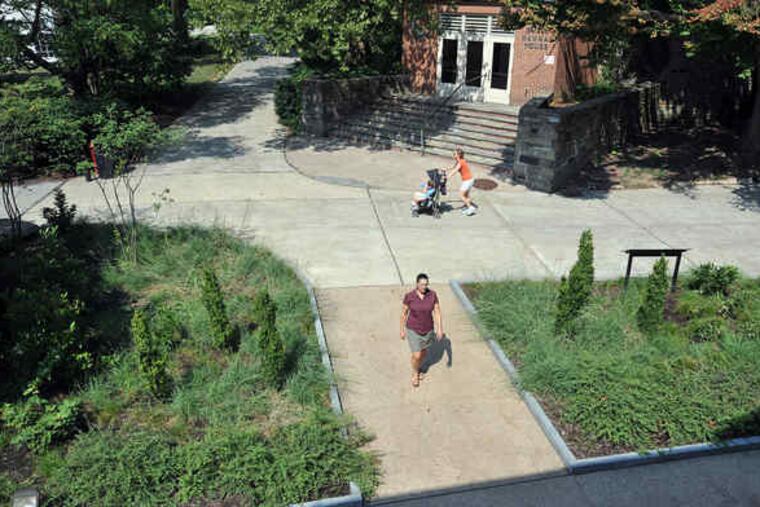
Potter has installed native plants, such as carex grass, which has the naturalistic look Penn liked in his garden and mimics the grass that grew right up to the edge of 18th-century houses. An added attraction: It's tough, low-growing, and easy to maintain.
Potter has lowered the boxwoods to restore the views from the zoo walkways to the house, if not from the house to the river.
The gravel turnaround has been replaced, but the old is echoed in the new concrete walkway with small stones embedded in it. "We have older people visiting and women in high heels," Potter explained.
And Penn's "wilderness" is not re-created, but reflected in native river birch and serviceberry trees, whose shade cools the zoo's meandering peacocks.
The new plantings are also intended to offer something fun in every season, whether interesting shapes, changing colors, blooms, or berries. "We wanted stuff that kids would think was cool," Potter said.
The house isn't open to the public yet, and the garden is not fully planted, but 4-year-old Shawn Painter of Wissinoming is already hooked on The Solitude. He visits the zoo once a week with his mother, Donna, and was there again Saturday.
"Every single time we're here, he stares in the window. But no one's ever around," Donna Painter said. "We definitely have to come back when it's opened."
In September, tours of The Solitude can be reserved for groups of at least eight, for $5 per person. Combined tickets for the zoo and Solitude tour will be $18. The house will also be opened periodically to the public for scheduled tours. It's already available to rent for small parties and events.
For information, call the zoo's group sales office at 215-243-5235.