Mourners celebrate lawyer and activist Charles W. Bowser
In the Wynnefield neighborhood where he lived, and in the church where he worshipped, political and civil rights activist and lawyer Charles W. Bowser was remembered Tuesday as a trailblazer who set the path for a generation of black politicians and lawyers in Philadelphia.
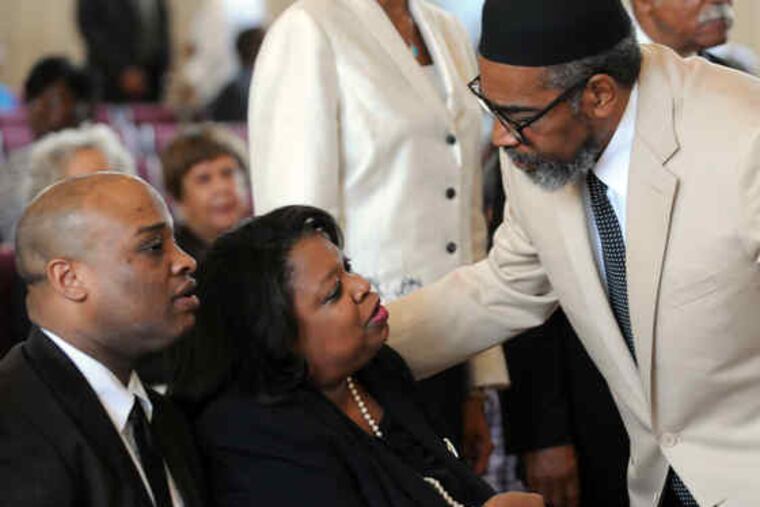
In the Wynnefield neighborhood where he lived, and in the church where he worshipped, political and civil rights activist and lawyer Charles W. Bowser was remembered Tuesday as a trailblazer who set the path for a generation of black politicians and lawyers in Philadelphia.
The life of Charles Walker Bowser, 79, whose campaigns for Philadelphia mayor in 1975 and in 1979 inspired many black politicians in the city, was celebrated at a funeral attended by about 350 people at Pinn Memorial Baptist Church in the 2200 block of North 54th Street.
Tuesday's celebratory two-hour gathering for Bowser, who died on Aug. 9 from complications of Alzheimer's disease, included many black leaders.
The Rev. William H. Gray 3d, the former U.S. congressman and retired pastor of Bright Hope Baptist Church, remembered Bowser as a star football player at Central High School, a scholar who graduated from Temple University with degrees in journalism and law, a lawyer who fought for social justice, and an inspiring politician.
"Lord, we thank you this morning for the athlete that he was. We thank you this morning for the scholar that he was, we thank you for the lawyer and the coach and the mentor," said Gray. ". . . We thank you, Lord, for the Moses of black politics that he was."
Reading a letter from Mayor Nutter, Everett A. Gillison, deputy mayor for public safety, called Bowser "one of the leading figures in Philadelphia history."
"He was and will always be Mr. Bowser," Gillison read from Nutter's letter. Gillison said Bowser had "the courage to take on whatever challenge he saw in front of him . . . the courage to blaze a trail that many African Americans would follow."
"I know I stand on the shoulders of this giant," Gillison said, quoting Nutter, who was on vacation and could not attend. "Our city is immeasurably richer because of his work."
Many of the speakers referred to Bowser's having been appointed in 1967 as the city's first black deputy mayor by Mayor James H.J. Tate.
Above all, they noted Bowser's campaigns for mayor, the first in 1975, in which he ran as an independent against Democrat Frank L. Rizzo and Republican Thomas Foglietta and finished second to Rizzo.
In the 1979 race, Bowser came within 37,000 votes of beating Bill Green for the Democratic nomination.
W. Wilson Goode, who was elected Philadelphia's first black mayor in 1983, said unequivocally that Bowser's work set the stage for his election.
"I became the first African American mayor because of Charles Bowser and the heavy lifting he did," Goode said. "I stand here not because of me, but because of Charles Bowser and the others who went before me."
Offering the closing prayer, Goode said, "Thank you, Lord, for the example he set for me . . . for his outrage against injustice, for his refusal to go along just to have peace."
Former Mayor John F. Street called Bowser Philadelphia's "most important nonelected figure from 1975 to 2000."
"For me, Charles Bowser was the ultimate role model," Street said, adding that "it just seemed that Charlie Bowser had it all."
Former Mayor Bill Green, who won the 1979 primary against Bowser, said "that what was so important, at least in my own memories, was that Charlie was a fighter, that he was willful, determined, and strong, and that he had sort of an Olympian heart when it came to the struggle for providing a more just society."
Bowser's work as a lawyer, which included a successful legal fight as an attorney for the local chapter of the NAACP in 1964 to end the use of blackface by marchers in the Mummers Parade, was also remembered.
Common Pleas Court Judge Frederica A. Massiah-Jackson said Bowser, an Army veteran who served in Korea, "believed in America, and that the Constitution and the Bill of Rights were worth fighting for."
Bowser thought "the law should be used as a tool of empowerment," she said.
"He said we have to believe in justice."
Bowser's son, Charles W. Bowser 2d, said that his father, who earned a bachelor's degree in journalism in 1952, loved writing and poetry and that he would write a Christmas poem each year to be included in personalized greeting cards he would send.
Bowser 2d said that he and his father would often read the poem "Invictus" by William Ernest Henley.
Bowser 2d then recited the poem, concluding with the words:
"It matters not how strait the gate,
How charged with punishments the scroll.
I am the master of my fate:
I am the captain of my soul."