At Vineland auction, farmers reap bids for what they've sown
VINELAND, N.J. - Chris Alimenti watched patiently as final bids from the action in the next room were projected on a wall at the Vineland Produce Auction.
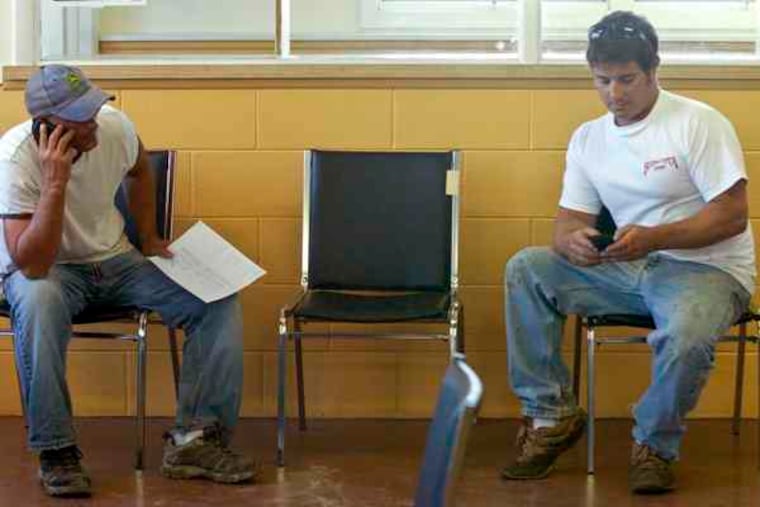
VINELAND, N.J. - Chris Alimenti watched patiently as final bids from the action in the next room were projected on a wall at the Vineland Produce Auction.
Squash, peppers, watermelons, and other crops from his East Vineland farm would be up soon. How much would they fetch?
Alimenti is among a community of farmers who gather every day but Sunday in the historic building on North Main Road, near the center of this Cumberland County city.
The market is "the biggest [produce] auction on the East Coast," said Peter C. Bylone Sr., its manager since 2001.
A cooperative owned by 160 growers from six South Jersey counties runs the auction and directs sales between buyers, who represent grocery chains and food markets, and individual growers.
"As a co-op, we work for the farmers," Bylone said. "Farmers say what's for sale, and we put it in the computer, create a [daily] catalog."
From April through Thanksgiving, up to 60 different commodities pass through the 140,000 square feet of loading docks at the facility, which had its first sale in 1931. Last month, almost 50,000 units - boxes, bushels, crates - of nearly two dozen types of produce were sold in less than four hours.
The Vineland auction is "the greatest place for buyers and sellers in the country," said Lou Pizzo, a buyer with Pizzo Produce, a distributor across the street. "This is a place where small buyers and big buyers are on equal, competitive playing fields."
Elsewhere, he said, large buyers have the edge because produce is sold on pallets. Here, "it doesn't make a difference if a guy is buying for Acme or ShopRite and he has big buying power," Pizzo said.
Pizzo has been on both sides of the transaction: He has spent 48 years in farming and buying. His firm supplies eight companies, including grocery chains and food-service firms he declined to identify.
Each morning, growers gather in the sparsely furnished waiting room and follow along as bids are displayed on the wall. Before 2001, when the auction was computerized, a full load of crops was taken to the center before sale. Now farmers don't transfer the produce to buyers until transactions are complete.
One day last month, about a dozen buyers took away eggplants, squash, watermelons, pickles, cabbages, cucumbers, tomatoes, cilantro, parsley, onions, lettuce, kale, arugula, blueberries, basil, dill, radishes, corn, and beets. Peppers - bell, Cuban, jalapeño, long hot - also were popular.
Alimenti, among 73 farmers in attendance on a warm morning, followed the sales in his catalog. The 120-acre Buena Vista Farms in East Vineland, where he grew up, has been operated by Alimenti's family since the 1970s.
"The heat drives you," he said, noting that some crops needed to be put up for sale immediately. "You can't let them sit. Then you'll lose money."
Gilbert Mazzoni, 76, of Landisville, agreed. Peppers can fetch a good price, the longtime farmer pointed out, but with the recent high temperatures "it takes a lot of water. Costs a lot."
Dan Franceschini, who runs a 140-acre farm in East Vineland, was concerned about prices for cabbage.
"I'm giving cabbage away," he said with a smile, but added that at least he was getting some money back. "Cabbage has been like that this year all over the East Coast."
After a few hours spent joking and chatting with fellow farmers, Alimenti had his turn. He entered the steeply pitched auditorium-style auction room to watch firsthand while buyers considered each of his six sets of crops. As Alimenti's offerings were listed, item by item, on a wide screen, buyers placed their bids electronically.
When it was over, he had sold 75 half-bushels of small yellow squash for $5.90 each and 66 half-bushels of medium squash for $3 each. Fifty bushels of long hot peppers fetched $6 each.
The watermelons came in two sizes. The smaller ones fetched $10 for a crate of six. Crates containing four of the larger melons fetched $8. He sold 25 units of each.
"Not too bad," he said, scanning his notes. "But I've seen better."
The previous day, he said, he had sold Cuban peppers for $12 a box. In one day, the price dropped to $5.
Across the room, Marlene Kraynock - who farms about 100 acres in Buena Vista Township with her husband, Andrew Kraynock Jr. - was luckier.
Her 60 crates of curly parsley were purchased for $30 each, way above the $9 average.
"A good day," she said, smiling.
The buying starts at 10:45 a.m., but the action begins at least an hour earlier. Beginning around 9:30, farmers park their cars and pickups in a line out back and display samples.
Throughout the proceedings, auction participants drop in to Tony's Lunch, a small diner in the building, for food and takeout coffee.
By early afternoon, business is usually over.
As the auction wound down, Bernice Ferrari, whose family farm is in East Vineland, assessed her take.
The auction, she said, is "like a casino. Like you're gambling every day."