Philadelphia artist captures Chinatown festival spirit before the event
Every September, the windows and doorways of Chinatown explode in an identical burst of color, adorned with the poster announcing the arrival of the Mid-Autumn Festival.
Every September, the windows and doorways of Chinatown explode in an identical burst of color, adorned with the poster announcing the arrival of the Mid-Autumn Festival.
It's like a one-picture art exhibit, each space displaying the same image, a show that appears and disappears in the span of three weeks.
Whom to credit? Kathy Shimizu, a Canadian microbiologist-turned-graphic-designer, from whose mind and hand a new poster has emerged in each of the last five years. Every one is different, though all take inspiration from photos of Philadelphians and from traditional images of lanterns and lion dancers.
Shimizu's posters have become as much a part of the festival as mooncake, serving as the main advertising for the event - this year set for Saturday - and as a popular collectible.
Each poster tells a different story, a short, illustrated exposition on people, culture, and place. Or maybe that's not true. Maybe every poster tells the same story, but from a slightly different perspective.
"Each one is more amazing than the last," said Ellen Somekawa, executive director of Asian Americans United, the festival organizer. "Some of her art is evocative of Japanese woodcuts, so that really speaks to me. At the same time, she's captured some of the key visual elements of the festival."
The Mid-Autumn Festival, also known as the Moon Festival, has been celebrated in Asia for more than 3,000 years. It's a time for family and friends to gather, to gaze skyward, and to share the legends of goddesses who dwell on the moon.
On Saturday, the 15th Philadelphia festival will draw about 5,000 to Chinatown to watch tai chi exhibitions, Beijing Opera performances, and a mooncake-eating contest.
Shimizu's art tells people when to arrive, where to go, and what they will see. She strives to create an image that captures the memories of longtime festivalgoers while holding out the promise of new excitement to people who have never attended.
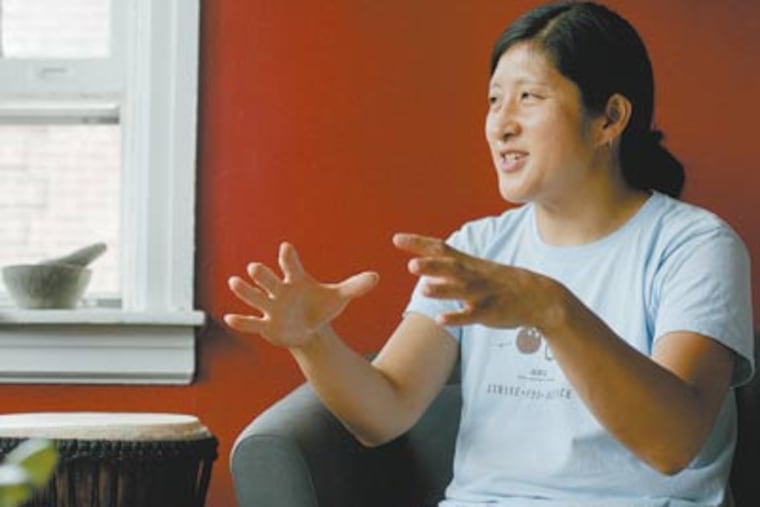
"I try to put something in it that's personal, but it's not about putting my artwork on the street," Shimizu, 42, said in an interview at her West Philadelphia home. "The festival has become very close to my heart."
Shimizu didn't plan to be an artist. She intended to be a scientist, earning a bachelor's degree in biology and a master's in microbiology.
Within months of starting work, she realized lab life was not for her. Breaking the news to her parents - her mother an elementary school teacher, her father a college philosophy professor - wasn't easy. Nor was going back to school, in her mid-30s, to earn a degree in communication design.
She came here from Vancouver in 2006, after Children's Hospital of Philadelphia hired her husband as a leukemia researcher. Friends introduced her to the AAU leadership, who persuaded her to take over the task of producing the poster.
Until then, the assignment had been passed among a succession of volunteers.
Shimizu brought not just ability but sensibility, honed during her tenure as coordinator of the Powell Street Festival, a celebration of the culture of Japanese Canadians. The Vancouver event is the largest of its kind in Canada, drawing 15,000 to a neighborhood once known as Japantown.
That place is now called the Downtown Eastside. Japantown vanished in 1942, when Canada reacted to the attack on Pearl Harbor the same way the United States did - by rounding up people of Japanese descent and putting them in camps.
Both of Shimizu's parents were interned. Her maternal grandfather died in the camps. Her paternal grandmother died soon after release.
"Of course it makes me angry," she said, "but in a different way than if it was more firsthand. It is part of what makes me want to stand with people who are facing injustice, because you can see how it comes to different communities, and you've got to do something about it."
Her posters betray no sense of anger or sadness. They do suggest that the festival is more than food and fun. Organizers see the event as a political act, a physical and cultural reclamation of space.
This year, AAU shortened the program, cutting the nighttime entertainment for one unhappy reason: In the darkness away from the stage, teens were getting into fights.
Helping youths find their way forward has long been a festival aim. Toward that, Shimizu seeks to create a poster attractive to young and old. She often relies on real-life images captured by a friend, photographer Joan May Cordova.
Her first poster was the most abstract, a moon bisected by horizontal lines of type. The next year, the Friendship Gate at 10th and Arch Streets was the focal point. In 2008, Shimizu showed the moon not just full but dominant, hovering above Chinatown.
This year's edition portrays the festival stage strung with lanterns and staffed by two emcees. Is one longtime volunteer Lai Har Cheung? Or is it just a woman on a stage?
Maybe both.
"The Asian community and especially the Chinese community is so about who they are and where they come from," Shimizu said. "To me it makes sense to connect the imagery to the festival."