Academy of the Fine Arts discloses sales of artworks
In a highly unusual effort to shed light on the reality of its own art dealing, the Pennsylvania Academy of the Fine Arts has reported the sale of five works, the prospective sale of five others, and the purchases made from sales proceeds.
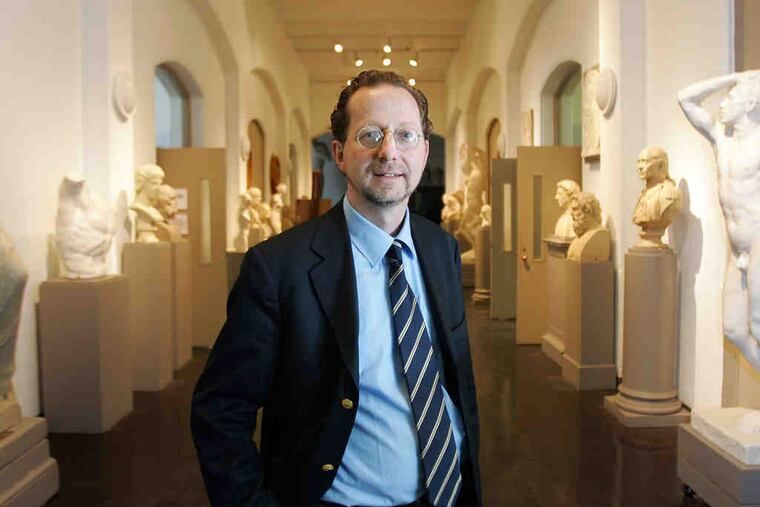
In a highly unusual effort to shed light on the reality of its own art dealing, the Pennsylvania Academy of the Fine Arts has reported the sale of five works, the prospective sale of five others, and the purchases made from sales proceeds.
"We wanted to be as open as possible," said David R. Brigham, president and chief executive of the academy.
"It's a positive story, and we want to tell it," he added, discussing the sales - deaccessioning, in museum parlance - and the areas of acquisition.
The works sold, and the galleries that handled the sales, are Autumn Still Life by William Merritt Chase and Looking Over Frenchman's Bay at Green Mountain (1896) by Childe Hassam (Avery Galleries); and Flowers (1893) by John H. Twachtman, Bathers in a Cove (1916) by Maurice Prendergast, and Great White Herons (1933) by Frank Weston Benson (Menconi & Schoelkopf).
The sales brought about $5 million into a fund designated exclusively for acquisitions, Brigham said. Works chosen for sale passed through a multi-part review process involving institutional and independent curators, academy board members, and top officials. The process followed the guidelines laid out by the institution's strategic plan.
Janet Landay, executive director of the Association of Art Museum Directors, a professional organization, said she was "pleased to hear this story because this is the direction we are encouraging our institutions to go."
Landay said she knew of no other museum that has made such a specific public announcement of sales, and said it could be an important step toward providing "more transparency" for such normally murky transactions.
The academy's sales were done in accordance with the association's ethical guidelines, which allow such sales only for the purpose of acquiring other works of art. The art museum directors' guidelines are more rigorous than those issued by the American Association of Museums and the American Association for State and Local History Museums, which allow proceeds from deaccessioning to be used for care of collections, in addition to acquisitions.
In the last two years, officials at the Philadelphia History Museum at the Atwater Kent have used the looser guidelines of the two museum associations to justify a slew of sales. Those included a number of paintings formerly held by the Historical Society of Pennsylvania, which had drawn severe criticism after The Inquirer reported in 1997 that the society planned to sell or give away its entire collection of art and artifacts.
That controversy led to the resignation of the historical society's director and the transfer of its holdings to the Atwater Kent, the city's history museum.
Recent sales by the Atwater, such as a Raphaelle Peale still life of a small fish sold to a private collector for $700,000, included material from the historical society. The institutions split the proceeds.
Some of the funds from the Atwater Kent sales will be used to cover the museum's current $5.8 million building-renovation project; in 1997, the historical society planned to use at least some sale proceeds for renovation of its building.
The Atwater's sales have been conducted out of the limelight, and a spokeswoman for the museum said recently that sales of additional items from the collections were in process. She declined to identify them, citing negotiations.
At the Pennsylvania Academy of the Fine Arts, five additional works are now slated for deaccessioning: Girl at Piano (c. 1887) by Theodore Robinson, Top of Cape Ann (1918) by Childe Hassam, The Turkey (1927) by Arthur B. Carles, and Peggy's Cove, Nova Scotia (1924) by Ernest Lawson (all consigned to Menconi & Schoelkopf); and Still Life #1 (1827) by James Peale (consigned to Avery Galleries).
Funds generated by the sales will be used to improve its holdings of Hudson River School artists, selected movements in 20th-century art, and contemporary art, officials said.
There already have been some purchases: Lilly Martin Spencer's Mother and Child by the Hearth (1867); Philip Evergood's Mine Disaster (1933); Dorothea Tanning's Midi et Demi (Half Past Noon) (1956-57); Norman Lewis' Redneck Birth (1961); Nancy Spero's At Their Word (The Sick Woman) (1957-58), The Great Mother (1960), and The Bug, Helicopter, Victim (1966); Mickalene Thomas' Din Avec la Main Dans le Miroir (2008); Odili Donald Odita's Future Perfect (2009); and Mark Bradford's Untitled: [Dementia] (2009).
Landay, head of the art museum directors group, noted that it is common for museums to sell from one section of a collection in order to strengthen another.
"It's a normal part of building a collection," she said. "It shouldn't be such a touchy subject," adding that "the touchy part, of course, is how the money is spent."
Brigham acknowledged that "there will always be people who quibble" with the choices of works put on the market. Indeed, the academy was severely criticized for the sale of Thomas Eakins' The Cello Player in 2007 to defray the huge cost of acquiring the same artist's Gross Clinic in partnership with the Philadelphia Museum of Art. (Jefferson University prompted that $68 million acquisition - and received its own storm of criticism - by putting the painting of Dr. Samuel Gross up for sale to fund building construction and expansion.)
"Collections aren't static," Brigham said. "They aren't meant to be static."
The academy's policy, he reiterated, is to sell to increase funds available for acquiring other works of art.
"When you start spending on building and operations, that's an easy way to plug the budget," he said, which ultimately "compromises the public trust."