Changes in Delaware County animal control
Be prepared if you discover a stray animal in parts of Delaware County these days. Finding someone to take it off your hands might be difficult.
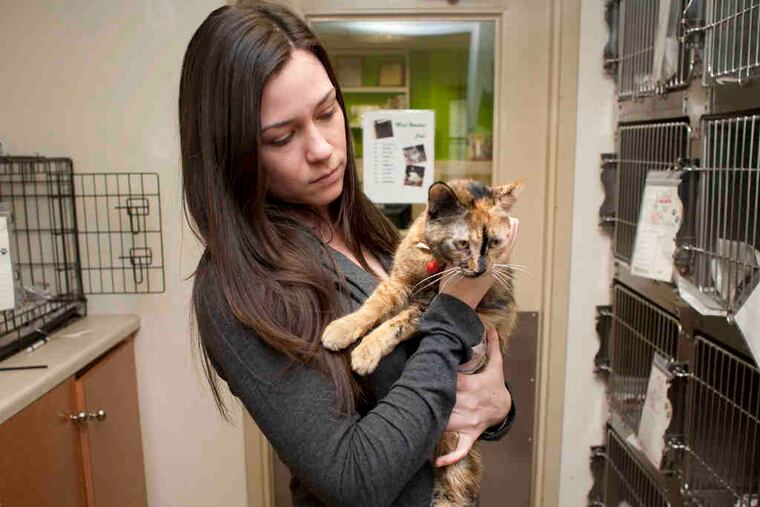
Be prepared if you discover a stray animal in parts of Delaware County these days. Finding someone to take it off your hands might be difficult.
At Clifton Heights borough offices last week, for instance, a visitor who asked what to do with a stray was told to speak to borough police. Police bounced the questioner back to borough officials. Pressed for an official response, they failed to return a reporter's call.
At Haverford Township, the answer was quicker and clearer. "If you can't find the owner," Police Officer Phyllis Edmondson said, "keep it or let it go."
Asked the same question, a Lansdowne borough official suggested the Delaware County SPCA in Media, which is the right answer only if you have $116 to pay for the service.
Over the summer, the county SPCA announced it would get out of the business of euthanizing animals by July this year. It will no longer take strays from the municipalities and instead will focus on programs to reduce overpopulation.
It also raised its rates for taking in strays from $15 to $116 for dogs and from $20 to $116 for cats. The fee covers vet care and room and board.
As a result, 20 of the county's 49 municipalities have not renewed contracts with the privately run SPCA. Shelter officials are holding firm in turning away strays brought in from municipalities that won't pay. People who bring in such animals are told to take them to their police station or municipal offices.
All of this raises the specter of stray animals left to roam portions of the county or meeting with inhumane ends.
On Thursday, a group of state, county, and municipal officials, police, and rescue groups met with the SPCA board to try to find a solution. They appealed to the society to reconsider its timeline.
"It has become a statewide issue," Tom Hickey Sr., a member of the state Dog Law Advisory Board, said afterward.
Gov. Rendell, before he leaves office Tuesday, is expected to address animal-control issues, Hickey said, "not just locally but across the state."
Member Jo-Ann Zoll said the SPCA board would not make any decisions until after Rendell's announcement.
In the meantime, SPCA officials said, they have already turned away a number of animals brought in by Good Samaritans.
"People are still thinking this is an idea we are talking around, not a decision we have made," said Justina Calgiano, SPCA spokeswoman. "We are getting out of the animal-control business."
As for the fee increases, she said the tiny shelter would go out of existence if not reimbursed for the full cost of caring for strays.
The shelter has room for about 200 cats and 80 dogs and relies on 160 foster homes for overflow. It takes in 6,000 to 7,000 animals a year.
Municipalities say they are upset with the fee increases, which came, they say, with little notice and when budgets are tight.
"There are not funds available for each municipality to go out and build itself an animal shelter," said Brian Hoover, Glenolden borough manager.
Monroe County, in northeastern Pennsylvania, offers a peek at what might happen here in the coming months. In 2009, that county's only animal shelter - a branch of the Philadelphia SPCA - closed.
Daryl Eppley, supervisor of Stroud Township, said people continued to leave animals at the facility. "Animals were dropped off and running free," he said.
When police picked up strays, the animals were kept in cages, sometimes for months, until a rescue group could find homes, Eppley said. Police officers walked and fed the animals in their care.
In Delaware County, municipalities are looking for ways to avoid that outcome.
Aston officials said they had found a temporary fix and were taking their animals to the Chester County SPCA.
Glenolden may look to local veterinarians to handle animals for the short term, Hoover said.
"Until everyone sits at the table, there won't be a solution," he said. "We have six months, and it is impossible to implement, fund, and build [a shelter] in six months."