Philly forensic investigator Suplee retires
Last week, as senior forensic investigator Gene Suplee cleaned out his desk in preparation for retirement, he came across a silver earring shaped like a tennis racket.
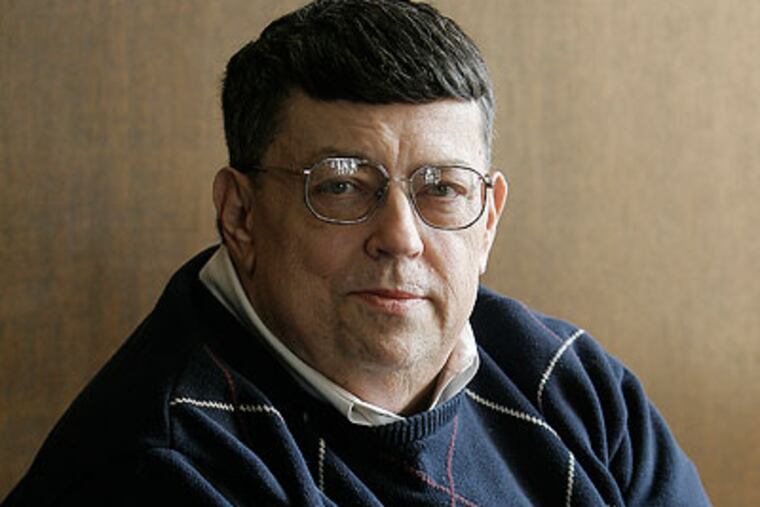
Last week, as senior forensic investigator Gene Suplee cleaned out his desk in preparation for retirement, he came across a silver earring shaped like a tennis racket.
The earring belonged to a woman, believed to have been about 22, whose body was found in a shallow pool of water off Kelly Drive on a hot day in July 1982. Suplee, then a medical examiner's investigator, released information about her to the public, and her DNA and fingerprints were reviewed. But her name remains a mystery, and investigators have not determined how she died.
Suplee has always believed that the earring was distinctive enough that someone would come forward to identify her. But it has never happened.
"There are the ones that still haunt me," Suplee said. "She's somebody's kid. You hate to leave things unfinished."
Suplee, 59, retired after 35 years as an investigator in the Philadelphia Medical Examiner's Office, a job that required him to speak the language of doctors, lawyers, police officers, judges, and residents of the city's roughest neighborhoods.
Forensic investigators study crime scenes and the circumstances of deaths, knock on doors to interview people, review evidence, identify the dead, develop opinions in cases on matters such as time of death, and sometimes testify. Suplee was one of 10 investigators in the office, and the longest-serving.
Acting as a link between law-enforcement officials and medical examiners, Suplee helped police uncover facts in countless investigations, including the inquiry into the 1985 deaths of 11 MOVE members in the bombing of the group's West Philadelphia compound.
Suplee has sat in on more autopsies and reviewed more photographs of dead bodies than he can estimate. The thankless job of delivering bad news to loved ones has often fallen to him, and relatives of murder victims have fainted in his office. Once, in the mid-1980s, a man who came in to identify his wife's body confessed to Suplee that he had killed her.
"You have to be part doctor, part counselor, part lawyer, part priest, and part human being," he said recently. "And I think the human being can be the hardest part. But I always tried to remember that this is just a day of work for us. For someone else, it's the worst day of their life."
Philadelphia Police Officer Virginia Hill, who worked often with Suplee until her 2002 retirement, said he was known for the attention to detail he paid to the dead, as well as for the compassion he showed with the living.
"He really cared," said Hill, who devoted much of her career to finding missing children. "If a parent called me about their child's case, I would tell them to call down to the M.E.'s Office and talk to Suplee. It's one thing to solve a case, but he always went beyond the call of duty."
Suplee, who lives in East Oak Lane, grew up in Kensington as one of nine children. After graduating from Central High School, he attended Villanova University for a year before enlisting in the Air Force. He served four years during the Vietnam War era in Europe, the Middle East and Asia, then came home and enrolled at Temple University.
After completing college, Suplee hoped to join the Police Department. When a job as a medical examiner's investigator was posted as well, he applied to both. The medical examiner job became available first.
"I found a home," he said. "Lucky for me, I just slipped into a niche that was great for me. . . . It was actually a tougher decision to retire than to take the job."
Suplee started in August 1975, long before the dawn of DNA profiling and the computer databases that would make his job easier. His office had cabinets filled with phone books to help find people, he said, and any license plate checks had to be done by hand.
"It's an ever-evolving job," he said. "When we first started out, we didn't even know what rubber gloves were."
In May 1985, the bombing of the MOVE compound on Osage Avenue started a massive fire. Suplee was tasked with helping figure out who the badly burned victims were, among them five children.
"That was a mess," Suplee said. "We didn't have a real handle on who was in the house."
Suplee compiled a list of potential names, based on interviews with police and surviving MOVE members. Since MOVE members did not use traditional medical care, Suplee could not find health records.
"We were working 24-hour days for a week," Suplee said. "I fell asleep driving home one night and woke up in the parking lot of a Wawa in Cheltenham."
Some adult victims were identified through police records, and pathologists pieced together others' identities using bone, skull, and tooth fragments. Suplee used his notes to narrow down who the bodies were.
Suplee devoted much of his career to the painstaking task of identifying unknown bodies, no matter how long it took.
Suplee worked on the "Boy in the Bag" case, in which 4-year-old Jerell Willis was beaten to death in 1994 by his mother and stepfather in Camden, put in a duffel bag, and dumped in a trash-strewn lot in Philadelphia. Willis' name was unknown for 10 years before an uncle saw a reconstruction of the boy's head, made by forensic sculptor Frank Bender, and identified the child.
In 2009, Suplee spent months trying to determine the name of a homeless man shot by police near City Hall after brandishing a box cutter. The identity of the man, who had been using someone else's name, remains a mystery.
Suplee kept meticulous records of the city's unidentified bodies, Hill said. The unnamed woman's silver earring found in 1982, for example, may well remain in the Medical Examiner's Office until someone comes forward to say whom it belonged to.
"You always knew you could call down there and say, "Y'all still have those dental records for this kid, those X-rays?" Hill said. "Gene would know exactly what you were talking about, and he'd be able to get it for you."
Suplee said his military service helped prepare him for the traumas of his career. Even so, he said, he never got used to some of the worst aspects of the job.
"Accidents you can take, and even some of the inhumanities that people do to each other," Suplee said. "But people killing kids, killing elderly people - I don't care who you are, that bothers everybody. That never gets easier."
Suplee's last day on the job was Jan. 14. He retired with an estimated annual pension of about $57,000, as well as a DROP payment of about $252,000, according to the city.
Suplee said he had no plans yet for the rest of his life but was considering going back to school, or possibly pursuing a job as a consultant for some type of law enforcement center.
For now, he plans to take a month to decompress, relax, and catch up on his reading with a Kindle he received as a Christmas gift.
"I can sleep until 7 or 8 o'clock if I want," he joked. "I'll be able to listen to KYW news without cringing."