Camden's female firefighters look back as three are laid off
It was 2001 when the Camden Fire Department hired Renee Muhammad and Jennifer Barrientos - its first female firefighters in 134 years.
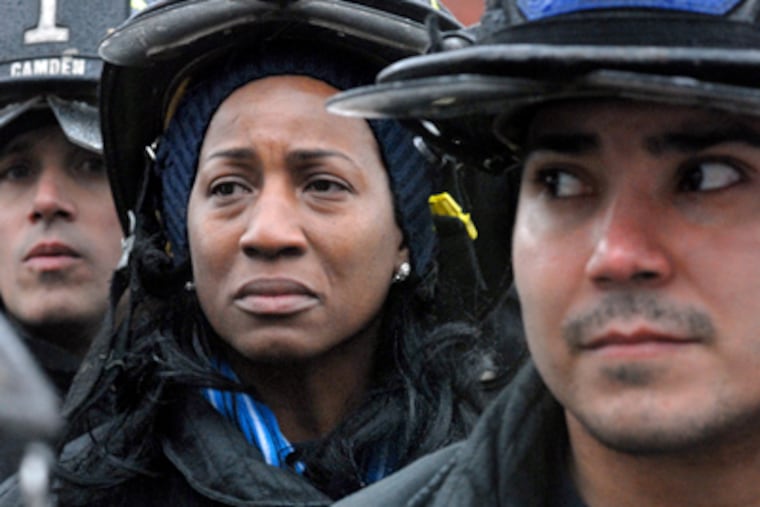
It was 2001 when the Camden Fire Department hired Renee Muhammad and Jennifer Barrientos - its first female firefighters in 134 years.
During her inaugural shift, Muhammad was called into a supervisor's office.
"Cut your hair or don't come back," she remembers him saying.
Muhammad, now 44, couldn't believe it. "I've got to worry about fighting a fire, and now I have to worry that if my hair isn't right, I won't have a job at all?"
Two more women, Lydia Chapman and Shonda Harris, became Camden firefighters in 2004.
Today, only Barrientos, 30, remains on the job after last month's public-safety layoffs. Sixty-five of the city's 150 firefighters were dismissed for budgetary reasons, though a $5.1 million Federal Emergency Management Agency grant may bring some of them back.
For the other women, the cutbacks derailed careers they had fought hard to achieve and loved dearly.
"I live and die for what I do," says Muhammad.
According to a 2008 Cornell University study, fewer than 4 percent of the nation's firefighters were women, and more than half of paid fire departments had never hired a female firefighter.
While female firefighters often report gender-related problems ranging from ill-fitting equipment to sexual harassment, the Camden women say that has not been their experience.
A few years ago, Harris and Chapman attended a training session where female firefighters were asked if they had encountered discrimination. Many raised their hands and went on to tell harrowing stories, Harris recalls.
"We were just sitting there with our eyebrows raised in disbelief," she says. "There's no way the men in our department would do those things to us."
The four Camden women grew up surrounded and supported by tough men.
Muhammad's father was a military firefighter who enthralled his 10 children with his stories and helped her follow his career path. She was accepted as a firefighter on the day of his funeral.
Barrientos had just enrolled at Camden County College when male firefighter friends encouraged her to apply.
"I kept telling them, 'But there's no females!' " she says. Still, she and a brother gave it a try.
Unlike Muhammad, who fought to keep her hair and eventually negotiated a ponytail, the younger, eager Barrientos quickly chopped hers off.
With their arrival - and that of the other two a few years later - things changed in the firehouses.
"In the beginning," says Harris, 38, the men "would tiptoe around us."
Fellow firefighter Rick Riley remembers the transition.
"You couldn't walk around in your wifebeater and underwear anymore," he says. "You had to watch your language, take down your calendars. Dinner talk had to change. You had to watch family movies!
"It definitely changed things, though, for the good."
A major accommodation, though not in the contract, was to allow the women desk duty while pregnant or nursing. It's one they appreciate, says Harris, a single mother of two, because "the toxins and smoke can mess with the health of the baby."
Harris says she won over her new workmates with her cooking, setting the bar high from the start. For the traditional dinner that every "probie," or probationary firefighter, cooks for station mates at the 90-day mark, Harris served steak, shrimp, clams, chicken, and crab legs.
Her childhood in East Camden prepared her for the job's physical challenges.
"I was jumping off roofs, doing backflips on mattresses, and building clubhouses in the woods," Harris says.
She was a corrections officer before becoming a firefighter at a salary of $25,000. Like the others, she had risen to about $70,000 by the layoffs.
Chapman, who was raised in South Camden, was encouraged to apply by her husband, Delaware River Port Authority Police Officer Ed Chapman, because, he says, "I've never seen her not accomplish anything she's gone after."
She had been a stay-at-home mom and part-time librarian, and was working as an insurance agent when he took her to watch recruits train.
"I saw a big, stocky guy do the obstacle course and throw up in a garbage can. I knew I could do it," says Chapman, who regularly worked out.
Her husband became her "drill sergeant" and led her through the training, including 40-minute lunch breaks when she would sprint up a six-story building wearing 80 pounds so she would feel light during the test.
The mother of four daughters, Chapman, 40, says she enjoyed being seen in such a traditionally male role on the streets of Camden.
"Women would toot their horns and give us high-fives," says Chapman. "And it's not just that we're females, but females who were raised in this city. When they saw us, they probably saw hope."
Over the years, Muhammad, a mother of three, had knee surgery after falling through a floor during a fire and broke her hand rescuing ducks from a sewer drain.
Firefighter Tyrone Miles, her former captain, says she was so popular that she was often asked to appear at community events.
Muhammed, whose 22-year-old daughter is applying to be a firefighter, says she takes pride in being a role model.
"If little girls don't see us getting off the fire trucks," she says, "how will they know they can do this, too?"