Radnor watch list targets historical sites
A mansion whose socialite owner inspired a Hollywood movie. A popular venue for weddings that was built for the son of the owner of the country's largest distillery. An entire village that was once the bustling center of Radnor and is now just a busy intersection.
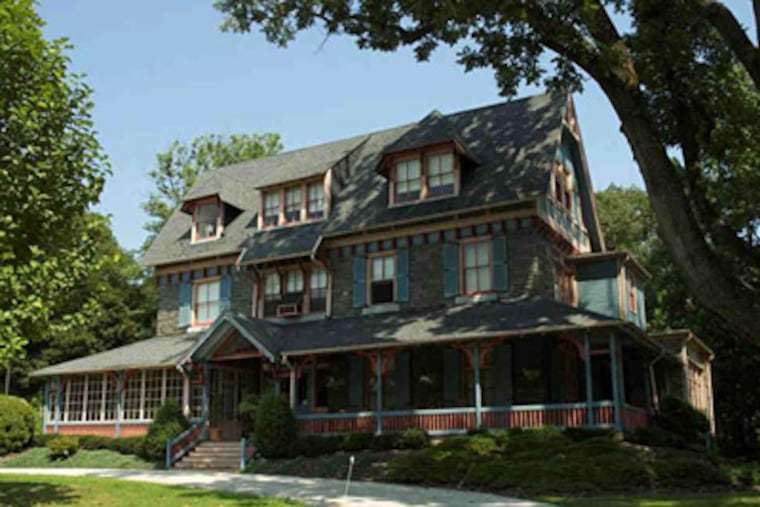
A mansion whose socialite owner inspired a Hollywood movie. A popular venue for weddings that was built for the son of the owner of the country's largest distillery. An entire village that was once the bustling center of Radnor and is now just a busy intersection.
What do they have in common? They all played a significant role in Radnor's history but are in danger of becoming lost to development, according to the Radnor Historical Society.
"Their historic and aesthetic value is inestimable and their loss would be deeply felt by future generations," the group said in naming these and eight other iconic properties to its first Preservation Watch List.
Ted Pollard, president of the Historical Society, said the group issued the list to raise awareness of the township's architectural and historic landmarks and of the economic and social forces that threaten their future.
"We're stewards of our properties," Pollard said. "We need to enhance our buildings, not destroy them."
There is reason to worry. In the last few years, two significant buildings were demolished: The Poplar House mansion, built in 1902 and designed by Lindley Johnson for the Barringer family, was torn down last year to make way for a new house, and the Walmarthon Log Cabin on Eastern University's campus came down in 2009 after university officials said it couldn't be rehabbed.
Unlike neighboring Lower Merion and Haverford, Radnor has no regulations to prevent the loss of its most valued properties, said Greg Prichard, a Historical Society board member.
Speaking of the destruction of the Poplar House, the 108-year-old Federal style mansion whose late owner, Dorothy Therman, founded the township's Historical Society, he said: "If that can happen, then anything can happen."
The Preservation Watch List singles out 10 properties or locations and puts two others on a list of those to watch.
The best known is Ardrossan, the Horace Trumbauer-designed mansion whose owner, Hope Montgomery Scott, was the inspiration for the play and movie The Philadelphia Story, starring Katharine Hepburn, and evoking the now-vanished aristocratic Main Line life. Occupied since 1912 by one family, the Montgomery Scotts, the house on Newtown Road has maintained its architectural integrity and serene beauty, according to the Historical Society.
It is the largest undeveloped block of land in the township and perhaps the last vestige of Radnor's rural past. It is also its last working farm, home to a herd of prize Angus cows and 50 outbuildings that once supported the life of the landed gentry. A sale is pending.
The other endangered properties include the Harford estate on Gulph Creek Road, the longtime headquarters of Main Line School Night and a Victorian "stick-style" building designed by the Philadelphia firm of Furness & Evans. Owned by the township, it needs extensive repairs.
Another popular building is the Willows Mansion, the former "Rose Garland" estate designed in 1910 by the architect Charles Barton Keen for John Sinnott Jr., whose father owned the country's largest distillery. Located on Darby-Paoli Road, it was purchased in 1937 by utility magnate Clarence Geist for his daughter Mary Zantzinger, whose family lived there until it was sold to a developer who wanted to build townhouses. After rejecting that plan, Radnor bought the mansion and 46-acre park, popular for weddings, but has proposed closing it because it is too expensive to maintain.
Also on the list: the village of Ithan, the township's earliest settlement, founded in 1682 as Radnorville. Centered at Conestoga and Sproul Roads, it is anchored by the 18th-century Radnor Friends Meeting and was a major trade route that George Washington monitored from a nearby encampment during the Revolutionary War. "If a large development is able to take hold in this historic downtown, the character of Radnor's oldest community will be lost forever," the Historical Society said.
Other endangered properties include an 1830s stone wall at Radnor-Chester and King of Prussia Roads that dates to the early history of Morgan's Corner, the town surrounding what is now the Radnor train station. Originally on the property of Mordecai Morgan, the wall adjoined a greenhouse and stood among a complex of buildings that is no longer there.
Also, a stone stable that was once belonged to the "Wildwoods" estate, one of the many large properties in St. Davids and now a part of Fenimore Woods, a township park; and the vacant "Percy Colket House," a 1909 Colonial revival mansion that had been converted to a restaurant and is the last major estate on Lancaster Avenue.
Nineteenth-century homes on King of Prussia Road and Bloomingdale Avenue, along with one of the Main Line's longest-running businesses, L.K. Burket, a supplier of hay, coal, and feed that was founded in 1887 and went out of business in 2005, complete the list.
But also of great concern, Pollard said, is the Louella Mansion, now apartments in the heart of Wayne. Built in 1865, it is under agreement to a developer who wants to convert it into 12 condominiums and build a garage next door.
"When you drive down Lancaster Avenue and look up and see this wonderful mansard-roof building, any changes to it would change the appearance drastically, and that would be a major, major loss to the community," he said.