Two Philadelphia-area principals honored for helping students
One has created a school environment in which teachers are expected to grow as much as their students; the other has launched an innovative program to encourage young people to think about what they will do after they graduate.
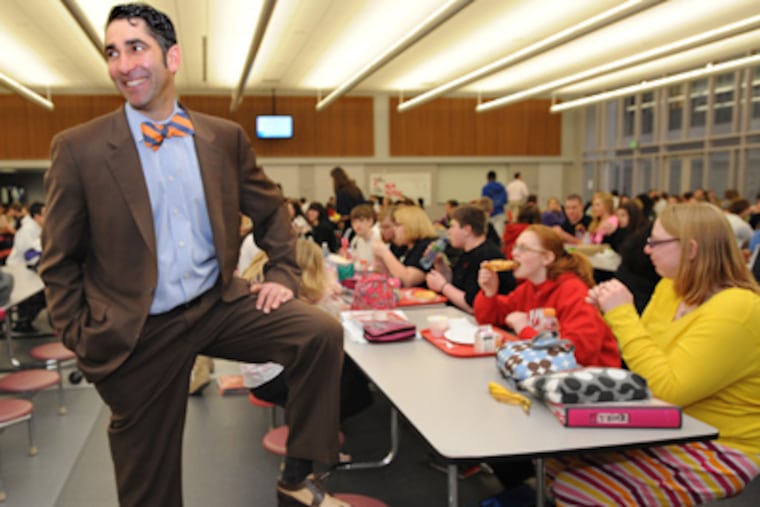
One has created a school environment in which teachers are expected to grow as much as their students; the other has launched an innovative program to encourage young people to think about what they will do after they graduate.
Those efforts have won principal of the year recognition for John Adiletto, of Upper Merion Area Middle School, and Samuel Varano, of Souderton Area High School. The Pennsylvania Association of Elementary and Secondary School Principals announced the awards recently.
Adiletto and Varano said their goal was to help students grow not just academically, but as people.
John Adiletto
Pop into a classroom at Upper Merion Area Middle School and instead of a teacher presenting students with a lesson, you might find a group of faculty members talking about how to instruct students based on their individual learning needs.
Some schools set aside four or five days a year for staff development. At Upper Merion, such activity is built into the daily schedule.
Under the leadership of principal John Adiletto, the school's 80 teachers are encouraged to continually hone their skills. Each day for 45 minutes, they are required to meet with their peers in varying groups to learn from one another, touch base about any concerns, and create cross-curricular lesson plans.
"We've set up a culture here where everybody needs to learn," Adiletto said.
He has served as principal for 16 years at the school, with an enrollment of about 1,100 students in fifth through eighth grades.
Adiletto said he aimed to create a welcoming environment for all students. Last year, the school was one of 15 recognized nationally for "outstanding achievements in character education."
"I want to see kids succeed," said Adiletto, 56. "School is not easy for some students. I try to create a situation where kids want to learn."
Adiletto, who arrives each day about 7 a.m., spends most afternoons and many evenings attending student sports events, concerts, and other activities. He finds them good opportunities to connect with parents and students.
"I play football and baseball for the school, and he always tries to come to the games to support us," said Ryan Glauner, an eighth grader whose father was taught by Adiletto years ago.
Adiletto makes it a point to show students that he cares about their concerns even outside school. One recent afternoon, his schedule included a meeting called by a former student now in high school, who wanted to explore the possibility of allowing students to take bicycles to the school.
Adiletto has an open-door policy, although he does not appear to be in his office much. Instead, when he is not in meetings, he often walks the hallways and stops in classrooms.
As with many principals, he said, people frequently catch him in the halls and say, "Do you have a minute? I want to run something by you."
Adiletto said that was a good thing.
"If you build relationships with people and they feel that they are part of the school and have input and are valued, that's important," Adiletto said.
Helen Beatty, a math teacher for 26 years at the school, said Adiletto wanted to make sure that everybody achieved to his or her potential, from students up to administrators. "He wants everybody to accomplish as much as they can," Beatty said.
Samuel Varano Jr.
Before Samuel Varano Jr. taught his first class as a social studies teacher 16 years ago, he knew he wanted to become a principal.
Varano, 40, has long had his eye on the future, a trait that has served him well in his jobs as a principal at Souderton Area High School since 2004 and at the district's Indian Crest Junior High School from 2000 to 2003.
Today, Varano works in a $120 million high school he helped to plan (prerecession, he notes). Now in its second year, the building "was designed around the future educational needs of students and was not simply a new facility with an old program," thanks in part to Varano's leadership, according to Superintendent Frederick Johnson.
A modern television-production studio, for example, serves as the classroom for instruction in TV work and digital-video editing.
On a recent morning, a TV class is broadcasting to every classroom a 20-minute newsmagazine show the students have made, including a live question-and-answer session with "Mr. V," as students call him.
Christian Benner, a senior, asks Varano about his being named principal of the year. Varano credits the students, his staff, and a supportive community. Then he laughs, recalling a comment from his 10-year-old daughter, who, upon learning that her father had won, said she thought her principal should have won.
Varano, who is known for his bow ties and stylish shoes, has an easygoing yet energetic presence with students. When Benner asks the principal, who is married with two children, where his first kiss took place, Varano jokes, "It hasn't happened yet." Minutes later, he is bantering with Robert Coll, another senior, about college and ColecoVision, an early video game console.
Among his proudest achievements at the school of 2,100 students is creating Career Pathways, now in its first year. The program starts with a survey eighth graders take to help them determine which of four career pathways they could follow in high school: arts and humanities, health and human services, industry and engineering, and business and communications. Each track has its own set of requirements and electives.
Students can change tracks at any time, but the point, Varano said, is to "get kids thinking about what they want to do later in life" and how they can get there.
Rich Curtis, a new teacher at the school, said he had been "immensely surprised at how open [Varano] is to crazy ideas," meaning that if an idea is unconventional but worthwhile, he will support it.
Varano pushed the school district to stop ranking its high school students, for example, believing that they would be better served on their college applications by factors such as grade point average, SAT scores, activities, and leadership.
"We're able to do things that are good for kids," Varano said.