Attraction reborn - for fish
ATLANTIC CITY - When Garden Pier opened in 1913, with its stylish Spanish Renaissance architecture and lush gardens, it provided a touchstone of sophistication that hadn't been found previously on the more garish piers along Atlantic City's famous Boardwalk.
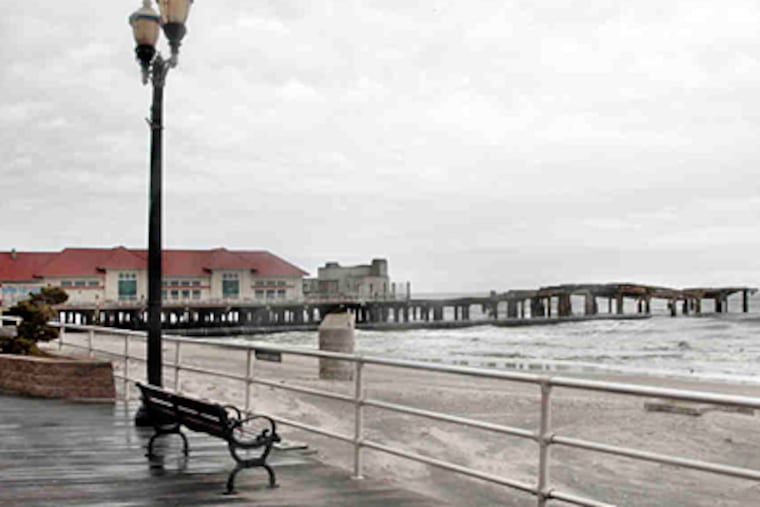
ATLANTIC CITY - When Garden Pier opened in 1913, with its stylish Spanish Renaissance architecture and lush gardens, it provided a touchstone of sophistication that hadn't been found previously on the more garish piers along Atlantic City's famous Boardwalk.
So it may be fitting that sections of damaged concrete from Garden Pier, which once supported a lavish ballroom, a classy theater, and giant typewriter and baby incubator exhibits, will end up preserved in a kind of underwater graveyard.
Old trains, buses, subway cars, military tanks, and vessels of various vintages have been sunk seven stories deep at a spot about nine miles off Ocean City to form one of New Jersey's 15 artificial reefs. Now about 6,000 cubic yards of Garden Pier rubble will bolster the habitat for marine life in three places along the milelong expanse, known as the Great Egg Harbor Reef. If the weather cooperates, the installation will take place Friday.
"Garden Pier was a fabulous place - a magnificent place - and I think it is fitting that pieces of it will be preserved, saved, and put to good use in some way," said Allen "Boo" Pergament, an Atlantic City historian and board member of the Atlantic City Historical Museum.
A hurricane significantly damaged the seaward half of the pier in 1944, and the ballroom, theater, and stunning gardens were never rebuilt. A band shell and seating were eventually erected on a portion of the site. The section of the pier closest to the Boardwalk contained, on either side, two elaborately decorated stucco buildings with red tiled roofs.
The twin buildings have housed the Atlantic City Historical Museum and the Atlantic City Art Center since the 1970s. Both museums closed within the last year after extensive storm damage but are expected to be refurbished through funding from the Revel Casino being built nearby and the state Casino Reinvestment Development Authority.
Though Pergament has amassed hundreds of photographs and drawings of Garden Pier in all its early-20th-century splendor, not one of the images lives up to his memories, he said.
"It was a gorgeous, attractive showplace. The entire center of it has huge, magnificent gardens and floral displays and very attractive, prestigious shops that sold clothing and other things," said Pergament, 78, who grew up only a few blocks from the Inlet section of the Boardwalk, where Garden Pier is.
He can remember walking to the Boardwalk from home and seeing famed Heinz Pier, with its historical kitchen displays and innovative dietary laboratory, followed by elegant Garden Pier. Nearby were Steel Pier, with its famous diving horses, and jazzy Million Dollar Pier, where every inch seemed covered in entertainment venues, attractions, and hawkers of newfangled products. Steeplechase Pier was a free attraction where children loved to ride on swings and merry-go-rounds.
In the fancily festooned theater on Garden Pier were acts ranging from Houdini to the Three Stooges. It became a kind of proving ground for Broadway plays and other productions, with fledgling performers such as Clark Gable, Helen Hayes, and Spencer Tracy. Over the years there were operas, ballroom dancing, concerts, boxing bouts, conventions, and sports tournaments, featuring the likes of Ethel Barrymore, Rudolph Valentino, and Rudy Vallee.
Garden Pier also was home to such only-in-Atlantic City attractions as premature babies kept in tiny incubators that were a medical breakthrough invented by a French physician. Onlookers paid a dime, and the money went toward the medical care, which the families likely couldn't have afforded.
Thousands also saw a 14-ton, 18-foot-tall Underwood typewriter that showed an office innovation of the early 20th century. The giant typewriter was scrapped for metal to make weapons during World War II.
"It's interesting that something that was such an attraction on the pier at one time went to help a good cause, and now sections of the pier itself will go to help the environment," Pergament said.
The state's Artificial Reef Program provides a network of hard substrate for fish and crustaceans, rich grounds for fishing, and, says Hugh Carberry, who manages the program for the Division of Fish and Wildlife, places for scuba divers to explore.
Once the concrete is placed, as long as two years may be needed for it to reach its peak in attracting marine life.